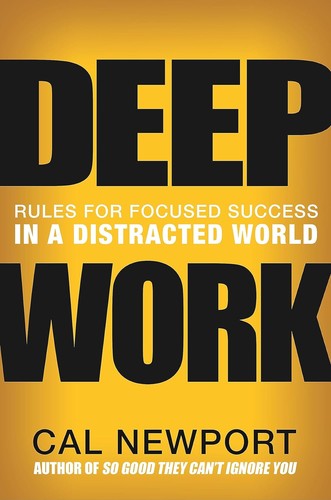
Deep Work
by Cal Newport · 2016
Focus is the new superpower. Newport makes the case, then hands you the schedule.
Worth reading? Deep Work is the book that turns 'focus' from a vague virtue into a trainable skill, and it beats Flow if you want instructions rather than theory. Newport's four rules are the most useful part; the first third, the case for focus, is solid but skimmable if you're already convinced. Skip it if your job is truly all meetings and firefighting -- the advice will just make you resent your calendar.
| Author | Cal Newport |
|---|---|
| Published | 2016 |
| Category | Self-Improvement & Psychology |
The Verdict
Newport argues that deep, distraction-free work is both increasingly rare and increasingly valuable, which makes it the career leverage of this era. The second half is practical: time-block your day, embrace boredom, quit tools that don’t pass a cost-benefit test. One of the few productivity books whose advice compounds the longer you use it.
knowledge workers whose output depends on sustained concentration
your work is genuinely reactive and meeting-driven (the advice will frustrate you)
Book Summary
Focused, distraction-free work is rare and valuable, and it's a skill you can train like a muscle. In a noisy economy, the ability to learn hard things fast is a real career moat.
Newport's four rules: work deeply (rituals, schedules, deadlines), embrace boredom (train your brain to stay off stimuli), quit social media deliberately, and drain the shallow (protect blocks of time from low-value busywork).
Attention residue is real -- switching tasks leaves part of your mind stuck on the last one. Single-tasking in long blocks produces better results in less time than frantic multitasking.
Top 7 Lessons from Deep Work
- Treat focus as a skill you build, not a trait you're born with.
- Schedule deep work blocks like meetings you can't break.
- Quit social media by the cost-benefit test, not by default.
- Shrink 'shallow' work -- email and Slack aren't your job.
- Embrace boredom; don't reach for your phone in every idle moment.
- Use deadlines and constraints to force intensity.
- Attention residue means every task switch quietly taxes you.
Frequently Asked Questions
Is Deep Work worth reading?
Yes, if your output depends on learning or creating -- it's the most actionable focus book available. Skip it if your work is genuinely reactive and meeting-driven.
What is the main idea of Deep Work?
Sustained, distraction-free concentration is a learnable skill that produces better results faster, and you should protect it with rituals and boundaries.
How long does it take to read Deep Work?
Roughly 5 hours. It runs 302 pages and the first section is skimmable if you're already sold on the premise.
Who should read Deep Work?
Knowledge workers whose results hinge on sustained concentration. Skip it if your day is mostly meetings and reactive firefighting.
Ready to read it?
Get Deep Work on Amazon