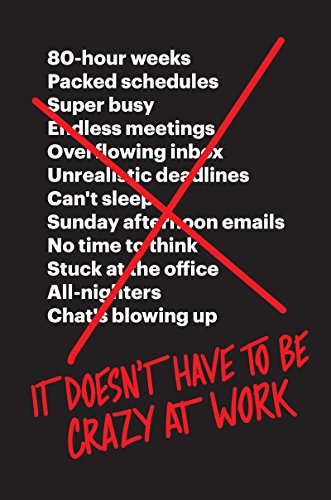
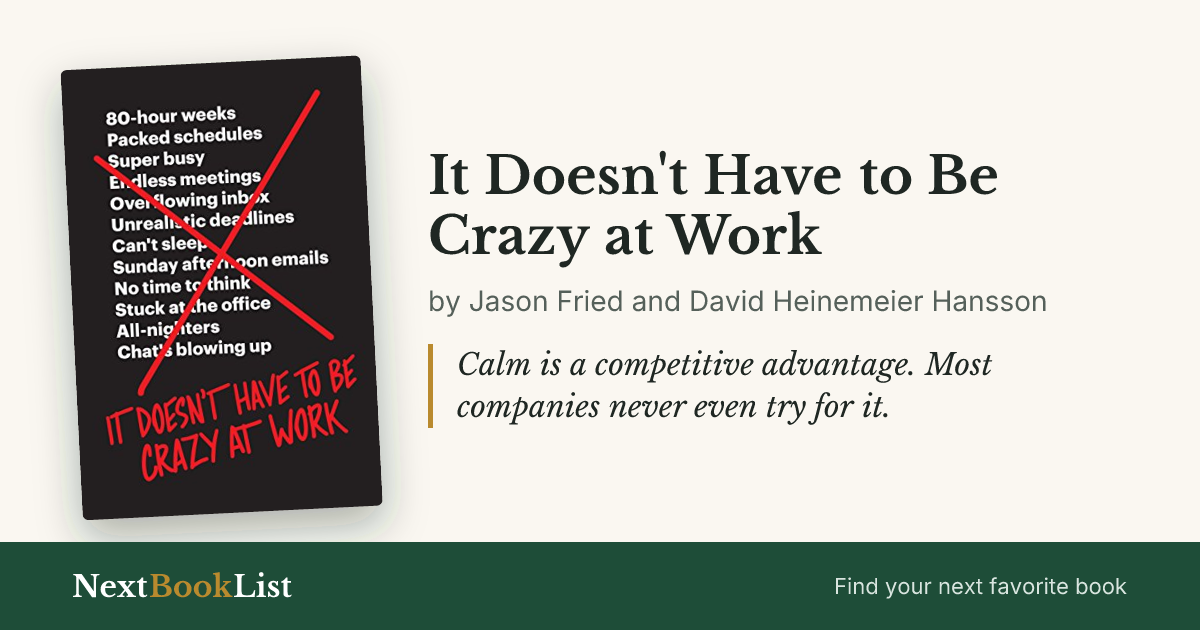
It Doesn't Have to Be Crazy at Work
by Jason Fried and David Heinemeier Hansson · 2018
Calm is a competitive advantage. Most companies never even try for it.
Worth reading? It Doesn't Have to Be Crazy at Work is Basecamp's manifesto against hustle culture, and it's most useful as a permission slip: you're allowed to run a small, profitable, boring company instead of chasing growth for its own sake. It's short on nuance for anyone actually in a hypergrowth phase, but for a stable small business drowning in self-inflicted urgency, it's close to a cure. Skip it if calm isn't actually available to you yet.
| Author | Jason Fried and David Heinemeier Hansson |
|---|---|
| Published | 2018 |
| Publisher | Harper Business |
| Category | Business & Money |
| Favorite quote | “Workaholism isn't a badge of honor. It's a symptom of fear.” |
The Verdict
This is Basecamp’s most quotable book, and it earns the quotability: “workaholism is a symptom of fear” is the kind of line that reframes a whole management philosophy in one sentence. The chapters are short, almost aphoristic, and stack up into a coherent argument that most business urgency is manufactured, not real.
The blind spot is scale and stage. This is easy advice for a profitable, bootstrapped company with no investors breathing down its neck – much harder for anyone in a genuine fundraising or survival sprint. Read it as the target state to build toward, not a rule for right now if you’re not there yet.
founders and managers whose team is busy, exhausted, and quietly resentful of it
you're pre-revenue and still need to sprint; this is a book for companies that can afford calm
Book Summary
Most of what businesses call "hard work" is actually just anxiety dressed up as ambition. Fried and Hansson argue that workaholism is a symptom of bad planning and fear, not dedication, and that calm companies out-execute chaotic ones over any real time horizon.
The fix is structural, not motivational: shrink the workweek, protect long uninterrupted blocks, say no to more instead of yes to more, and treat every meeting as an expensive interruption by default.
Growth for its own sake is the quiet villain of the book. Small, profitable, and boring beats big, funded, and chaotic -- and most companies never even consider that as a legitimate goal.
Top 10 Lessons from It Doesn't Have to Be Crazy at Work
- Calm is a competitive advantage most companies never try for.
- Workaholism is a symptom of fear and bad planning, not dedication.
- Shrink the workweek to force focus instead of adding more hours.
- Protect long, uninterrupted stretches of time -- that's when real work happens.
- Say no to more, not yes to more; growth for its own sake creates the chaos.
- Treat every meeting as expensive and optional by default.
- Exhaustion is not proof of commitment -- stop glorifying the hustle.
- 'Good enough and done' beats 'perfect and late' almost every time.
- Give people real, uninterrupted personal time; being always-on erodes quality over the long run.
- Small, profitable, and boring can beat big, funded, and chaotic.
Top 4 Quotes from It Doesn't Have to Be Crazy at Work
"Workaholism isn't a badge of honor. It's a symptom of fear."
Jason Fried and David Heinemeier Hansson, It Doesn't Have to Be Crazy at Work
"A calm company is a company at peace with its ambitions."
Jason Fried and David Heinemeier Hansson, It Doesn't Have to Be Crazy at Work
"Most of what's considered 'hard work' in business really is just anxiety."
Jason Fried and David Heinemeier Hansson, It Doesn't Have to Be Crazy at Work
"Being unavailable isn't inconsiderate. It's what allows you to do great work."
Jason Fried and David Heinemeier Hansson, It Doesn't Have to Be Crazy at Work
Frequently Asked Questions
Is It Doesn't Have to Be Crazy at Work worth reading?
Yes, if your team is busy and exhausted and you suspect most of it is self-inflicted. It's a fast, blunt case for structural calm. Skip it if you're pre-revenue and genuinely need to sprint right now.
What is the main idea of It Doesn't Have to Be Crazy at Work?
Most workplace 'hard work' is anxiety, not productivity, and a calm, boring, profitable company beats a chaotic, hustling one over any real time horizon.
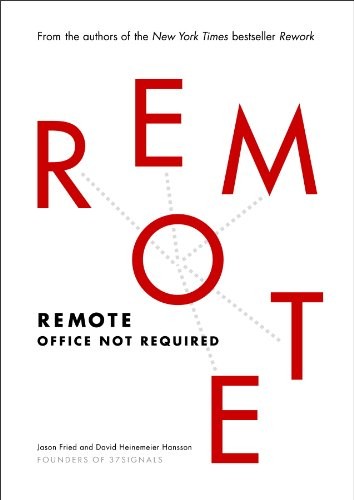
How is this different from Remote?
Remote makes the case for distributed teams specifically. This book is broader -- it's about company culture and pace generally, remote or not.
Who should read It Doesn't Have to Be Crazy at Work?
Founders and managers running a stable small business who've mistaken constant busyness for progress. Skip it if you're in a genuine growth sprint that requires short-term intensity.
Ready to read it?
Get It Doesn't Have to Be Crazy at Work on Amazon