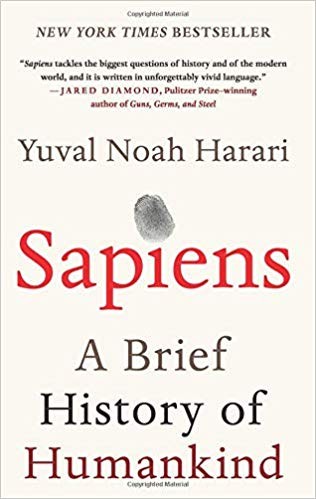
Sapiens
by Yuval Noah Harari · 2015
A historian explains how an unremarkable ape came to dominate the planet, through a talent for believing collectively in things that don't physically exist.
Worth reading? Sapiens became the rare history book that crossed into mainstream cultural conversation, and its central claim explains why: humans dominate the planet not because we're individually stronger or smarter than other animals, but because we're uniquely good at believing in shared fictions (money, nations, religions, corporations) at scale, which lets millions of strangers cooperate toward common goals. It's sweeping and occasionally overconfident where the evidence is genuinely contested, but the cognitive-revolution framing is genuinely useful and widely cited across disciplines since.
| Full Title | Sapiens: A Brief History of Humankind |
|---|---|
| Author | Yuval Noah Harari |
| Published | 2015 |
| Category | History |
| Favorite quote | “Fiction has enabled us not merely to imagine things, but to do so collectively.” |
The Verdict
Harari’s real skill is compression – distilling 300,000 years into a readable, argument-driven narrative without it collapsing into a dry timeline. Academic historians have pushed back on specific claims since publication, which is worth knowing going in, but the shared-fiction framework has genuinely changed how a lot of readers think about money, borders, and institutions.
you want the single most influential big-picture history book of the last decade, spanning cognitive, agricultural, and scientific revolutions in one readable volume
you want rigorous, narrowly-scoped academic history -- Harari writes as a synthesizer covering 300,000 years in one book, which means broad strokes over granular precision by design
Book Summary
Harari organizes 300,000 years of human history around three revolutions: the Cognitive Revolution (roughly 70,000 years ago, when Sapiens developed the capacity for complex, flexible language and shared fiction), the Agricultural Revolution (roughly 12,000 years ago, which Harari provocatively frames as possibly history's biggest fraud -- more work, worse nutrition, but locked in by population growth), and the Scientific Revolution (the last 500 years, marked by an unprecedented admission of ignorance that enabled genuine progress).
His signature argument is that humans' unique advantage isn't intelligence or physical capability but the ability to believe collectively in things that have no objective physical existence -- money, nations, human rights, corporations, religions -- which allows cooperation at a scale no other species achieves, since chimpanzees can cooperate in small bands but can't organize a stock exchange or a nation-state around a shared fiction everyone agrees to treat as real.
Top 7 Lessons from Sapiens
- Human dominance stems primarily from the ability to cooperate at scale through shared fictions, not raw intelligence or strength.
- Money, nations, corporations, and human rights are all 'intersubjective realities' -- real because enough people agree to act as if they are, not because they physically exist.
- The Agricultural Revolution may have made individual lives worse (more work, worse nutrition, new diseases) even as it enabled population growth and eventual civilization.
- The Scientific Revolution's key innovation was admitting collective ignorance, which paradoxically enabled faster genuine progress than assumed certainty had.
- Large-scale human cooperation (nations, corporations, religions) requires belief in a shared story, not just shared interest.
- History isn't a story of inevitable progress -- many transitions (like agriculture) involved real losses alongside the gains.
- Examining your own society's 'obvious' institutions (money, borders, corporations) as constructed fictions, not natural facts, changes how you understand them.
Top 4 Quotes from Sapiens
"Fiction has enabled us not merely to imagine things, but to do so collectively."
Yuval Noah Harari, Sapiens
"We did not domesticate wheat. It domesticated us."
Yuval Noah Harari, Sapiens
"Money is the most universal and most efficient system of mutual trust ever devised."
Yuval Noah Harari, Sapiens
"There are no gods in the universe, no nations, no money, no human rights, no laws, and no justice outside the common imagination of human beings."
Yuval Noah Harari, Sapiens
Frequently Asked Questions
Is Sapiens worth reading?
Yes, as a big-picture, highly readable synthesis of human history that's shaped mainstream conversation about our species more than almost any other book this century. Read it for the framing, and treat contested specific claims with some skepticism.
What is the main idea of Sapiens?
Humans came to dominate the planet primarily through a unique capacity for large-scale cooperation, enabled by shared belief in fictions -- money, nations, religions, corporations -- that don't physically exist but that enough people agree to treat as real.
Is Sapiens historically accurate?
It's a broad synthesis, and some historians and anthropologists have challenged specific claims (particularly around the Agricultural Revolution and some evolutionary biology claims) as oversimplified or contested. Read it for the big-picture framing rather than as settled, granular history.
What are the three revolutions in Sapiens?
The Cognitive Revolution (roughly 70,000 years ago, enabling complex shared fiction), the Agricultural Revolution (roughly 12,000 years ago), and the Scientific Revolution (the last 500 years).
Ready to read it?
Get Sapiens on Amazon