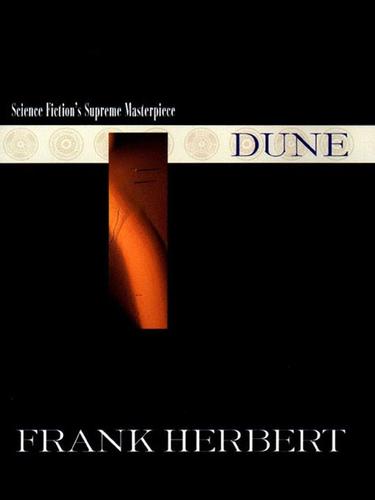
Dune
by Frank Herbert · 1965
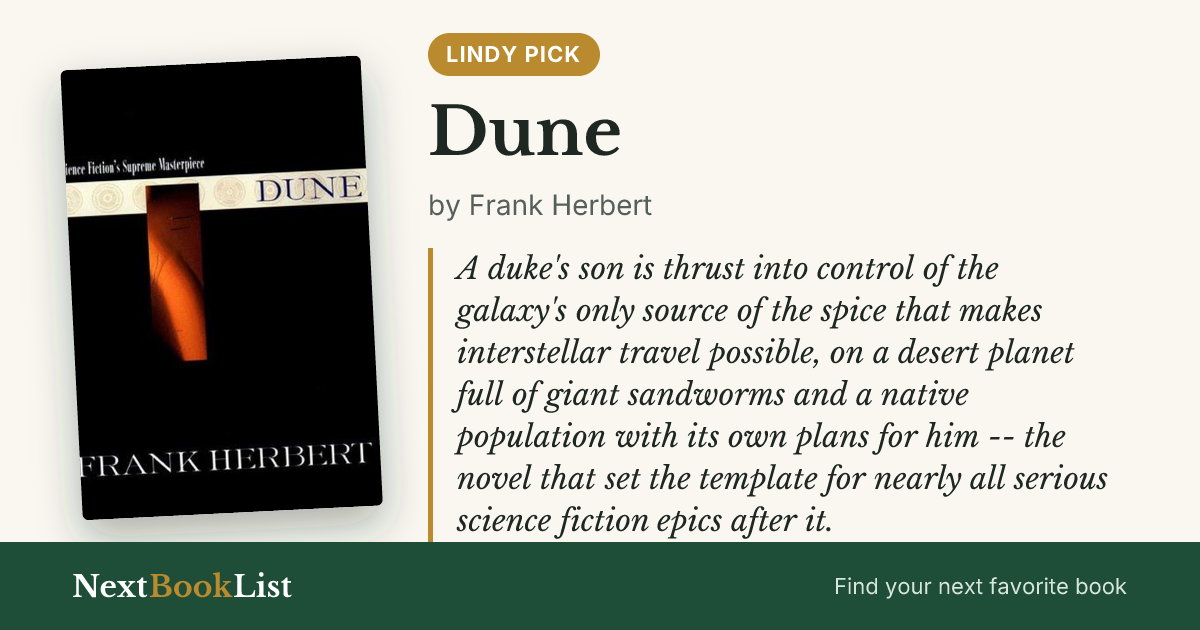
A duke's son is thrust into control of the galaxy's only source of the spice that makes interstellar travel possible, on a desert planet full of giant sandworms and a native population with its own plans for him -- the novel that set the template for nearly all serious science fiction epics after it.
Worth reading? Dune earns its status as the foundational modern science fiction novel because Herbert refuses to write a simple chosen-one story, even though the plot's surface looks exactly like one. Paul Atreides becomes a messiah figure to the Fremen, and the book is explicit, especially by its ending, that this is a warning about the danger of messianic leaders and religious fervor, not a triumphant hero's journey. That critical distance from its own plot is what separates Dune from the genre it spawned.
| Author | Frank Herbert |
|---|---|
| Published | 1965 |
| Publisher | Ace Books |
| Category | Fiction |
| Favorite quote | “Fear is the mind-killer.” |
The Verdict
What separates Dune from the countless space epics it inspired is that Herbert doesn’t trust his own hero. Paul Atreides gets every trapping of a chosen-one story, prophecy, exile, a native people ready to follow him, and Herbert keeps undercutting it: this prophecy was manufactured by a manipulative religious order, and Paul’s rise leads toward a holy war he can see coming and can’t stop.
The ecology is the other thing that holds up. Herbert was trained in the subject and it shows: Arrakis’s water scarcity and the Fremen culture built entirely around conserving it aren’t backdrop, they’re the actual mechanics driving the spice economy and the politics on top of it.
The density is real, though, and worth being honest about. This is a book built on internal monologue, court politics, and ecological exposition as much as action, and it asks more patience of a reader than most genre fiction published today.
Read it if you want dense, serious science fiction that questions its own hero instead of celebrating him uncritically. Skip it if you want a fast-paced space adventure – Dune moves at the pace of its politics and its planet, not its plot.
you want dense, politically serious science fiction that treats ecology, religion, and power as seriously as it treats plot, and you're willing to sit with a slower, denser build than most modern genre fiction
you want fast-paced, action-driven sci-fi -- Dune is built on political maneuvering, ecology, and internal monologue as much as action, and its density is a real barrier for readers expecting a straightforward space adventure
Book Summary
Paul Atreides, heir to House Atreides, moves with his family to the desert planet Arrakis to take control of spice mining -- spice being the only substance in the galaxy that enables the faster-than-light travel the entire interstellar civilization depends on. A political betrayal destroys House Atreides shortly after arrival, and Paul flees into the desert with his mother, where he's taken in by the native Fremen.
Herbert builds Arrakis's ecology (the giant sandworms, extreme water scarcity, the Fremen's entire culture organized around water conservation) as seriously as any of the book's politics, and the planet's ecology is never just set dressing -- it's the mechanism that drives the plot, the spice, and the Fremen's worldview all at once.
Paul's rise among the Fremen as a prophesied messianic figure (a role partly manufactured generations earlier by the Bene Gesserit, a secretive order that seeded messiah myths across many worlds as a manipulation tool) is the book's central warning: Herbert wrote Dune explicitly skeptical of charismatic leaders and religious fervor, even as the plot gives Paul every trapping of a classic hero's journey.
Top 7 Lessons from Dune
- Paul Atreides's rise as a messiah figure among the Fremen is presented critically, not triumphantly -- Herbert built Dune specifically as a warning about the dangers of charismatic, messianic leadership, even while giving the plot the surface shape of a classic hero's journey.
- The Fremen's messianic prophecy about Paul was partly manufactured generations earlier by the Bene Gesserit, a secretive order that seeded similar myths across many worlds specifically to manipulate populations later -- the 'chosen one' narrative is revealed as engineered, not organic.
- Arrakis's ecology (extreme water scarcity, giant sandworms, the Fremen's stillsuits and water discipline) is never just setting -- Herbert, a trained ecologist, built the planet's environment as the actual mechanism driving the plot and the spice economy.
- Spice, the substance that makes interstellar travel possible, functions as a direct allegory for a scarce, geopolitically vital resource that whoever controls Arrakis effectively controls the wider galaxy through -- oil is the most commonly cited real-world parallel.
- The Bene Gesserit's centuries-long selective breeding program, aimed at producing a messianic figure they could control, backfires when Paul arrives a generation early and outside their control, showing how long-term manipulation schemes can escape their designers.
- Paul's prescient visions show him multiple possible futures, many involving a galaxy-spanning holy war fought in his name -- and part of the novel's tension is Paul trying and failing to avoid a future he can see coming and doesn't want.
- Herbert deliberately avoids simple good-versus-evil politics -- House Atreides isn't purely noble, the Fremen aren't purely virtuous, and Paul's own path toward power involves real manipulation and violence, not just heroic necessity.
Top 5 Quotes from Dune
"I must not fear. Fear is the mind-killer. Fear is the little-death that brings total obliteration."
Frank Herbert, Dune
"He who controls the spice controls the universe."
Frank Herbert, Dune
"A beginning is the time for taking the most delicate care that the balances are correct."
Frank Herbert, Dune
"The mystery of life isn't a problem to solve, but a reality to experience."
Frank Herbert, Dune
"Deep in the human unconscious is a pervasive need for a logical universe that makes sense. But the real universe is always one step beyond logic."
Frank Herbert, Dune
Frequently Asked Questions
Is Dune worth reading?
Yes -- it's the foundational modern science fiction epic, and its skepticism toward its own messiah plot is what separates it from the many books it influenced.
Is Dune hard to read?
It's denser and slower than most modern sci-fi, with heavy political and ecological detail, but Herbert's prose itself is accessible -- the density is in the world, not the sentences.
Is Dune a hero's journey or a warning about heroes?
Both, deliberately -- Paul's plot follows a classic chosen-one arc, but Herbert built the book explicitly as a critique of messianic leadership and the dangers of charismatic power.
How many Dune books are there?
Frank Herbert wrote six Dune novels; his son Brian Herbert and Kevin J. Anderson have continued the series with many more books since, of varying critical reception.
Do I need to read Dune before watching the movies?
No, but it helps -- Denis Villeneuve's 2021 and 2024 films adapt the first novel fairly faithfully and work as a standalone introduction, though the book has more political and ecological depth.
Ready to read it?
Get Dune on Amazon