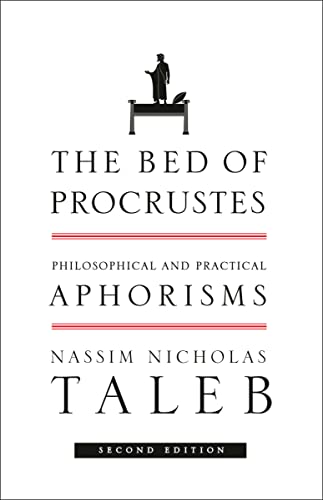
The Bed of Procrustes
by Nassim Nicholas Taleb · 2010
Taleb's collection of blunt, standalone aphorisms, his version of ancient wisdom literature, named for the Greek myth of a host who mutilated guests to fit his bed.
Worth reading? This is the odd one out in Taleb's Incerto series, not a sustained argument like The Black Swan or Antifragile, but a collection of standalone aphorisms in the tradition of La Rochefoucauld and the Stoics. The title comes from the Greek myth of Procrustes, who forced travelers to fit his bed exactly, stretching or amputating them as needed, Taleb's metaphor for how modern life forces reality to fit theory instead of the other way around. Read it as a distilled, quotable companion to his longer books, not a standalone introduction. Skip it if you haven't read Antifragile or The Black Swan yet, the aphorisms hit harder once you know the underlying arguments.
| Full Title | The Bed of Procrustes: Philosophical and Practical Aphorisms |
|---|---|
| Author | Nassim Nicholas Taleb |
| Published | 2010 |
| Category | Self-Improvement & Psychology |
| Favorite quote | “You are rich if and only if money you refuse tastes better than money you accept.” |
The Verdict
This is Taleb at his most compressed, no sustained argument, just single lines meant to lodge in your head. Best read after his longer books, when you already have the underlying worldview to unpack each aphorism against.
readers who already know Taleb's longer books and want his ideas distilled into single lines
you haven't read Antifragile or The Black Swan yet, the aphorisms land harder with that context
Book Summary
Taleb's Procrustes metaphor, a mythical host who mutilated guests to force them to fit his bed exactly, stands in for what he sees as modern life's central error: forcing messy, uncertain reality to conform to tidy theories, models, and narratives, rather than adapting our thinking to reality's actual, irreducible messiness.
Unlike his longer books, this one makes its case entirely through single-line aphorisms rather than sustained argument, a deliberate choice that puts Taleb in a tradition of aphoristic moral writing (La Rochefoucauld, Marcus Aurelius) he explicitly admires, arguing that some truths land harder compressed into one sentence than expanded into a chapter.
Top 7 Lessons from The Bed of Procrustes
- Forcing reality to fit a tidy theory, rather than adapting theory to reality, is a recurring, avoidable error.
- Some ideas land harder as a single compressed sentence than as an expanded argument.
- Aphoristic writing is a deliberate literary tradition, not a shortcut around making a real argument.
- The 'Procrustes' metaphor, mutilating reality to fit a preconceived model, applies across finance, science, and personal life.
- Reading standalone aphorisms rewards slow, repeated reading over one linear pass.
- Taleb's shortest book carries the same underlying worldview as his longest ones, just compressed.
- A collection without a single sustained argument can still cohere around one consistent philosophy.
Top 5 Quotes from The Bed of Procrustes
"You are rich if and only if money you refuse tastes better than money you accept."
Nassim Nicholas Taleb, The Bed of Procrustes
"The three most harmful addictions are heroin, carbohydrates, and a monthly salary."
Nassim Nicholas Taleb, The Bed of Procrustes
"Wanting people to agree with you is asking them to have the same weaknesses as yours."
Nassim Nicholas Taleb, The Bed of Procrustes
"Nothing is more permanent than a temporary fix that works."
Nassim Nicholas Taleb, The Bed of Procrustes
"You can tell how uninteresting a person is by asking him whom he finds interesting."
Nassim Nicholas Taleb, The Bed of Procrustes
Frequently Asked Questions
Is The Bed of Procrustes worth reading?
Yes, but as a companion to Taleb's longer books, not a first introduction. The aphorisms compress ideas from The Black Swan and Antifragile into single, quotable lines.
What is The Bed of Procrustes about?
A collection of Nassim Taleb's standalone philosophical aphorisms, named for the Greek myth of Procrustes, who mutilated guests to force them to fit his bed, a metaphor for forcing messy reality into tidy theory.
Should I read this before or after Taleb's other Incerto books?
After. The aphorisms are denser and land harder once you already understand the arguments in The Black Swan, Antifragile, and Fooled by Randomness that they're distilling.
Ready to read it?
Get The Bed of Procrustes on Amazon