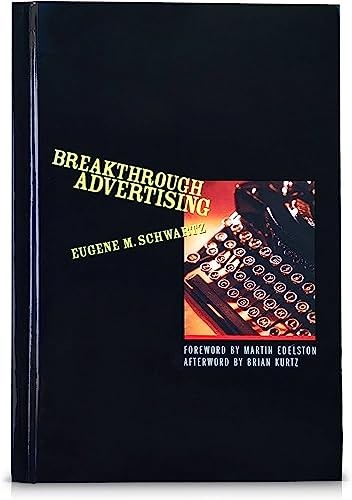
Breakthrough Advertising
by Eugene Schwartz · 1966
The 1966 copywriting bible that says your ad can't create desire, only channel desire that already exists.
Worth reading? Sixty years old and still the book working copywriters quietly rank above almost everything published since. Schwartz's core claim, that copy channels pre-existing mass desire rather than manufacturing it, reframes what an ad is actually for. It's dense and repetitive by design; this is a book to study over months, not read once. Skip it if you're brand new to marketing, start with something more accessible and come back.
| Author | Eugene Schwartz |
|---|---|
| Published | 1966 |
| Publisher | Bottom Line Books |
| Category | Business & Money |
| Favorite quote | “Copy cannot create desire for a product. It can only take the hopes, dreams, fears and desires that already exist in the hearts of millions of people, and focus those already existing desires onto a particular product.” |
The Verdict
Eugene Schwartz wrote this in 1966, and it went out of print for years, which is exactly how it turned into the book working copywriters pass around like a trade secret instead of a bestseller everyone’s already read. The central claim (that an ad’s power comes from the market’s pre-existing desire, not the writer’s cleverness) reframes the entire job of writing copy, from “invent something persuasive” to “find what’s already there and point at it correctly.”
It’s genuinely hard reading. Schwartz repeats himself, circles back, and assumes you already understand basic marketing concepts before he’ll take you further. This isn’t a flaw so much as the design: the book rewards rereading over months, not a single weekend pass.
Skip it if you’re new to marketing and haven’t read something more foundational yet, Influence or even Made to Stick will make more sense on a first pass. Come back to this one once you’re actually writing ads for money, because that’s who it was written for.
One note on sourcing: this is a decades-old, cult-classic direct-response text with a genuinely tangled print history (long out-of-print stretches, multiple reprint editions); the ASIN above points to a widely-circulated reprint edition, not necessarily the original 1966 printing.
you write copy or ads and want the deepest, hardest book on why people actually buy
you're new to marketing and haven't read Influence or a beginner copywriting guide yet (this book assumes you already know the basics and rewards you for rereading it, it does not hold your hand)
Book Summary
Copy cannot create desire. It can only take desires that already exist in a market (hopes, fears, dreams already present in a statistically significant number of people) and channel them onto a specific product. The advertiser's job is to identify and direct mass desire, not invent it.
Every market has a "stage of sophistication," how many similar claims the audience has already heard, and a "stage of awareness," how aware the prospect is of their own problem and the available solutions. Copy has to match both stages or it fails regardless of how clever it is.
Headlines exist to channel the reader's already-existing desire into the first sentence of the ad; nothing about the headline is meant to be original for its own sake, it's meant to be recognized instantly by the person who already wants what you're selling.
Top 10 Lessons from Breakthrough Advertising
- Copy channels desire that already exists in a market; it cannot manufacture desire from nothing.
- Identify the mass desire behind a purchase before you write a single line of copy.
- Match your copy to the market's stage of sophistication, how many similar claims they've already heard and grown numb to.
- Match your copy to the prospect's stage of awareness, whether they know they have the problem, know the solution exists, or know your specific product.
- A headline's job is instant recognition by someone who already wants the thing, not cleverness for its own sake.
- Old, unsophisticated markets respond to direct claims; sophisticated markets need a new mechanism or angle to break through the noise.
- The most powerful force in an ad is the market itself, not the writer's skill.
- Reread foundational marketing texts rather than treating a single pass as mastery; the ideas compound with repeated study.
- Product mechanism (how it works) matters most when a market has grown skeptical of general claims.
- Identification, the reader seeing themselves in the copy, does more work than clever wordplay.
Top 6 Quotes from Breakthrough Advertising
"The power, the force, the overwhelming urge to own that makes advertising work, comes from the market itself, and not from the copy."
Eugene Schwartz, Breakthrough Advertising
"Copy cannot create desire for a product. It can only take the hopes, dreams, fears and desires that already exist in the hearts of millions of people, and focus those already existing desires onto a particular product."
Eugene Schwartz, Breakthrough Advertising
"Your ad always begins with your market, and leads that market inevitably into your product."
Eugene Schwartz, Breakthrough Advertising
"Your headline has only one job — to stop your prospect and compel him to read the second sentence of your ad."
Eugene Schwartz, Breakthrough Advertising
"Be simple. Be direct. Above all, don't be fancy."
Eugene Schwartz, Breakthrough Advertising
"The idea for an ad or a headline demands its own shape. It cannot be fitted into someone else's solution."
Eugene Schwartz, Breakthrough Advertising
Frequently Asked Questions
Is Breakthrough Advertising worth reading?
Yes, if you write copy or ads seriously. It's dense and demanding, but working copywriters have quietly ranked it above almost everything published since 1966. Skip it if you're brand new to marketing; start with something more accessible first.
What is the main idea of Breakthrough Advertising?
Copy can't create desire, it can only take desire that already exists in a market and channel it onto a specific product. Match the copy to the market's stage of awareness and sophistication.
Who should read Breakthrough Advertising?
Copywriters, marketers, and founders writing their own ads who already understand the basics and want the deepest available book on why people actually buy.
Why is Breakthrough Advertising so expensive or hard to find?
It went out of print for years after its original 1966 release, which turned it into a cult classic among direct-response marketers; reprints have since made it more available, but its print history is genuinely murky compared to a typical bestseller.
Ready to read it?
Get Breakthrough Advertising on Amazon