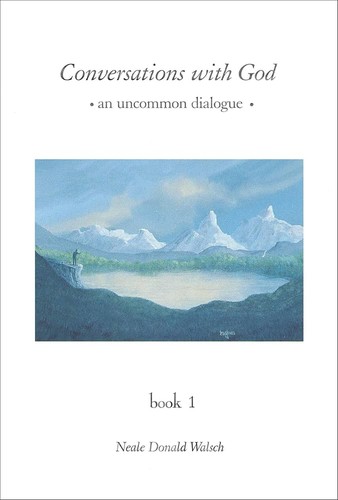
Conversations with God
by Neale Donald Walsch · 1995
A man at a personal low point starts writing an angry letter to God and claims the answers that came back, in his own hand, were God's actual voice -- and the resulting question-and-answer manuscript became one of the bestselling spiritual books of the decade.
Worth reading? Conversations with God rests entirely on a single unverifiable premise: that Walsch's own hand transcribed answers actually spoken by God. Strip that claim away and what's left is one man's personal philosophy on morality, purpose, and the afterlife, presented with the authority of divine revelation but without any theological or evidential grounding to back that authority up.
| Full Title | Conversations with God: An Uncommon Dialogue, Book 1 |
|---|---|
| Author | Neale Donald Walsch |
| Published | 1995 |
| Publisher | G. P. Putnam's Sons |
| Category | Religion & Spirituality |
| Favorite quote | “Life is not a process of discovery, but a process of creation.” |
The Verdict
Walsch never hedges the book’s central claim, and that’s really the whole story here – if you accept that the manuscript is a literal transcription of a divine conversation, the rest follows easily. If you don’t, what’s left is one man’s personal philosophy, presented with a confidence the premise itself never earns.
To be fair to the book, its actual content is mostly gentle: individual responsibility, self-acceptance, a permissive view of morality. None of it requires believing the premise to find useful. But the packaging insists on the premise anyway, and that’s the part worth being honest about before you buy in.
Read it if you want accessible, first-person spiritual philosophy and don’t need external grounding for its central claim. Skip it if you can’t get past a book asking you to accept, on the author’s word alone, that you’re reading God’s actual voice.
you want an accessible, conversational take on big spiritual questions -- purpose, morality, the afterlife -- written in plain, first-person dialogue rather than scripture or theology
you want the book's claims grounded in anything beyond the author's own account of automatic writing -- there's no external verification offered for its central premise, and Walsch doesn't attempt one
Book Summary
Walsch, going through a period of personal crisis, describes writing an angry letter to God and then receiving, through his own hand, a set of answers he presents as an actual dialogue with God -- a claim the book treats as literal rather than metaphorical or introspective.
The "conversation" that follows covers major spiritual and moral questions -- the nature of good and evil, the purpose of life, the afterlife, relationships -- with answers that often diverge from traditional religious doctrine, presenting a more permissive, self-directed spirituality in place of conventional religious authority.
The book's commercial success, and the multi-volume series it spawned, reflects a broader 1990s appetite for individualized spiritual authority outside established religious institutions, a premise that asks readers to accept the author's claim of direct divine communication on faith alone.
Top 10 Lessons from Conversations with God
- The book's entire authority rests on Walsch's claim that the text is a literal transcription of God's words, a premise the book asks readers to accept without any external verification.
- The 'conversation' format presents complex theological and moral questions in plain, first-person dialogue, which made the material far more accessible than traditional religious or philosophical texts, whatever you think of its claims.
- The book's answers often diverge from established religious doctrine, positioning individual spiritual authority above institutional religious teaching.
- Walsch frames the book's origin in personal crisis, tying its spiritual claims directly to his own emotional low point rather than to any external religious tradition or study.
- The commercial success of the book and its many sequels illustrates a real market appetite in the 1990s for spirituality delivered outside traditional religious institutions.
- The book offers no mechanism for distinguishing its claimed divine content from Walsch's own personal views, since the entire text is presented in his voice as dictated by God.
- The 'God' voice in the book claims fear and love are the only two core human emotions, and traces every thought, word, and action back to one or the other.
- The text reframes prayer and belief as a matter of felt, moment-to-moment experience rather than petitioning an external authority, describing God as closer to a process running through life than a rule-giving figure.
- Relationships are presented not as a means to happiness but as the mechanism by which a person discovers who they are, since the book argues you can't know your own values except in contrast to another person.
- The book rejects the idea of sin, punishment, and a pass/fail afterlife judgment outright, recasting life as an ongoing process of self-discovery rather than a moral test to be graded.
Top 3 Quotes from Conversations with God
"Life is not a process of discovery, but a process of creation."
Neale Donald Walsch, Conversations with God
"Feelings are the language of the soul."
Neale Donald Walsch, Conversations with God
"You are today where your thoughts have brought you; you will be tomorrow where your thoughts take you."
Neale Donald Walsch, Conversations with God
Frequently Asked Questions
Is Conversations with God worth reading?
It depends on what you're looking for -- as accessible, conversational spiritual philosophy it's easy to read, but it asks you to accept an unverifiable premise as literally true, which is a real ask for a skeptical reader.
What is Conversations with God about?
Neale Donald Walsch presents a first-person dialogue he claims to have transcribed directly from God, addressing questions about morality, purpose, relationships, and the afterlife.
Is Conversations with God based on any established religious tradition?
No -- it presents itself as a direct, original dialogue with God, and its answers often diverge from established doctrine in traditional religions.
How many books are in the Conversations with God series?
Walsch wrote multiple volumes continuing the same claimed dialogue format, expanding on the original book's questions and themes.
Is there any evidence supporting the book's central claim?
No -- the book offers no external verification for the claim that its content was transcribed from an actual conversation with God; the premise rests entirely on Walsch's own account.
Ready to read it?
Get Conversations with God on Amazon