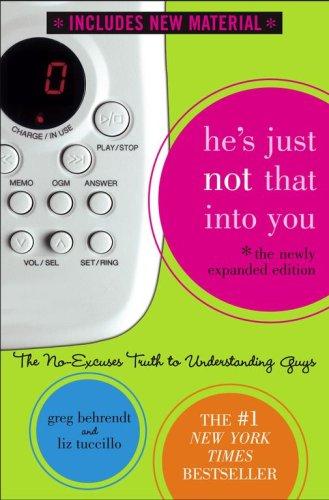
He's Just Not That Into You
by Greg Behrendt and Liz Tuccillo · 2004
The excuses you're making for the guy who hasn't called are the same excuses your friends would laugh at if you weren't the one making them.
Worth reading? The whole book is one idea stretched to book length, and that's the point: if a man is interested, he acts like it, and every exception you're inventing is a story you're telling yourself. It's blunt to the point of being reductive, but the bluntness is the service it provides.
| Full Title | He's Just Not That Into You: The No-Excuses Truth to Understanding Guys |
|---|---|
| Author | Greg Behrendt and Liz Tuccillo |
| Published | 2004 |
| Publisher | Simon Spotlight Entertainment |
| Category | Parenting & Relationships |
The Verdict
The trick of this book is that you already know the advice before you open it – you’d say the exact same thing to a friend describing her situation. Behrendt’s contribution is saying it back to you, in your own case, without letting you wriggle out.
It repeats itself. Each chapter is a variation on the same excuse getting the same answer, and by chapter ten you could probably write the rest yourself. That’s a feature for anyone who needs to hear it more than once.
Read it if you’re stuck rationalizing a man’s inconsistent behavior and need someone blunt to interrupt the spiral. Skip it if you’ve already internalized the core idea, or if you want dating advice built for the app-and-text era instead of 2004’s phone calls.
you keep dating men who send mixed signals and want a blunt, funny outside voice to cut through the rationalizing
you want a nuanced take on modern dating norms like texting ambiguity, situationships, or non-monogamy -- this is a 2004 book built for a simpler dating landscape
Book Summary
Behrendt, a writer on Sex and the City, built the book around a single confrontation: women spend enormous energy inventing reasons a man who isn't calling, isn't asking you out, or isn't committing is secretly interested, when the simpler explanation -- he's just not that into you -- is almost always the true one.
Each chapter takes a specific excuse ("he's just really busy," "he's afraid of commitment," "he's just shy") and dismantles it, arguing that a genuinely interested man doesn't need the excuse-maker's help to show up.
The book's real argument is about self-respect rather than dating tactics: it's less "here's how to get a man" and more "stop spending your time and dignity on men who've already told you, through their behavior, where you stand."
Top 7 Lessons from He's Just Not That Into You
- If a man wants to see you, he'll make it happen -- the excuses you build for his absence are usually more work than he's putting in.
- 'He's just shy' rarely survives scrutiny once you notice he's not shy with his friends, his job, or the things he actually cares about.
- A man who says he's not ready for a relationship is telling you the truth, not issuing a challenge for you to change his mind.
- Chasing a man who isn't reciprocating costs you time and self-respect you don't get back, regardless of whether he eventually comes around.
- The book reframes rejection as information, not a problem to be solved -- clarity, even painful clarity, beats staying in ambiguous limbo.
- Friends who validate your excuses for a man's bad behavior aren't doing you a favor; the book positions itself as the blunt friend who won't.
- Waiting for a man to change into someone who treats you well is a bet against the evidence already in front of you.
Frequently Asked Questions
Is He's Just Not That Into You worth reading?
Yes, if you're the kind of reader who over-analyzes a man's behavior for hidden interest -- it's a quick, funny gut-check, even if the advice is simple.
What is the main idea of He's Just Not That Into You?
If a man is interested in you, he'll show it through consistent effort; the excuses you make on his behalf are usually covering for the fact that he isn't.
Is the book outdated for modern dating?
Some of the specifics (calling a landline, no texting or dating apps) feel dated, but the core argument about reading actions over excuses still holds.
Is this book only for women?
It's written for and marketed to women, though the underlying advice about reading behavior instead of excuses applies more broadly.
Ready to read it?
Get He's Just Not That Into You on Amazon