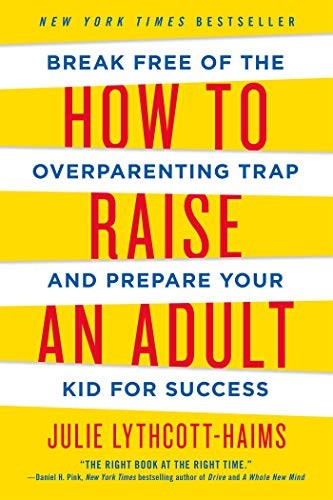
How to Raise an Adult
by Julie Lythcott-Haims · 2015
A former Stanford dean's case for why doing everything for your kid is exactly how you end up with a kid who can't do anything.
Worth reading? Lythcott-Haims spent over a decade as a Stanford dean watching bright, accomplished students arrive on campus unable to manage a conflict with a roommate or advocate for themselves with a professor, and this book is her case for why: parents optimized so hard for the college application that they skipped teaching actual self-reliance. The overparenting critique isn't vague hand-wringing -- she names specific habits (checking the grade portal daily, calling the coach about playing time, editing every essay) and explains what skill each one blocks the kid from building. It's more diagnosis than parenting-technique manual, so don't expect scripts. Skip it if you're not yet in the school-age-through-college stretch; the examples won't land.
| Full Title | How to Raise an Adult: Break Free of the Overparenting Trap and Prepare Your Kid for Success |
|---|---|
| Author | Julie Lythcott-Haims |
| Published | 2015 |
| Category | Parenting & Relationships |
The Verdict
Julie Lythcott-Haims spent over a decade as a Stanford dean watching capable, high-achieving 18-year-olds arrive on campus and fall apart over things like scheduling their own doctor’s appointment. This book is her explanation for why.
The answer isn’t complicated: parents who manage every grade, every activity, and every college essay are optimizing for the application, not the kid. Every problem you solve for your child is a rep they didn’t get to build the skill of solving it themselves.
What makes the critique land instead of feeling like generic finger-wagging is specificity. She names the exact habits – checking the grade portal daily, calling the coach about playing time, “editing” an essay until it’s really yours – and walks through what each one actually costs.
It’s more diagnosis than toolkit. You won’t get a stack of scripts here, you’ll get a clear-eyed case for backing off and letting your kid fail at low-stakes things while the stakes are still low.
Read it if you’re parenting through the school-age-to-college stretch and suspect you’re over-managing things. Skip it if you’ve got a toddler – come back to this one in a decade.
parents of school-age to college-age kids who suspect they're over-managing homework, activities, and college admissions, and want a clear case for backing off
you have a toddler or preschooler -- this book is aimed squarely at the school-age-through-college stretch, especially the college admissions arms race
Book Summary
Overparenting isn't love, it's outsourcing a kid's problem-solving to yourself, and every time you solve a problem your kid could have solved, you take away a rep they needed. The kids who arrive at college unable to handle basic adult friction usually had parents who never let them fail small.
The college admissions arms race has warped parenting into a resume-building project. Chasing the "right" activities and grades for an application often crowds out the unstructured time and real responsibility that actually builds capable adults.
Chores, unsupervised time, and the freedom to fail at something low-stakes are not optional extras -- they're the actual training ground for the self-reliance, work ethic, and resilience that matter far more than a transcript.
Love and high expectations aren't the problem. The problem is when parents attach their own identity and anxiety to the kid's outcomes, which turns support into control.
Top 9 Lessons from How to Raise an Adult
- Let your kid handle age-appropriate problems themselves instead of stepping in to fix or prevent every setback.
- Assign real chores -- they build competence and work ethic that grades and activities don't.
- Resist checking the grade portal or emailing teachers on your kid's behalf; let them advocate for themselves.
- Don't let the college application become the organizing goal of your kid's whole adolescence.
- Protect unstructured, unsupervised time -- it's where kids practice self-direction, not just where nothing happens.
- Separate your own identity and anxiety from your kid's outcomes and achievements.
- Let your kid fail at something small and recover from it before the stakes get high.
- Teach life skills (laundry, cooking, managing money) on a real timeline, not 'eventually.'
- Praise effort and self-directed problem-solving over the finished, polished result you helped produce.
Frequently Asked Questions
Is How to Raise an Adult worth reading?
Yes, especially if you suspect you're over-managing your kid's schoolwork, activities, or college process. Lythcott-Haims makes a specific, well-argued case for backing off, grounded in a decade of dean-level observation.
What is the main idea of How to Raise an Adult?
Overparenting -- managing every grade, activity, and application decision for your kid -- prevents them from building the self-reliance and problem-solving skills they need as adults, even when it's done out of love.
What age range does this book cover?
Mostly school-age through college, with heavy attention on the high school and college-admissions years.
Is this book anti-involvement or anti-parenting?
No. It's specifically against outsourcing a kid's problems and decisions to yourself. High expectations and love are fine; doing the work for them is the problem.
Is this book based on research or personal opinion?
Both -- it draws on Lythcott-Haims' years as a Stanford dean observing incoming students, plus developmental and educational research, not just anecdote.
Ready to read it?
Get How to Raise an Adult on Amazon