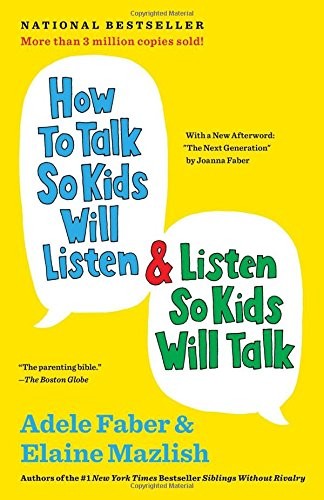
How to Talk So Kids Will Listen & Listen So Kids Will Talk
by Adele Faber and Elaine Mazlish · 2012
The book that replaces 'because I said so' with a set of scripts that actually get a kid to cooperate.
Worth reading? This book has been reprinted for over 40 years for a reason -- the scripts work, and they still sound normal coming out of your mouth today. Faber and Mazlish aren't selling a philosophy, they're selling technique: acknowledge feelings instead of dismissing them, describe the problem instead of accusing, give choices instead of orders. It's dense with comic-strip examples that make the technique concrete instead of abstract, which is why parents actually remember and use it. Skip it if you want a book that explains child psychology in depth -- this one just tells you what to say and shows you the difference it makes.
| Full Title | How to Talk So Kids Will Listen & Listen So Kids Will Talk |
|---|---|
| Author | Adele Faber and Elaine Mazlish |
| Published | 2012 |
| Publisher | Scribner |
| Category | Parenting & Relationships |
| Favorite quote | “Children need to have their feelings accepted and respected.” |
The Verdict
Most parenting advice tells you what to believe about your kid. This book tells you what to say to them, word for word, and then shows you the difference it makes.
The core move is simple: acknowledge the feeling before you address the behavior. “You’re really mad you have to leave the park” lands completely differently than “stop crying, we’re leaving.” One makes a kid feel heard; the other makes them dig in.
What sells the book is the comic-strip format – side-by-side panels showing the same situation handled the old way and the new way. You see the kid’s face change. That’s more convincing than any explanation of why it works.
It’s light on theory and heavy on scripts, which is exactly what makes it usable at 7pm when your patience is gone and you need something that works right now, not a framework to meditate on later.
Read it if you want language that gets a kid to cooperate without threats, bribes, or repeating yourself five times. Skip it if you’re looking for the neuroscience behind why kids behave the way they do – for that, pair it with something like The Whole-Brain Child.
parents who are tired of nagging, threatening, and repeating themselves and want language that works the first time
you want research-heavy neuroscience explanations for why kids behave the way they do -- this book is almost entirely scripts and examples, light on the why
Book Summary
Kids cooperate more when their feelings get acknowledged first. Dismissing a feeling ("you're not really that upset") makes a kid dig in; naming it ("that's frustrating") often defuses it enough that they can hear what comes next.
Description beats accusation. "I see a wet towel on the floor" gets more cooperation than "you never hang up your towels" because it doesn't put the kid on the defensive before they've even acted.
Punishment teaches a kid how not to get caught, not how to behave. The book pushes problem-solving and natural consequences instead -- let the kid help figure out the fix, and they're more likely to actually follow through.
Praise can backfire if it's evaluative ("you're so smart"). Descriptive praise ("you kept trying even when it was hard") tells the kid exactly what worked, which is more useful and less pressure-inducing than a label.
Top 9 Lessons from How to Talk So Kids Will Listen & Listen So Kids Will Talk
- Acknowledge the feeling before addressing the behavior -- 'you're mad' lands better than 'stop being mad.'
- Describe the problem instead of accusing the kid ('there's toothpaste on the sink' beats 'you never clean up').
- Give a choice instead of an order when the outcome doesn't actually matter ('red shirt or blue shirt') to reduce power struggles.
- Replace punishment with problem-solving -- ask the kid what they think would fix it.
- Use one word instead of a lecture ('the towel') when a kid already knows the rule.
- Praise descriptively, not evaluatively -- say what they did, not what they are.
- Let natural consequences teach instead of manufacturing a punishment for everything.
- Express your own feelings honestly instead of suppressing them until you snap.
- Don't deny a feeling you can plainly see -- it teaches a kid to distrust their own perception.
Top 4 Quotes from How to Talk So Kids Will Listen & Listen So Kids Will Talk
"Children need to have their feelings accepted and respected."
Adele Faber and Elaine Mazlish, How to Talk So Kids Will Listen & Listen So Kids Will Talk
"You can't make a child feel something he doesn't feel."
Adele Faber and Elaine Mazlish, How to Talk So Kids Will Listen & Listen So Kids Will Talk
"Instead of denying feelings, give them a name."
Adele Faber and Elaine Mazlish, How to Talk So Kids Will Listen & Listen So Kids Will Talk
"When children feel right, they'll behave right."
Adele Faber and Elaine Mazlish, How to Talk So Kids Will Listen & Listen So Kids Will Talk
Frequently Asked Questions
Is How to Talk So Kids Will Listen worth reading?
Yes. It's one of the most practical parenting books ever written -- more scripts and comic-strip examples than theory, which makes the technique easy to actually use the same day you read it.
What is the main idea of How to Talk So Kids Will Listen?
Kids cooperate more when you acknowledge their feelings and describe problems instead of accusing, ordering, or punishing. The book gives concrete language for doing this in everyday moments.
What age range is How to Talk So Kids Will Listen for?
The examples mostly cover toddlers through the early teen years, but the core techniques (acknowledging feelings, describing instead of accusing) apply at almost any age.
Is this book outdated since it was first published in 1980?
The core techniques have held up remarkably well -- the updated edition keeps the examples current, and the underlying communication skills don't expire.
How is this different from Good Inside?
Good Inside gives you a philosophy (your kid is good inside even when behaving badly); this book gives you the actual sentences to say in the moment. They pair well together.