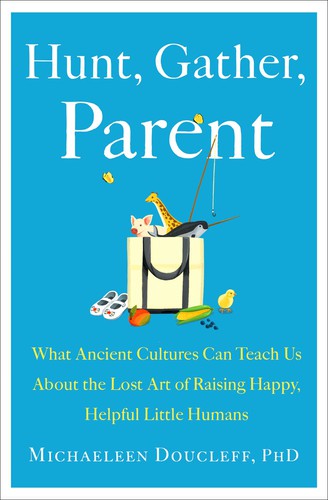
Hunt, Gather, Parent
by Michaeleen Doucleff · 2021
An NPR science reporter travels to Maya, Inuit, and Hadzabe communities to find parenting that doesn't rely on nagging, bribing, or timeouts.
Worth reading? Doucleff's reporting instinct is what makes this work -- instead of theorizing about what ancient cultures 'probably' did, she actually goes to live with Maya, Inuit, and Hadzabe families and documents what she sees. The throughline across very different cultures is consistent: young kids are included as real contributors to family life (not entertained or micromanaged), and that inclusion is what produces the helpfulness Western parents spend years trying to bribe out of their kids with sticker charts. It's more travelogue-and-anecdote than randomized-controlled-trial, so treat the cross-cultural fieldwork as compelling observation, not clinical proof. Skip it if you want a research-heavy Western parenting book instead of fieldwork-based cultural comparison.
| Full Title | Hunt, Gather, Parent: What Ancient Cultures Can Teach Us About the Lost Art of Raising Happy, Helpful Little Humans |
|---|---|
| Author | Michaeleen Doucleff |
| Published | 2021 |
| Publisher | Avid Reader Press / Simon & Schuster |
| Category | Parenting & Relationships |
| Favorite quote | “It's not my job to entertain the children. It's their job to be part of the team.” |
The Verdict
Most Western parenting advice assumes kids need to be entertained, managed, or bribed into cooperating. Doucleff went looking for an alternative and found one, repeatedly, across cultures that don’t share a language or a continent.
She lives with Maya families in the Yucatán, Inuit families in the Arctic, and Hadzabe families in Tanzania, and the pattern she documents is consistent: young kids are treated as real contributors to the household, not future helpers who need to wait until they’re “old enough.” A toddler handed a real knife-adjacent task, supervised but not micromanaged, learns to help because helping is just what the family does – not because a sticker chart told them to.
The book’s best line captures the whole philosophy: it’s not the parent’s job to entertain the kids, it’s the kids’ job to be part of the team. That’s a genuinely different frame from most Western parenting content, which spends its energy on managing behavior rather than restructuring what the child is included in.
It’s reported, not clinically proven – Doucleff is a science journalist doing fieldwork, and the evidence is observational and cross-cultural rather than a randomized trial. Treat the conclusions as compelling pattern-matching, not settled science, and you’ll get the most out of it.
Read it if you’re exhausted by constant negotiating and want to see how differently structured family life produces genuinely cooperative kids. Skip it if you want a Western, research-citation-heavy parenting book instead.
parents exhausted by constant negotiating and rewards-based discipline, who want kids that help around the house without being asked or bribed
you want a Western-clinical-research-based parenting book -- this leans on cross-cultural fieldwork and anecdote more than controlled studies
Book Summary
Modern Western parenting over-entertains and over-directs young kids, when what actually produces helpful, cooperative behavior is treating them as real contributors to family life from a young age -- included in real tasks, not given pretend ones or excluded until they're "old enough."
Forcing or bribing a child to do something undermines their intrinsic motivation, can damage the parent-child relationship, and removes their chance to learn to make the decision themselves -- three costs that outweigh whatever short-term compliance the bribe buys.
Calm is contagious, and so is its absence: parents need to regulate their own internal state first, since kids are constantly reading and mirroring the adult's emotional state rather than following verbal instructions to "calm down."
Top 8 Lessons from Hunt, Gather, Parent
- Include young kids in real household tasks and family life, rather than entertaining them separately or waiting until they're 'old enough' to help.
- Model calm regulation yourself before expecting a child to self-regulate -- kids mirror your state more than they follow verbal instructions.
- Avoid forcing or bribing compliance -- it undermines intrinsic motivation and removes the child's chance to decide for themselves.
- Let kids make real mistakes (a genuine mess, a failed attempt) as part of how they learn a skill, rather than intervening to prevent every misstep.
- Treat a young child's refusal to listen as a sign they're not developmentally ready for the lesson yet, not defiance to be punished.
- Reduce direct commands and questions -- excessive verbal instruction can undercut a child's independent motivation to help.
- Give children genuine autonomy over small decisions and tasks, since being trusted with real responsibility builds helpfulness better than praise or rewards do.
- Look to cross-cultural parenting practices (Maya, Inuit, Hadzabe) as evidence that constant negotiation and reward systems aren't the only way to raise cooperative kids.
Top 4 Quotes from Hunt, Gather, Parent
"It's not my job to entertain the children. It's their job to be part of the team."
Michaeleen Doucleff, Hunt, Gather, Parent
"We need to model calmness. We have to be regulating our own internal states first before we expect our children to learn to regulate theirs."
Michaeleen Doucleff, Hunt, Gather, Parent
"Togetherness is easy. It's relaxing. It flows. It's what happens when we all stop trying to control each other's actions and simply let each other be."
Michaeleen Doucleff, Hunt, Gather, Parent
"If a little child doesn't listen, it's because she is too young to understand. She is not ready for the lesson."
Michaeleen Doucleff, Hunt, Gather, Parent
Frequently Asked Questions
Is Hunt, Gather, Parent worth reading?
Yes, especially if you're tired of negotiating, bribing, and reward charts and want to see what a genuinely different approach to raising cooperative kids looks like.
What is the main idea of Hunt, Gather, Parent?
Kids become helpful and cooperative when they're included as real contributors to family life from a young age, not when they're entertained, over-directed, or bribed into compliance.
Is this book based on scientific studies or cultural observation?
Mostly firsthand fieldwork and reporting -- Doucleff, an NPR science journalist, lived with Maya, Inuit, and Hadzabe families and documents what she observed, so treat it as compelling observation rather than controlled research.
What age range is Hunt, Gather, Parent aimed at?
Mostly toddlers through early elementary age, though the underlying principles about inclusion and autonomy apply more broadly.
How is this different from The Whole-Brain Child or Raising Good Humans?
Those books focus on brain science and the parent's own regulation. Hunt, Gather, Parent focuses on cross-cultural practices and structuring family life so kids want to help, rather than techniques for a single difficult moment.
Ready to read it?
Get Hunt, Gather, Parent on Amazon