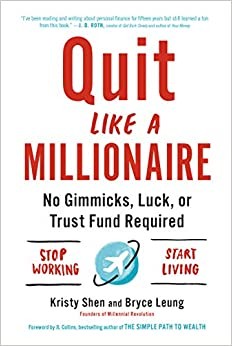
Quit Like a Millionaire
by Kristy Shen & Bryce Leung · 2019
A software engineer retired at 31 with no inheritance and no lucky exit. Here's the exact math.
Worth reading? Quit Like a Millionaire is the FIRE book with the least mythology and the most math. Shen grew up genuinely poor, ran the numbers obsessively, and retired at 31 without a windfall, that origin story is why the frugality advice here reads as strategy instead of preaching. It beats Your Money or Your Life on modern portfolio specifics and loses to it on philosophical depth. Skip it if you want a US-only tax guide, some of the account and geoarbitrage advice leans Canadian and international.
| Full Title | Quit Like a Millionaire: No Gimmicks, Luck, or Trust Fund Required |
|---|---|
| Author | Kristy Shen & Bryce Leung |
| Published | 2019 |
| Publisher | TarcherPerigee |
| Category | Business & Money |
| Favorite quote | “One of the biggest lies we've been sold is that following our passion is the key. Statistically, following your passion will lead to unemployment or underemployment.” |
The Verdict
Shen grew up poor in China before immigrating to Canada, and that origin story does real work here: the frugality advice reads like strategy from someone who’s actually been broke, not a lifestyle pose. She retired from software engineering at 31 with no inheritance, no startup exit, just a spreadsheet and discipline.
The book earns its place over vaguer FIRE guides because it shows its work. The bond tent for sequence-of-returns risk, the actual withdrawal math, the geographic arbitrage playbook, these are specifics you can act on, not just a mindset shift. Skip it if you need US-specific tax guidance; some of the account advice leans Canadian.
you want a real, numbers-first FIRE story from someone who wasn't already rich
you want US-only tax and account advice; Shen's playbook leans Canadian and cross-border in places
Book Summary
Shen's core argument is that retiring early isn't about extreme deprivation, it's about running the actual math on your \"enough\" number, then building a portfolio (she details her own asset allocation) that survives withdrawals for 60+ years. The book de-mythologizes FIRE by showing the real spreadsheet, not just the mindset. Geographic arbitrage does real work here: healthcare costs, travel hacking, and choosing where you live post-retirement change the math more than most people assume. Shen treats location as a lever, not an afterthought. The most useful chapters aren't about cutting lattes, they're about sequence-of-returns risk and how to structure withdrawals so a bad market in year one of retirement doesn't wreck the whole plan.
Top 9 Lessons from Quit Like a Millionaire
- Retiring early is a math problem: know your real 'enough' number before you optimize anything else.
- Frugality is a tool for reaching a number faster, not a permanent identity.
- Sequence-of-returns risk (a bad market right after you retire) matters more than average returns.
- A bond tent, holding more bonds right around your retirement date, protects against that early-sequence risk.
- Geographic arbitrage (cost of living, healthcare, travel hacking) changes the math more than diet cuts do.
- Index investing plus a clear withdrawal strategy beats picking stocks or timing markets.
- Health insurance and healthcare costs are the actual hard part of early retirement, plan for them explicitly.
- Real estate isn't automatically better than index funds; run the numbers for your specific situation.
- A childhood without money isn't a disqualifier for wealth, it can be the reason you take the math seriously.
Top 4 Quotes from Quit Like a Millionaire
"You only become 'special' by developing skills that are in demand, which takes focus, grit, and long-term work."
Kristy Shen & Bryce Leung, Quit Like a Millionaire
"One of the biggest lies we've been sold is that following our passion is the key. Statistically, following your passion will lead to unemployment or underemployment."
Kristy Shen & Bryce Leung, Quit Like a Millionaire
"The more stuff people owned, the unhappier and more stressed they tended to be. Conversely, the less stuff people owned and the more they spent on experiences like travel or learning new skills, the happier and more content they were."
Kristy Shen & Bryce Leung, Quit Like a Millionaire
"Index investing beats 85 percent of actively managed mutual funds."
Kristy Shen & Bryce Leung, Quit Like a Millionaire
Frequently Asked Questions
Is Quit Like a Millionaire worth reading?
Yes, if you want a FIRE book built on real portfolio math rather than motivational frugality talk. It's one of the more numbers-heavy entries in the genre.
What is the main idea of Quit Like a Millionaire?
Financial independence is a solvable math problem, run your real number, protect against sequence-of-returns risk, and use geographic arbitrage, not just cut spending.
Who should read Quit Like a Millionaire?
Anyone who wants a real FIRE story from someone without a trust fund or lucky exit, plus the specific portfolio mechanics behind it.
Is Quit Like a Millionaire only useful for Canadians?
No, but some of the account types and geoarbitrage advice lean Canadian and cross-border. US readers should double-check the tax specifics against their own accounts.
Ready to read it?
Get Quit Like a Millionaire on Amazon