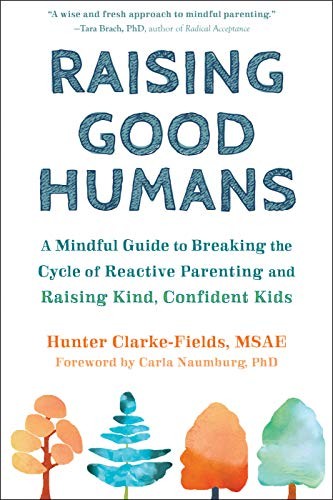
Raising Good Humans
by Hunter Clarke-Fields · 2019
A mindfulness teacher's guide to noticing your trigger before it turns into a yelling match with your kid.
Worth reading? The core insight in Raising Good Humans is uncomfortable but correct: your reactivity is rarely about your kid's behavior in the moment, it's about your own unprocessed stuff getting triggered by it. Clarke-Fields, a longtime mindfulness teacher, spends more time on you than on your child -- teaching you to notice the gap between trigger and reaction and widen it, rather than handing you a script to recite. That makes it slower to apply than a straight parenting-tactics book, but it's also why the change tends to stick instead of evaporating the next time you're tired and the kid won't put on shoes. Skip it if you want fast scripts over self-work -- pair it with something more tactical if that's what you need.
| Full Title | Raising Good Humans: A Mindful Guide to Breaking the Cycle of Reactive Parenting and Raising Kind, Confident Kids |
|---|---|
| Author | Hunter Clarke-Fields |
| Published | 2019 |
| Publisher | New Harbinger Publications |
| Category | Parenting & Relationships |
| Favorite quote | “Children tend to be terrible at doing what we say but great at doing what we do.” |
The Verdict
Most parenting advice assumes the problem is your kid’s behavior. Clarke-Fields starts somewhere else: your own reactivity, and where it actually comes from.
That reframe is the whole book. When you snap at a kid for spilling juice, the intensity of your reaction rarely matches the size of the spill – it matches something older, usually a pattern from your own childhood that the moment just triggered. Clarke-Fields, a mindfulness teacher first, wants you to notice that gap between trigger and reaction and widen it, one breath at a time.
It’s slower than a tactics book. There’s no laminated script for “what to say when they won’t put on shoes.” Instead you get practices for noticing your own state before you respond, which is less satisfying in the moment but more durable over time – you’re not just managing one tantrum, you’re changing the pattern that produces your response to all of them.
The tradeoff is real: if you’re exhausted and want a fast script tonight, this isn’t the fastest read. But if the same trigger keeps working on you no matter how many scripts you’ve memorized, this is the book that explains why, and gives you something to actually do about it.
Read it if you keep losing your temper despite knowing better in calmer moments. Skip it if you want kid-facing tactics first – pair this with a more script-heavy book for that.
parents who know exactly what they should say in the moment but keep snapping anyway, and want to understand why the pause is so hard to find
you want parenting tactics and scripts first -- this is mostly about your own nervous system, and the kid-facing techniques come second
Book Summary
Most reactive parenting isn't really about the kid's behavior -- it's your own childhood patterns and unprocessed emotions getting triggered by an ordinary moment, then discharged onto whoever's closest, usually your child.
There's a gap between a trigger and your reaction to it, and that gap is trainable. Mindfulness practice widens the gap so you get a real choice point instead of an automatic blowup.
Kids learn regulation by watching you regulate, not by being told to calm down. Modeling a calm response teaches the skill far more effectively than demanding one.
Connection has to come before correction. A child who feels connected to you is far more receptive to a boundary or a lesson than one who just felt your anger.
Top 9 Lessons from Raising Good Humans
- Notice the gap between a trigger and your reaction -- that gap, however small, is where change happens.
- Trace your own reactivity back to its source -- often a childhood pattern, not the actual severity of what your kid just did.
- Model the calm you want your child to have, instead of demanding they self-regulate before you do.
- Connect with your child emotionally before trying to correct behavior -- correction lands better after connection.
- Use a short physical pause (breath, a few seconds of silence) to interrupt an automatic reactive pattern before it fires.
- Treat your own self-compassion as a parenting tool, not an indulgence -- a depleted parent has less patience to offer.
- Identify your family's core values explicitly, so discipline decisions trace back to something more solid than mood.
- Favor natural consequences over punishment or bribery when you want a lesson to actually generalize.
- Repair after a rupture -- apologizing to your kid after you lose it teaches accountability better than pretending it didn't happen.
Top 4 Quotes from Raising Good Humans
"Children tend to be terrible at doing what we say but great at doing what we do."
Hunter Clarke-Fields, Raising Good Humans
"The best predictor of a child's well-being is the parent's self-understanding."
Hunter Clarke-Fields, Raising Good Humans
"The only way out of our difficult feelings is through."
Hunter Clarke-Fields, Raising Good Humans
"Six months with a preschooler can be more effective than years alone on a mountain top."
Hunter Clarke-Fields, Raising Good Humans
Frequently Asked Questions
Is Raising Good Humans worth reading?
Yes, especially if you already know the calm response and still can't access it in the moment. The book targets that gap directly instead of just handing you another script.
What is the main idea of Raising Good Humans?
Reactive parenting usually traces back to the parent's own unprocessed patterns, not the severity of the child's behavior. Widening the gap between trigger and reaction, through mindfulness practice, is how you break the cycle.
Is this book more about the parent or the child?
Mostly the parent. Clarke-Fields spends more pages on your own nervous system and triggers than on kid-facing scripts, which is unusual for a parenting book.
Do I need meditation experience to use this book?
No. The mindfulness practices are simple and parenting-specific -- short pauses and breath work you can use mid-tantrum, not a formal meditation practice.
How is Raising Good Humans different from The Whole-Brain Child?
The Whole-Brain Child explains your kid's brain science. Raising Good Humans focuses on your own reactivity as the parent -- they pair well together.
Ready to read it?
Get Raising Good Humans on Amazon