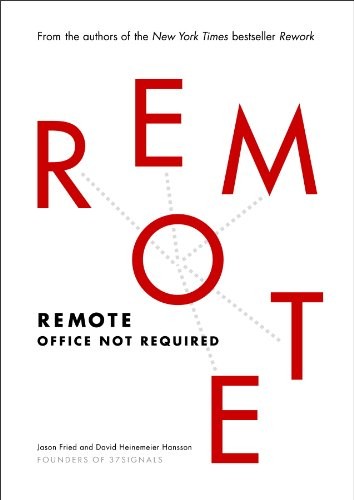
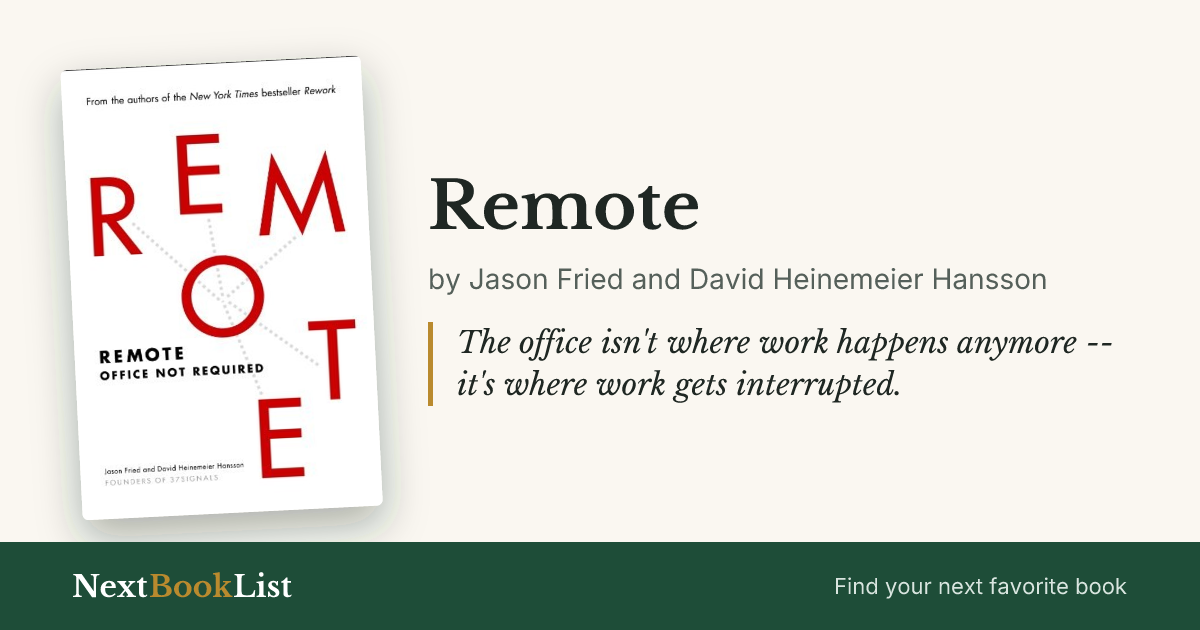
Remote
by Jason Fried and David Heinemeier Hansson · 2013
The office isn't where work happens anymore -- it's where work gets interrupted.
Worth reading? Remote is the case Basecamp made for distributed teams years before the rest of the world was forced into the experiment. It's short and a little dated on the specific tools, but the core argument, that the office is a distraction machine dressed up as a requirement, holds up better than most 2013 business books. Skip it if you've already made the switch and need operating detail instead of persuasion.
| Full Title | Remote: Office Not Required |
|---|---|
| Author | Jason Fried and David Heinemeier Hansson |
| Published | 2013 |
| Publisher | Crown Business |
| Category | Business & Money |
| Favorite quote | “Even short commutes stab at your happiness.” |
The Verdict
Fried and Hansson wrote this while running Basecamp fully distributed years before most companies had a reason to try it, and it shows: this isn’t theory borrowed from a pandemic, it’s a company that had already stress-tested the idea for a decade. The argument is blunt – offices interrupt more than they enable – and it doesn’t dress that up with hedging.
Where it’s thinner is the “how”: specific tools, specific rituals, the operational texture of actually running a distributed team day to day. Read it for the case, not the manual, and pair it with something more current for the tactics.
managers and founders deciding whether to let a team work remotely, and skeptical about it
your team is already fully remote and past the 'is this legitimate' argument
Book Summary
The office is sold as necessary for collaboration, but Fried and Hansson argue it mostly produces interruption: meetings, drop-bys, and hallway chatter that break the long uninterrupted stretches real work actually needs.
Remote work only breaks down when management still measures presence instead of output. The fix isn't more monitoring software, it's hiring people you trust and judging them on what they ship.
Going remote widens the hiring pool from "whoever can commute" to "whoever is best," which is a bigger competitive advantage than most companies realize until a competitor uses it against them.
Top 10 Lessons from Remote
- Remote work isn't a perk to offer -- it's a better default for most knowledge work.
- Overlap hours matter more than a fixed 9-to-5 schedule when a team is distributed.
- Hire and evaluate people on output, not hours logged at a desk.
- Remote teams have to over-communicate in writing; verbal context doesn't travel.
- Give remote workers a real setup budget instead of assuming a kitchen table is fine.
- Meetings are the biggest time-killer in any office; distributed work forces you to cut them.
- If you can't trust someone remotely, that's a hiring problem, not a location problem.
- Loneliness, not laziness, is the real risk of remote work -- build in real facetime deliberately.
- Going remote opens a global hiring pool instead of whoever lives in commuting distance.
- Protect the boundary between work and home yourself; nobody else will do it for you.
Top 5 Quotes from Remote
"A manager's natural instinct is to worry about his workers not getting enough work done, but the real threat is that too much will likely get done. And because the manager isn't sitting across from his worker anymore, he can't look in the person's eyes and see burnout."
Jason Fried and David Heinemeier Hansson, Remote
"Even short commutes stab at your happiness."
Jason Fried and David Heinemeier Hansson, Remote
"Forcing everyone into the office every day is an organizational SPoF (Single Point of Failure). If the office loses power or Internet or air conditioning, it's no longer functional as a place to do work."
Jason Fried and David Heinemeier Hansson, Remote
"The big transition with a distributed workforce is going from synchronous to asynchronous collaboration."
Jason Fried and David Heinemeier Hansson, Remote
"Release yourself from the 9am-to-5pm mentality. It might take a bit of time and practice to get the hang of working asynchronously with your team, but soon you'll see that it's the work—not the clock—that matters."
Jason Fried and David Heinemeier Hansson, Remote
Frequently Asked Questions
Is Remote: Office Not Required worth reading?
Yes, if you're still deciding whether remote work is legitimate for your team. It's the clearest, shortest version of the argument, though some of the specific tooling advice has dated. Skip it if you're already fully remote.
What is the main idea of Remote?
The office produces more interruption than collaboration, and companies that hire and manage for output instead of presence get both a happier team and a bigger hiring pool.
Is Remote still relevant after remote work went mainstream?
The persuasion chapters are less necessary now that most people have lived it, but the operating advice on trust, hiring, and overlap hours still holds.
Who should read Remote?
Managers and founders weighing whether to let a team go remote. Skip it if your team already works this way and you need execution detail, not the pitch.
Ready to read it?
Get Remote on Amazon