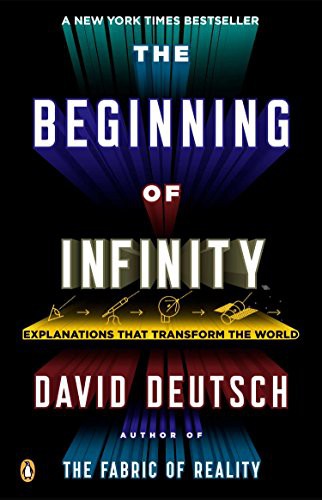
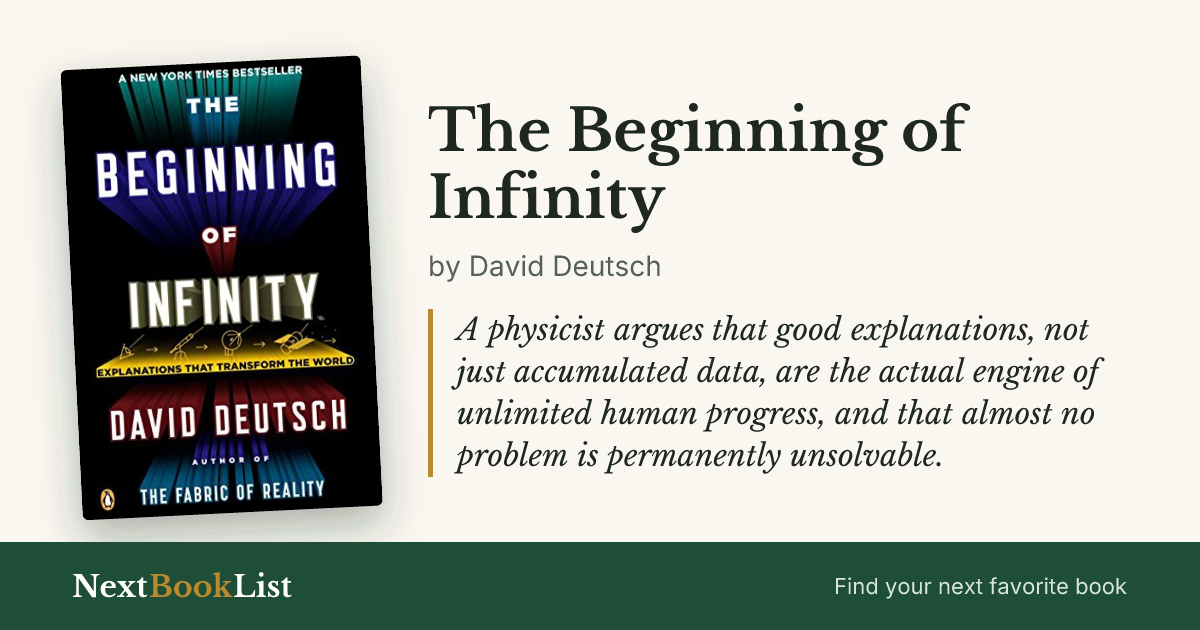
The Beginning of Infinity
by David Deutsch · 2011
A physicist argues that good explanations, not just accumulated data, are the actual engine of unlimited human progress, and that almost no problem is permanently unsolvable.
Worth reading? Deutsch's central argument is that what actually drives progress isn't the accumulation of data or resources, it's the creation of good explanations, ideas that are hard to vary while still accounting for what they explain, and that once a civilization has the capacity to create good explanations, there's essentially no limit to what problems it can eventually solve. Naval Ravikant has said the book made him smarter despite not being an easy read, and it's become a touchstone in tech and rationalist circles for its optimistic, anti-fatalist stance on human potential. Read it if you want your thinking genuinely stretched about the nature of knowledge and progress. Skip it as a first popular-science book, it rewards patience more than any other book on this list.
| Full Title | The Beginning of Infinity: Explanations That Transform the World |
|---|---|
| Author | David Deutsch |
| Published | 2011 |
| Category | Science & Nature |
| Favorite quote | “Problems are inevitable. Problems are soluble.” |
The Verdict
Deutsch isn’t writing for a casual afternoon read, and Naval says as much even while recommending it. But the core distinction between good and bad explanations is one of those ideas that, once it clicks, changes how you evaluate arguments well outside physics.
readers who want a demanding but genuinely mind-expanding case for unlimited progress through better explanations
this is a hard, dense read even by popular-physics standards, don't start here if you're new to the genre
Book Summary
Deutsch's key concept, the 'good explanation,' distinguishes ideas that are hard to vary (change any part and the explanation stops working or stops fitting the evidence) from bad explanations that can be endlessly adjusted to fit anything, arguing this distinction, not mere data volume, is what actually separates real scientific and philosophical progress from pseudo-explanation.
From this foundation he builds an expansive, deliberately anti-fatalist argument: given enough good explanations and enough time, there's no fundamental problem, physical, social, or otherwise, that's permanently unsolvable, a stance he contrasts sharply with both naive optimism (assuming progress happens automatically) and pessimism (assuming hard limits exist), calling his own position simply that unlimited progress is possible, not guaranteed.
Top 7 Lessons from The Beginning of Infinity
- 'Good explanations' are hard to vary while still accounting for the evidence, this is what separates real understanding from pseudo-explanation.
- Progress comes from better explanations, not just more data or resources accumulated passively.
- Almost no problem is permanently unsolvable, given enough good explanations and enough time, a genuinely anti-fatalist stance.
- Optimism about progress isn't the same as assuming it happens automatically, effort and good explanation-seeking still matter.
- A civilization's capacity for unlimited progress is a property of its knowledge-creation process, not its current resources.
- Distinguishing hard-to-vary explanations from endlessly-adjustable ones is a transferable skill well beyond physics.
- This is a genuinely difficult book, and the difficulty itself is part of what makes the ideas stick once absorbed.
Top 2 Quotes from The Beginning of Infinity
"Problems are inevitable. Problems are soluble."
David Deutsch, The Beginning of Infinity
"Everything that is not forbidden by laws of nature is achievable, given the right knowledge."
David Deutsch, The Beginning of Infinity
Frequently Asked Questions
Is The Beginning of Infinity worth reading?
Yes, but it's genuinely demanding, even Naval Ravikant, who recommends it, admits it's not an easy read. It rewards patience with a real shift in how you think about progress and explanation.
What is The Beginning of Infinity about?
Physicist David Deutsch's argument that good explanations, ideas that are hard to vary while still fitting the evidence, not data accumulation, are the actual engine of unlimited human progress.
Should I read The Fabric of Reality before The Beginning of Infinity?
Not necessarily. The Beginning of Infinity works as a standalone, more accessible entry point into Deutsch's thinking than his earlier, denser Fabric of Reality.
Ready to read it?
Get The Beginning of Infinity on Amazon