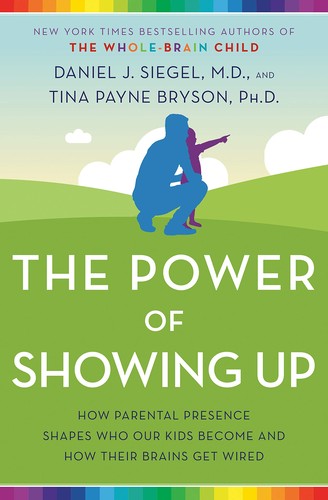
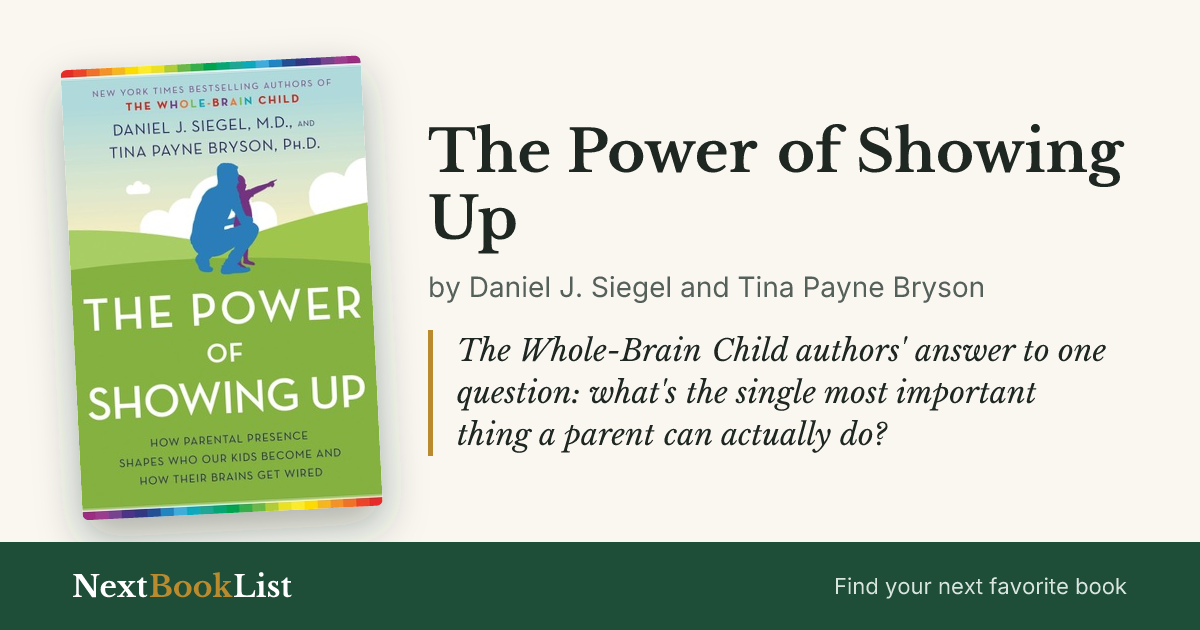
The Power of Showing Up
by Daniel J. Siegel and Tina Payne Bryson · 2020
The Whole-Brain Child authors' answer to one question: what's the single most important thing a parent can actually do?
Worth reading? Siegel and Bryson's answer to 'what matters most' is refreshingly narrow: showing up, consistently, in a way that gives your kid four specific experiences -- feeling safe, seen, soothed, and secure. The Four S's framework is the book's real contribution, and it's genuinely useful because it's concrete enough to self-check against ('did I make my kid feel seen in that conversation?') without collapsing into a rigid rulebook. It's a lighter, more focused read than The Whole-Brain Child, closer to a single thesis expanded than twelve strategies. Skip it if you want breadth over depth -- this doesn't cover as much ground as their earlier book.
| Full Title | The Power of Showing Up: How Parental Presence Shapes Who Our Kids Become and How Their Brains Get Wired |
|---|---|
| Author | Daniel J. Siegel and Tina Payne Bryson |
| Published | 2020 |
| Publisher | Ballantine Books |
| Category | Parenting & Relationships |
| Favorite quote | “One of the very best scientific predictors for how any child turns out--in terms of happiness, academic success, leadership skills, and meaningful relationships--is whether at least one adult in their life has consistently shown up for them.” |
The Verdict
Siegel and Bryson wrote The Whole-Brain Child to explain twelve strategies. Here they narrow the whole project down to one question: if a parent could only do one thing right, what would matter most?
Their answer is showing up – not perfectly, not constantly, just consistently enough that a kid can count on you. They break that down into four things a child needs to feel: safe, seen, soothed, and secure. Miss one of the S’s in a given moment and it’s not catastrophic; miss all four as a pattern over years, and that’s what actually predicts trouble.
What makes the framework useful is that it’s checkable. After a hard conversation with your kid, you can actually ask “did I make them feel seen there, or did I just manage their behavior?” That’s a more honest self-audit than most parenting advice offers, because it doesn’t let you hide behind good intentions.
It’s a narrower book than their first one – less ground covered, more depth on a single thesis. If you want the widest toolkit, The Whole-Brain Child still covers more scenarios. This one earns its place by being the more distilled, more repeatable idea.
Read it if you want one clear framework to check your parenting against, backed by real research. Skip it if you already have that framework and want new tactics instead – this is more thesis than script library.
parents who want the research case for why consistent presence matters more than any single parenting technique, plus a usable framework for delivering it
you already believe presence matters and just want new-situation scripts -- this leans more on the argument and the framework than on a script library
Book Summary
One of the best predictors of how a child turns out -- happiness, academic success, leadership, relationships -- is whether at least one adult in their life consistently showed up for them. Showing up isn't about time, money, or perfect parenting; it's a quality of presence.
Every child needs to feel four things from their caregivers: Safe (protected from harm, with room to take healthy risks), Seen (their emotions noticed and attuned to, not just their behavior), Soothed (helped through hard feelings rather than shielded from all of them), and Secure (able to reliably count on you, which builds the internal trust that becomes secure attachment).
You will not deliver the Four S's perfectly every time, and that's fine -- what matters more than any single moment is the pattern over time, plus your willingness to repair after you get it wrong.
Top 8 Lessons from The Power of Showing Up
- Focus on consistent presence over any single parenting technique -- it's the strongest predictor of long-term outcomes the authors point to.
- Make your child feel safe -- protected from real harm while still allowed the risks needed for growth.
- Make your child feel seen -- attune to the emotion underneath the behavior, not just the behavior itself.
- Make your child feel soothed -- the goal isn't a life with no hard feelings, it's knowing they won't face them alone.
- Make your child feel secure -- reliability across many small moments is what builds real trust, not one grand gesture.
- Treat repair after a parenting misstep as part of the job, not a failure -- kids learn resilience partly by watching you recover.
- Don't confuse showing up with hovering -- presence means attunement, not constant intervention.
- Apply the Four S's as a self-check across contexts -- discipline, celebration, conflict, apology -- not just in crisis moments.
Top 4 Quotes from The Power of Showing Up
"One of the very best scientific predictors for how any child turns out--in terms of happiness, academic success, leadership skills, and meaningful relationships--is whether at least one adult in their life has consistently shown up for them."
Daniel J. Siegel and Tina Payne Bryson, The Power of Showing Up
"Truly seeing a child means we pay attention to his emotions--both positive and negative--and strive to attune to what's happening in his mind beneath his behavior."
Daniel J. Siegel and Tina Payne Bryson, The Power of Showing Up
"Soothing isn't about providing a life of ease; it's about teaching your child how to cope when life gets hard, and showing him that you'll be there with him along the way."
Daniel J. Siegel and Tina Payne Bryson, The Power of Showing Up
"We can't always insulate a child from injury or avoid doing something that leads to hurt feelings. But when we give a child a sense of safe harbor, she will be able to take the needed risks for growth and change."
Daniel J. Siegel and Tina Payne Bryson, The Power of Showing Up
Frequently Asked Questions
Is The Power of Showing Up worth reading?
Yes, especially if you want a research-backed, concrete answer to what matters most in parenting, rather than another list of situational tactics.
What is the main idea of The Power of Showing Up?
Consistent parental presence -- making a child feel safe, seen, soothed, and secure -- is one of the strongest predictors of how they turn out, more than any single parenting technique.
What are the Four S's in The Power of Showing Up?
Safe, Seen, Soothed, and Secure -- the four experiences the authors argue every child needs from their caregivers, repeated across everyday moments.
How is this different from The Whole-Brain Child?
The Whole-Brain Child covers twelve strategies across a wide range of situations. The Power of Showing Up is narrower and more thesis-driven, built entirely around the Four S's framework.
Do I need to have read The Whole-Brain Child first?
No, it stands on its own, though fans of Siegel and Bryson's earlier work will recognize the same neuroscience-informed style.
Ready to read it?
Get The Power of Showing Up on Amazon