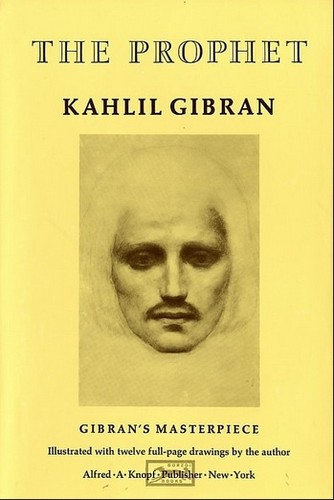
The Prophet
by Kahlil Gibran · 1923
A departing prophet answers a town's questions about love, marriage, work, and death in 26 poetic essays, written to feel like scripture without belonging to any single religion.
Worth reading? Gibran's structure, a prophet named Almustafa, about to leave a city after twelve years, answers the townspeople's questions on subjects from love and marriage to work, freedom, and death, gives the book the cadence and weight of scripture while belonging to no single religious tradition, which is exactly why it's been embraced across faiths for a century. It reads more like poetry than argument, and its most quoted lines on love ('for even as love crowns you so shall he crucify you') and children ('your children are not your children') have circulated independently of the book itself for decades. Read it as one of the most widely beloved pieces of spiritual writing that asks nothing of your specific beliefs. Skip it if you want structured argument rather than poetic, aphoristic reflection.
| Author | Kahlil Gibran |
|---|---|
| Published | 1923 |
| Category | Sociology & Culture |
| Favorite quote | “Your children are not your children. They are the sons and daughters of Life's longing for itself.” |
The Verdict
Gibran built this to feel like scripture without asking you to belong to anything, and that’s exactly why lines from it have outlived most people’s memory of where they came from. Short enough to read in one sitting, dense enough to reread for years.
readers who want poetic, spiritually resonant writing that doesn't require belonging to any particular faith
you want prose argument, this is closer to prose poetry, more felt than argued
Book Summary
Gibran's central choice, framing the entire book as one departing figure answering a town's accumulated life questions, lets him address nearly every major human experience, love, marriage, children, work, joy, sorrow, freedom, death, in short, self-contained sections that function almost like scripture without requiring allegiance to any specific religious doctrine.
The book's enduring appeal rests on this genuine universality: it was written by a Lebanese-American poet blending Christian, Islamic, and Sufi influences, deliberately avoiding sectarian specificity so that readers across religious backgrounds, and no religious background at all, have found its treatment of love, loss, and meaning equally resonant for a hundred years.
Top 7 Lessons from The Prophet
- Framing a book as answers to fundamental life questions gives even short, poetic sections real staying power.
- Writing that avoids sectarian specificity can achieve broader, longer-lasting resonance across different beliefs.
- Love and pain are treated as inseparable ('even as love crowns you so shall he crucify you'), not opposites to be resolved.
- Children are framed as belonging to life itself, not to their parents, a genuinely radical reframe for 1923.
- Poetic, aphoristic writing can carry as much philosophical weight as structured prose argument.
- A text's individual lines can outlive general awareness of the book they came from, as many of Gibran's have.
- Blending multiple religious and cultural influences deliberately, rather than picking one, was itself part of Gibran's method.
Top 6 Quotes from The Prophet
"Your children are not your children. They are the sons and daughters of Life's longing for itself."
Kahlil Gibran, The Prophet
"For even as love crowns you so shall he crucify you. Even as he is for your growth so is he for your pruning."
Kahlil Gibran, The Prophet
"Work is love made visible."
Kahlil Gibran, The Prophet
"Your pain is the breaking of the shell that encloses your understanding."
Kahlil Gibran, The Prophet
"The deeper that sorrow carves into your being, the more joy you can contain."
Kahlil Gibran, The Prophet
"Say not, "I have found the truth," but rather, "I have found a truth.""
Kahlil Gibran, The Prophet
Frequently Asked Questions
Is The Prophet worth reading?
Yes, it's one of the most widely beloved pieces of spiritual writing of the last century, poetic and universal rather than tied to any single religious tradition.
What is The Prophet about?
A departing prophet named Almustafa answers a town's questions on love, marriage, children, work, freedom, and death, in 26 poetic, self-contained essays.
Do I need to be religious to appreciate The Prophet?
No. Gibran deliberately avoided sectarian specificity, blending Christian, Islamic, and Sufi influences, so the book has resonated with readers across religious backgrounds and with no religious background at all.
Ready to read it?
Get The Prophet on Amazon