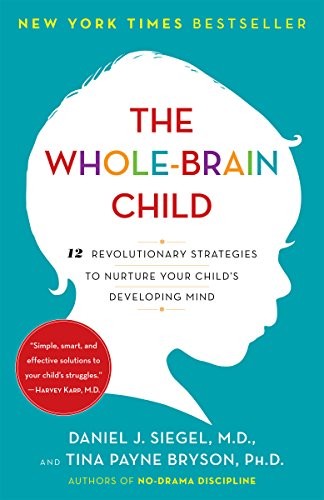
The Whole-Brain Child
by Daniel J. Siegel and Tina Payne Bryson · 2011
The book that explains why your kid's meltdown isn't defiance -- it's an upstairs brain that hasn't come online yet.
Worth reading? The 'upstairs brain / downstairs brain' framing is the single most useful mental model this book gives you, and it alone is worth the read -- once you understand that a meltdown is a downstairs-brain hijack, not a decision your kid is making, you stop taking it personally. Siegel and Bryson back the strategies with real neuroscience, but they translate it into kid-friendly language and simple techniques (name it to tame it, connect and redirect) that you can use mid-tantrum. It's a bit more academic in tone than Faber and Mazlish's classic, so it rewards patience. Skip it if you want pure scripts with no explanation -- for that, pair it with How to Talk So Kids Will Listen.
| Full Title | The Whole-Brain Child: 12 Revolutionary Strategies to Nurture Your Child's Developing Mind |
|---|---|
| Author | Daniel J. Siegel and Tina Payne Bryson |
| Published | 2011 |
| Category | Parenting & Relationships |
The Verdict
Most parents treat a meltdown as a behavior problem. Siegel and Bryson treat it as a brain state, and that reframe changes everything about how you respond.
The upstairs brain (reasoning, regulating) and downstairs brain (reactive, emotional) aren’t well connected in young kids. When the downstairs brain hijacks the show, no amount of logic reaches your kid – which is why arguing during a tantrum never works.
‘Name it to tame it’ is the technique that sticks: get the kid to describe what happened, in words, and the act of narrating calms the emotional storm. ‘Connect and redirect’ works the same way – meet the feeling first, then steer the behavior.
It’s more science-forward than most parenting books, and the strategies sometimes need translating into your own words rather than lifting a script directly off the page. That’s the tradeoff for actually understanding why the technique works instead of just memorizing a phrase.
Read it if you want the neuroscience behind your kid’s behavior, explained simply enough to use in the moment. Skip it if you want ready-made scripts with no explanation – pair this with How to Talk So Kids Will Listen for that.
parents who want to understand the neuroscience behind tantrums and use that understanding to respond instead of react
you already have a solid intuitive handle on emotional coaching and just want more scripts -- this leans more on brain science than on ready-made phrases
Book Summary
The brain has an 'upstairs' (rational, regulating) and 'downstairs' (reactive, emotional) part, and young kids' upstairs brains are still under construction. A tantrum is often a downstairs-brain hijack, not a willful choice, which changes how you should respond to it.
'Name it to tame it' -- helping a kid put words to a big feeling, or telling the story of what happened, calms the emotional brain down. You're literally integrating the two hemispheres by narrating the experience.
'Connect and redirect' -- connect emotionally first (right brain to right brain) before you try to redirect behavior with logic or rules (left brain). Skipping straight to logic during a meltdown doesn't work because the emotional brain can't hear it yet.
Integration, not suppression, is the goal. The point isn't to eliminate big feelings, it's to help the different parts of a child's brain work together so emotions don't overwhelm judgment.
Top 8 Lessons from The Whole-Brain Child
- Distinguish upstairs-brain (rational) behavior from downstairs-brain (reactive) behavior before responding to a meltdown.
- Use 'name it to tame it' -- help the kid put the feeling or the story of what happened into words to calm the emotional brain.
- Connect emotionally before redirecting behavior -- logic doesn't land until the feeling is acknowledged.
- Treat a tantrum as a brain state, not a character flaw or a manipulation.
- Engage, don't enrage -- appeal to the upstairs brain rather than triggering more downstairs reactivity.
- Use movement to shift a stuck emotional state when words aren't landing.
- Help kids integrate memory by encouraging them to retell difficult experiences in their own words.
- Teach the mindsight skill of noticing your own internal state, which is a prerequisite for managing it.
Frequently Asked Questions
Is The Whole-Brain Child worth reading?
Yes, especially if you want to understand the neuroscience behind why your kid melts down and how to respond in a way that actually helps regulate them instead of escalating things.
What is the main idea of The Whole-Brain Child?
Kids' brains have an upstairs (rational) and downstairs (reactive) part that aren't well connected yet. Understanding which part is driving a behavior, and connecting emotionally before redirecting, helps you respond more effectively.
What age range is this book for?
Mostly toddlers through the early teen years -- the brain science applies broadly, though most of the concrete examples focus on younger kids.
How is this different from How to Talk So Kids Will Listen?
This book explains the brain science behind why the techniques work; How to Talk gives you the actual scripts. They complement each other well.
Do I need a background in neuroscience to understand this book?
No. Siegel and Bryson translate the science into simple, kid-friendly language and hand-drawn illustrations you can use with your child directly.
Ready to read it?
Get The Whole-Brain Child on Amazon