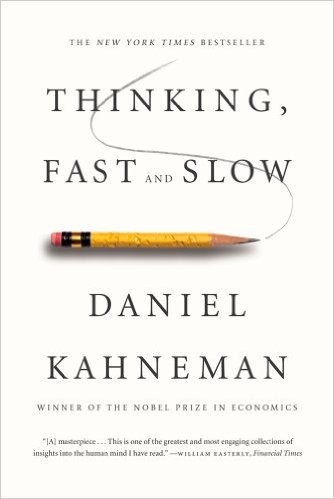
Thinking, Fast and Slow
by Daniel Kahneman · 2011
A Nobel laureate's map of every way your brain fools you. Dense, and worth every page.
Worth reading? The definitive map of how your mind lies to you, and it beats any pop-behavioral book because Kahneman is the source, not the summarizer. It's a textbook wearing a trade paperback cover, so it earns its length. Skip it if you want a light read — this one is dense, and you'll work for every insight.
| Author | Daniel Kahneman |
|---|---|
| Published | 2011 |
| Category | Self-Improvement & Psychology |
The Verdict
System 1 thinks fast and automatically; System 2 thinks slow and lazily. From that split, Kahneman explains anchoring, loss aversion, overconfidence, and why experts’ predictions fail. Some priming studies from the middle chapters failed replication, and Kahneman acknowledged it. The core framework remains the standard. Every other behavioral book cites this one.
readers who want the full science behind biases, not the blog-post version
you want a light read (this is a textbook wearing a trade paperback cover)
Book Summary
Two systems run your thinking: System 1 is fast, intuitive, and emotional; System 2 is slow, deliberate, and logical — and System 1 usually wins whether it should or not. Cognitive biases like overconfidence, anchoring, and loss aversion aren't bugs you fix once; they're defaults that quietly shape every judgment from the stock market to your vacation. You cannot trust your own intuitions about what will make you happy or what you'll predict — the remembering self and the experiencing self disagree, so decisions made on feeling misfire.
Top 7 Lessons from Thinking, Fast and Slow
- System 1 jumps to conclusions; slow down and let System 2 check it.
- Overconfidence is your default setting, not a rare lapse.
- Anchors and frames move you even when you know they're arbitrary.
- Loss aversion makes you hold losers and fear risks you should take.
- The planning fallacy means every project runs long — pad it.
- Happiness and memory diverge; you chase the wrong one.
- Statistical thinking beats intuition for any prediction that matters.
Frequently Asked Questions
Is Thinking, Fast and Slow worth reading?
Yes, for readers who want the full science behind biases, not the blog-post version. Skip it if you want a light read — this is a textbook wearing a trade paperback cover.
What is the main idea of Thinking, Fast and Slow?
Your mind runs on a fast intuitive system and a slow logical one, and the biases of the fast system quietly distort nearly every judgment you make.
How long does it take to read Thinking, Fast and Slow?
A serious commitment at about 400 pages — roughly 10 to 12 hours.
Who should read Thinking, Fast and Slow?
Readers who want the full science behind biases, not the blog-post version. Skip it if you want a light read (this is a textbook wearing a trade paperback cover).
Ready to read it?
Get Thinking, Fast and Slow on Amazon