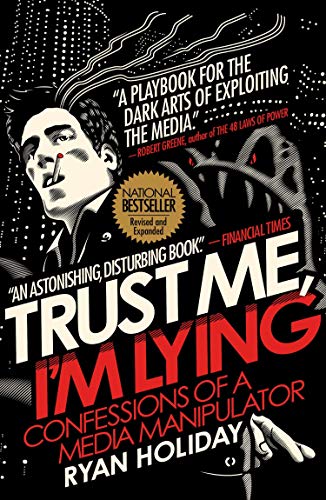
Trust Me, I'm Lying
by Ryan Holiday · 2012
A marketer confesses how he gamed blogs into becoming the news, and why the whole media food chain is built to let him.
Worth reading? The most useful media-literacy book written by the person doing the manipulating, not studying it from outside. It's uncomfortable because it works. Read it before you trust another viral headline. Skip it if you want Holiday's stoic, uplifting mode -- this is his cynical early book, and it stays cynical.
| Full Title | Trust Me, I'm Lying: Confessions of a Media Manipulator |
|---|---|
| Author | Ryan Holiday |
| Published | 2012 |
| Publisher | Portfolio |
| Category | Self-Improvement & Psychology |
| Favorite quote | “When you take away the question mark, it usually turns their headline into a lie.” |
The Verdict
Holiday wrote this before he became the calm stoic voice of Obstacle Is the Way and Ego Is the Enemy, and it shows. This is the cynical, insider version of him, admitting exactly how he gamed the media system as a marketing director, and naming the mechanics that still run every viral story you scroll past today.
The core trick is “trading up the chain”: plant a story with a small, hungry blog that needs content to survive, then watch bigger outlets pick it up as if it were already vetted. Nobody checks, because checking is slower than publishing, and slower loses.
Read it as a warning label for everything you read online. It won’t make you feel better about the internet, but it’ll make you a harder person to manipulate.
anyone who reads news online and wants to know how a story actually gets made
you want inspiration, not a cynical, insider-account exposé of how blogs get manipulated
Book Summary
Blogs run on a constant need for pageviews, and that need forces speed over accuracy every time. Holiday, working as a marketing director, exploited this for years before writing the confession.
"Trading up the chain" is the core trick: plant a story with a small, hungry blog, then watch bigger outlets treat that blog as a legitimate source and repeat the story as fact, no fact-checking required.
Outrage spreads faster than nuance, corrections run quietly while the original lie runs loud, and by the time anyone checks the story the damage is already done and everyone has moved on.
Top 10 Lessons from Trust Me, I'm Lying
- Blogs need constant content to survive, and that need shortcuts fact-checking.
- "Trading up the chain" -- plant a story small, watch bigger outlets treat it as fact.
- Headlines get written before the story is finished, and the headline is what spreads.
- Outrage and anger drive clicks faster than nuance or accuracy ever will.
- Corrections run quietly; the original lie runs loud and the damage sticks.
- "Sources say" language often hides that there's barely a source at all.
- Comment counts and shares are gameable, and gamed numbers look like real interest.
- Journalists are paid on traffic metrics whether or not anyone admits it.
- If you understand a platform's incentives, you can predict what it'll amplify.
- Treat any story that spreads unusually fast with real skepticism.
Top 5 Quotes from Trust Me, I'm Lying
"You cannot have your news for free; you can only obscure the costs."
Ryan Holiday, Trust Me, I'm Lying
"No marketer is ever going to push something with the stink of reasonableness, complexity, or mixed emotions."
Ryan Holiday, Trust Me, I'm Lying
"When you take away the question mark, it usually turns their headline into a lie."
Ryan Holiday, Trust Me, I'm Lying
"Snark makes the speaker feel a strength they know deep down they do not possess. It shields their insecurity and makes the writer feel like they are in control."
Ryan Holiday, Trust Me, I'm Lying
"When intelligent people read, they ask themselves a simple question: What do I plan to do with this information?"
Ryan Holiday, Trust Me, I'm Lying
Frequently Asked Questions
Is Trust Me, I'm Lying worth reading?
Yes, if you consume online news and want to understand the incentives behind what you're shown. It's a rare insider confession, not outside speculation.
What is the main idea of Trust Me, I'm Lying?
Blogs need constant traffic to survive, and that need makes them exploitable -- a savvy marketer can plant a story small and watch it get 'traded up the chain' into major coverage with zero fact-checking.
Is Trust Me, I'm Lying still relevant?
More than when it was written. The blog economics Holiday describes are now the same economics running social platforms and AI-summarized news.
Who should read Trust Me, I'm Lying?
Anyone who reads news online, works in marketing or PR, or wants to understand why misleading headlines outperform accurate ones.
Ready to read it?
Get Trust Me, I'm Lying on Amazon