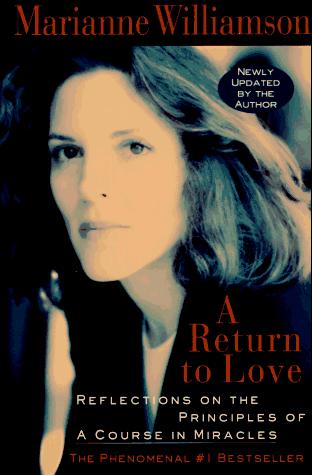
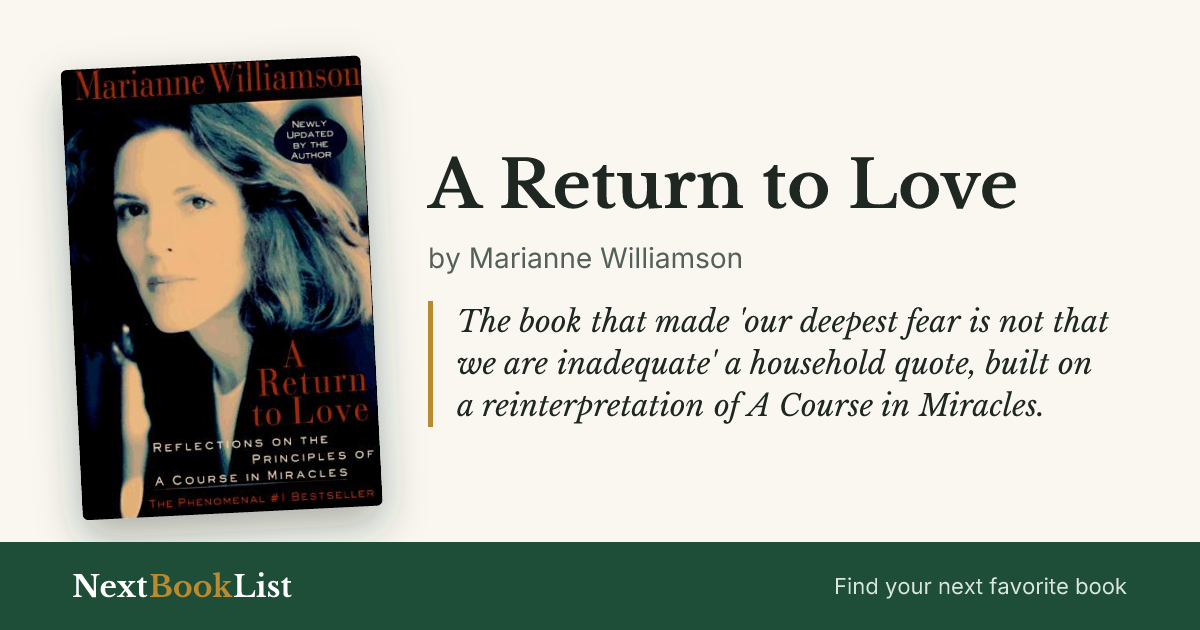
A Return to Love
by Marianne Williamson · 1992
The book that made 'our deepest fear is not that we are inadequate' a household quote, built on a reinterpretation of A Course in Miracles.
Worth reading? A Return to Love became a phenomenon largely on the strength of one passage -- 'our deepest fear is not that we are inadequate, our deepest fear is that we are powerful beyond measure' -- which Nelson Mandela is often (incorrectly) credited with, a myth that shows how widely it spread. Williamson's core argument, that love is our natural state and fear is the learned deviation, is a popularization of A Course in Miracles for a mainstream audience. Read it for the reframe on fear if the spiritual framing works for you; skip it if you want something grounded in research rather than metaphysics.
| Full Title | A Return to Love: Reflections on the Principles of A Course in Miracles |
|---|---|
| Author | Marianne Williamson |
| Published | 1992 |
| Category | Self-Improvement & Psychology |
| Favorite quote | “Our deepest fear is not that we are inadequate. Our deepest fear is that we are powerful beyond measure.” |
The Verdict
The Mandela misattribution alone tells you how far this book’s central passage traveled beyond its own cover – it became cultural shorthand independent of readers even knowing the source. Williamson’s fear-versus-love framing is more metaphysical than most books on this list, so approach it as a spiritual text first and a self-help book second.
you want a spiritually-framed take on fear, love, and self-worth, rooted in Course in Miracles philosophy
you want a secular or scientifically grounded approach, this is explicitly metaphysical and spiritual, adjacent to New Thought, not evidence-based psychology
Book Summary
Williamson's central claim, drawn from A Course in Miracles, is that love is our natural, default state, and fear is a learned distortion layered on top of it -- most psychological suffering, in this framing, comes from operating out of fear (of inadequacy, of rejection, of not being enough) rather than returning to a baseline of love, both for yourself and others.
She also popularized the idea that playing small doesn't serve anyone: shrinking yourself to avoid making others uncomfortable isn't humility, it's a form of fear, and choosing to fully show up and be your capable self actually gives other people permission to do the same, rather than threatening them.
Top 7 Lessons from A Return to Love
- Treat fear, not inadequacy, as the core obstacle to address -- Williamson argues most self-doubt is learned fear, not accurate self-assessment.
- Playing small to avoid making others uncomfortable is a form of fear, not genuine humility.
- Fully showing up as your capable self gives others permission to do the same, rather than threatening them.
- Forgiveness (of yourself and others) is treated as central to returning to a baseline state of love.
- Miracles, in the book's specific framing, are shifts in perception from fear to love, not supernatural events.
- Self-worth issues often stem from unexamined fear rather than accurate evidence about your actual capability.
- Relationships improve when approached from a place of love rather than fear-based control or self-protection.
Top 6 Quotes from A Return to Love
"Our deepest fear is not that we are inadequate. Our deepest fear is that we are powerful beyond measure."
Marianne Williamson, A Return to Love
"Love is what we were born with. Fear is what we learned here."
Marianne Williamson, A Return to Love
"As we let our own light shine, we unconsciously give other people permission to do the same."
Marianne Williamson, A Return to Love
"It is our light, not our darkness, that most frightens us."
Marianne Williamson, A Return to Love
"We ask ourselves, who am I to be brilliant, gorgeous, talented, fabulous? Actually, who are you not to be?"
Marianne Williamson, A Return to Love
"As we are liberated from our own fear, our presence automatically liberates others."
Marianne Williamson, A Return to Love
Frequently Asked Questions
Is A Return to Love worth reading?
Worth reading if you're drawn to spiritual, metaphysical self-help in the New Thought tradition. Its most famous passage on fear and inadequacy has resonated widely, but the book overall is explicitly religious in a Course in Miracles sense, not secular.
What is the main idea of A Return to Love?
Love is our natural state and fear is a learned deviation from it; most psychological suffering comes from operating out of fear rather than returning to love, both toward yourself and others.
Did Nelson Mandela write the famous 'deepest fear' quote?
No, despite widespread misattribution. The 'our deepest fear is not that we are inadequate' passage is from Williamson's A Return to Love, not from any Mandela speech.
Is A Return to Love based on A Course in Miracles?
Yes -- it's explicitly framed as Williamson's reflections on and popularization of A Course in Miracles, a spiritual text first published in 1976.
Ready to read it?
Get A Return to Love on Amazon