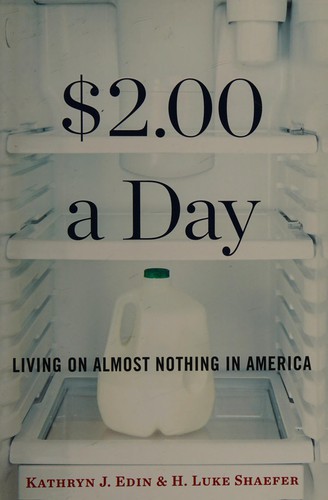
$2.00 a Day
by Kathryn Edin and H. Luke Shaefer · 2015
Two poverty researchers document the resurgence of true cash destitution in America -- households surviving on roughly $2 per person per day, the World Bank's global extreme-poverty line -- after 1990s welfare reform cut millions off cash assistance.
Worth reading? Edin and Shaefer's core finding, backed by both government survey data and years of embedded fieldwork with specific families, is that 1990s welfare reform (which replaced open-ended cash assistance with work-requirement programs) didn't eliminate deep poverty -- it created a specific new category of it. Families who can't find steady work, for reasons ranging from a criminal record to a lack of childcare to simple labor-market collapse in their area, are left with no cash income at all under the current safety net, which now runs mostly through in-kind benefits (SNAP, housing vouchers) that can't be used to pay a utility bill or a bus fare. The book's power comes from combining the macro data (a nationally representative estimate of $2-a-day households) with the specific, granular texture of individual families' survival strategies -- selling plasma, timing SNAP purchases to resell items for cash, informal work. It's a narrower, more specific argument than a general history of poverty in America, and it's more persuasive for being narrow: this is what happens at the exact bottom of the system, documented rather than estimated.
| Full Title | $2.00 a Day: Living on Almost Nothing in America |
|---|---|
| Author | Kathryn Edin and H. Luke Shaefer |
| Published | 2015 |
| Publisher | Houghton Mifflin Harcourt |
| Category | Sociology & Culture |
| Favorite quote | “The very existence of $2-a-day poverty in America seems to belie the fact that we are the richest nation on earth.” |
The Verdict
What separates this from a general poverty book is the specificity: Edin and Shaefer aren’t arguing poverty is bad in the abstract, they’re documenting a precise structural gap – a safety net that gives you food and shelter assistance but zero cash – and showing exactly how families route around it. That precision is what makes the argument about 1990s welfare reform land harder than a broader indictment would.
Read it if you want a documented, specific account of how the shift from cash welfare to work-requirement and in-kind programs created a population with no cash at all. Skip it if you’re looking for a comprehensive history of the entire American welfare state – this book stays deliberately narrow, and that’s its strength, not a limitation to work around.
you want a rigorously researched, ethnographic look at how welfare reform's shift from cash aid to work requirements left a specific population with no cash income at all, told through real families' documented daily lives
you want a broad policy history of the entire American welfare state -- this book is narrowly and deliberately focused on the extreme, near-invisible bottom tier of no-cash-income households, not a general survey of poverty programs
Book Summary
1990s welfare reform (the 1996 shift from AFDC to TANF) replaced open-ended cash assistance with time-limited, work-requirement programs, and in doing so removed the safety net's core function for a specific group: people who, for real and often compounding reasons (no available childcare, a criminal record, a local labor market with no jobs, a disability that doesn't quite meet disability-program thresholds), cannot meet those work requirements and end up with no cash income at all.
The remaining safety net runs mostly through in-kind benefits (SNAP/food stamps, housing assistance, Medicaid) rather than cash, and Edin and Shaefer argue this is a structural problem, not just a generosity problem -- in-kind benefits can feed a family but can't pay a electric bill, a phone bill, or bus fare to a job interview, so a household can be "provided for" on paper while having literally no cash to meet obligations that only cash can meet.
Families at the true bottom develop specific, documented survival strategies that function as an informal cash economy around the edges of the formal safety net -- selling blood plasma, reselling SNAP-purchased goods for cash at a loss, informal and off-the-books labor -- behaviors that are sometimes technically illegal but that Edin and Shaefer present as rational responses to a system that provides everything except the one thing (cash) their obligations actually require.
Top 8 Lessons from $2.00 a Day
- 1996 welfare reform replaced open-ended cash assistance (AFDC) with time-limited, work-requirement programs (TANF), and that structural shift -- not just program cuts -- created a new population with zero cash income.
- A household can be receiving substantial in-kind aid (SNAP, housing assistance, Medicaid) while having no cash at all, because in-kind benefits can't pay bills, bus fare, or other cash-only obligations.
- People who can't meet work requirements often face compounding, structural barriers -- lack of childcare, a criminal record, a local job market with no openings -- not simply a lack of individual effort.
- Families at the extreme bottom develop specific informal survival strategies (selling plasma, reselling SNAP purchases for cash, off-the-books work) as rational adaptations to a cash-less safety net, not as evidence of dysfunction.
- $2 per person per day is the World Bank's threshold for extreme poverty in the developing world, and Edin and Shaefer's research found a nationally significant number of American households falling below that same line in cash terms.
- Extreme cash poverty in America is geographically and demographically wider than commonly assumed -- it appears in rural areas, small cities, and among rustbelt families, not only in stereotyped urban settings.
- The absence of cash specifically (as opposed to material deprivation generally) is what creates some of the sharpest daily crises for these families -- an unpaid utility bill or a missed bus fare to a job interview can cascade into losing the job opportunity that would have solved the underlying problem.
- Embedded, long-term ethnographic fieldwork with specific families, combined with nationally representative survey data, lets the authors show both how widespread the problem is and what it actually looks like day to day.
Top 1 Quotes from $2.00 a Day
"The very existence of $2-a-day poverty in America seems to belie the fact that we are the richest nation on earth."
Kathryn Edin and H. Luke Shaefer, $2.00 a Day
Frequently Asked Questions
Is $2.00 a Day worth reading?
Yes -- it's a rigorously documented, narrowly focused study of the exact bottom tier of American poverty, combining national survey data with embedded fieldwork on specific families, and it makes a specific, persuasive case rather than a general appeal.
What is $2.00 a Day about?
Kathryn Edin and H. Luke Shaefer document the resurgence of true cash destitution in America -- households living on roughly $2 per person per day -- after 1990s welfare reform shifted the safety net from cash assistance to work-requirement and in-kind programs.
Why does $2.00 a Day focus specifically on cash rather than material poverty generally?
Because the authors' central finding is that the current safety net can provide substantial in-kind support (food, housing assistance) while leaving a household with literally no cash, and cash specifically is required for obligations like bills and bus fare that in-kind aid can't cover.
What changed in welfare policy that $2.00 a Day is responding to?
The 1996 shift from AFDC (open-ended cash assistance) to TANF (time-limited, work-requirement programs), which the authors argue created a new population of households with no cash income when they can't meet work requirements.
Is $2.00 a Day only about urban poverty?
No -- one of the book's findings is that extreme cash poverty appears in rural areas and small rustbelt cities as well as stereotyped urban settings, which the authors present as evidence the problem is wider and more structural than commonly assumed.
Ready to read it?
Get $2.00 a Day on Amazon