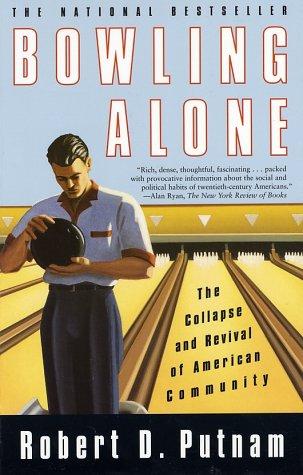
Bowling Alone
by Robert D. Putnam · 2000
Robert Putnam's data-heavy case that Americans stopped joining clubs, unions, and bowling leagues -- and that the resulting collapse in social capital costs democracy more than it looks like.
Worth reading? Bowling Alone is dense with charts and survey data in a way that can feel more like a political science monograph than a trade book, but the underlying argument earned its massive influence: civic participation across nearly every category (unions, churches, PTAs, bowling leagues) declined sharply across the late 20th century, and that decline in 'social capital' -- the trust and reciprocity that come from people actually knowing and relying on each other -- has real, measurable costs for democratic functioning, not just a vague sense of loneliness. It predates smartphones entirely, which makes its diagnosis of a pre-existing trend more impressive, and its implied warning about where an even more atomized future leads more unsettling in hindsight.
| Full Title | Bowling Alone: The Collapse and Revival of American Community |
|---|---|
| Author | Robert D. Putnam |
| Published | 2000 |
| Category | Sociology & Culture |
| Favorite quote | “For the first two-thirds of the twentieth century a powerful tide bore Americans into ever deeper engagement in the life of their communities, but a few decades ago -- silently, without warning -- that tide reversed and we were overtaken by a treacherous rip current.” |
The Verdict
Putnam later wrote a shorter, more prescriptive follow-up focused on solutions, since Bowling Alone itself is heavier on diagnosis than remedy. Worth knowing going in if you want the fix as much as the data – this book is the argument for why the problem matters, not primarily a playbook for solving it.
you want the definitive, data-driven account of why American civic and social engagement declined through the late 20th century, and why that decline matters more than it sounds like it should
you want something current on smartphones and social media -- this was published in 2000, before either existed at scale, so it's the foundational diagnosis of the trend, not an account of its most recent (and arguably worse) chapter
Book Summary
Putnam's core concept is "social capital" -- the networks, norms of reciprocity, and trust that develop when people actually participate together in shared institutions (bowling leagues, PTAs, unions, churches, civic clubs). He uses decades of survey and membership data to show that across nearly every measurable category of American civic life, participation declined steadily from the 1960s/70s through the 1990s, even as individual activities like bowling itself remained popular -- hence the title: Americans still bowled, they just stopped doing it in leagues, together, with the social interaction that implies.
He walks through several candidate explanations (generational turnover, television, suburban sprawl and commuting, women entering the workforce) and weighs their relative contribution, landing on generational replacement and television as the largest factors. His larger argument is that this isn't just a nostalgia complaint: lower social capital correlates with worse outcomes across public health, child welfare, crime, economic mobility, and democratic participation, making civic disengagement a structural problem, not a lifestyle preference.
Top 8 Lessons from Bowling Alone
- 'Social capital' -- trust and reciprocity built through shared participation in groups -- declined sharply across nearly every American civic category from the 1960s/70s through the 1990s.
- Individual activities (like bowling itself) often stayed popular even as the associational, shared version of the same activity (bowling leagues) collapsed -- the decline is specifically in shared, group-based participation.
- Putnam attributes the largest share of the decline to generational replacement (older, more civically engaged generations dying off) and the rise of television as a private, individual leisure activity.
- Lower social capital correlates with worse outcomes in public health, child welfare, crime rates, and economic mobility, not just subjective loneliness.
- Civic decline predates the internet and smartphones entirely -- the trend Putnam documents was already decades underway before either existed at scale.
- Suburban sprawl and longer commutes reduced the time and opportunity available for casual civic and neighborly interaction.
- Putnam distinguishes 'bonding' social capital (ties within a similar group) from 'bridging' social capital (ties across different groups), arguing American society specifically lost the bridging kind.
- The book ends with concrete, if modest, proposals for rebuilding civic infrastructure rather than just diagnosing the decline.
Top 2 Quotes from Bowling Alone
"Social capital refers to connections among individuals -- social networks and the norms of reciprocity and trustworthiness that arise from them."
Robert D. Putnam, Bowling Alone
"For the first two-thirds of the twentieth century a powerful tide bore Americans into ever deeper engagement in the life of their communities, but a few decades ago -- silently, without warning -- that tide reversed and we were overtaken by a treacherous rip current."
Robert D. Putnam, Bowling Alone
Frequently Asked Questions
What does 'bowling alone' actually mean?
It's Putnam's metaphor for the book's central finding: individual bowling stayed popular while organized bowling leagues collapsed, symbolizing a broader shift from shared, group-based civic activity to more isolated, individual versions of the same activities.
Is Bowling Alone still relevant given social media didn't exist in 2000?
Very much so -- it's frequently cited in later discussions of smartphone-era isolation precisely because it documents the trend was already well underway before either existed, which strengthens rather than weakens its relevance to that later conversation.
What is 'social capital' in Bowling Alone?
The trust, reciprocity, and mutual obligation that build up when people participate together in shared institutions and groups -- Putnam treats it as a genuine resource with measurable civic and economic value, not just a metaphor.
Ready to read it?
Get Bowling Alone on Amazon