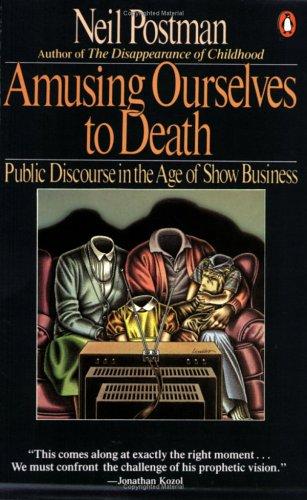
Amusing Ourselves to Death
by Neil Postman · 1985
Neil Postman argued in 1985 that TV was turning politics, news, and religion into entertainment -- and that we should have worried less about Orwell's boot and more about Huxley's screen.
Worth reading? Postman's central move is one of the best framing devices in media criticism: he contrasts Orwell's fear (a government that bans information) with Huxley's fear (a public drowning in so much trivial entertainment it stops wanting information at all), and argues Huxley was closer to right. Writing this about broadcast television in 1985 without any concept of smartphones or algorithmic feeds, and having the argument land harder in the internet era than it did on publication, is a genuinely rare feat for a media theory book. It's dense and academic in places, but the core thesis is one of the most quoted and reused frameworks in media criticism for a reason.
| Full Title | Amusing Ourselves to Death: Public Discourse in the Age of Show Business |
|---|---|
| Author | Neil Postman |
| Published | 1985 |
| Category | Sociology & Culture |
| Favorite quote | “Americans no longer talk to each other, they entertain each other. They do not exchange ideas; they exchange images. They do not argue with propositions; they argue with good looks, celebrities and commercials.” |
The Verdict
Postman died in 2003, well before smartphones and social media existed, so every “this predicted TikTok” comparison you’ll see attached to this book is a later reader’s extrapolation, not something Postman claimed himself. That the extrapolation holds up as well as it does is the real reason this book has stayed in print for almost 40 years instead of aging into a dated TV-era artifact.
you want the sharpest, earliest argument for why entertainment-first media degrades serious public discourse -- written about television in 1985, and repeatedly cited as having predicted the internet and social media era almost exactly
you want specific, contemporary media criticism -- Postman's examples are entirely TV-era (game shows, network news broadcasts), so you'll need to do the translation to smartphones and social media yourself, even though the underlying argument transfers cleanly
Book Summary
Postman's argument is that every medium has a built-in bias toward certain kinds of content and thought, and television's bias is entertainment -- it structurally favors the visual, the fast, the emotionally engaging over the complex, the slow, and the rational. His concern isn't that television broadcasts bad content occasionally; it's that television converts everything it touches (news, politics, religion, education) into entertainment by its very form, regardless of the seriousness of the underlying subject.
The book's most famous move is its foreword contrast between two dystopias: Orwell's 1984, where a totalitarian state controls the public by restricting and banning information, and Huxley's Brave New World, where the public is controlled by being drowned in so much frivolous, pleasurable distraction that it loses the capacity or desire to seek out serious information at all. Postman argues American culture in the television age was living out Huxley's scenario, not Orwell's -- a framing that's been repeatedly revived in the smartphone and social-media era as feeling even more prescient than when it was written.
Top 9 Lessons from Amusing Ourselves to Death
- Every medium has a built-in bias toward certain kinds of content -- television's bias favors the visual, fast, and emotionally engaging over the complex and rational.
- Television doesn't just broadcast entertainment occasionally; it structurally converts everything it touches (news, politics, religion) into entertainment by its very form.
- Postman's central framing contrasts Orwell's fear of information control with Huxley's fear of a public drowned in trivial distraction -- and argues Huxley was the more accurate prophet for television-age America.
- Political discourse suffers specifically because television rewards image, likability, and brevity over substance and argument, changing what kind of candidate can succeed.
- TV news structurally cannot handle complexity or context well, because its format demands constant visual engagement and rapid pacing over sustained explanation.
- Postman contrasts television unfavorably with print culture, arguing sustained reading trains a different, more rigorous mode of thought than television watching does.
- The danger Postman describes isn't censorship or misinformation exactly -- it's a public that becomes unable or unwilling to engage with anything that isn't entertaining.
- Religion, when adapted to television format (televangelism), gets reshaped by the medium's entertainment bias just as much as news or politics does.
- Postman's argument has repeatedly been extended by later writers to smartphones, social media, and algorithmic feeds, which he didn't live to see but whose logic he essentially predicted.
Top 5 Quotes from Amusing Ourselves to Death
"What Orwell feared were those who would ban books. What Huxley feared was that there would be no reason to ban a book, for there would be no one who wanted to read one."
Neil Postman, Amusing Ourselves to Death
"Americans no longer talk to each other, they entertain each other. They do not exchange ideas; they exchange images. They do not argue with propositions; they argue with good looks, celebrities and commercials."
Neil Postman, Amusing Ourselves to Death
"The problem is not that television presents us with entertaining subject matter but that all subject matter is presented as entertaining."
Neil Postman, Amusing Ourselves to Death
"Orwell feared those who would deprive us of information. Huxley feared those who would give us so much that we would be reduced to passivity and egoism."
Neil Postman, Amusing Ourselves to Death
"In short, Orwell feared that what we hate will ruin us. Huxley feared that what we love will ruin us."
Neil Postman, Amusing Ourselves to Death
Frequently Asked Questions
What is the main argument of Amusing Ourselves to Death?
That television's entertainment-first format structurally degrades serious public discourse -- converting news, politics, and religion into entertainment regardless of the seriousness of the subject -- and that this matters more than direct censorship or misinformation.
Is Amusing Ourselves to Death about the internet?
No, it was written in 1985 about broadcast television, before the internet existed at consumer scale. It's repeatedly cited as having predicted the social-media and smartphone era almost exactly, which is why it's still widely read decades later.
What's the Orwell vs. Huxley argument in this book?
Postman contrasts Orwell's 1984 (a state that controls the public by banning information) with Huxley's Brave New World (a public that loses interest in serious information because it's drowning in trivial pleasure), and argues Huxley's vision better describes television-age America.
Is Amusing Ourselves to Death still relevant today?
Arguably more relevant now than at publication -- its core argument about entertainment-format media degrading discourse applies even more directly to algorithmic social media feeds than it did to 1980s broadcast television.
Ready to read it?
Get Amusing Ourselves to Death on Amazon