A Fever in the Heartland
by Timothy Egan · 2023
In the 1920s, the Klan wasn't a fringe group hiding in the woods -- it controlled Indiana's governorship, legislature, and most of its civic life, until one woman's testimony brought its most powerful leader down.
Worth reading? Egan's real subject isn't the Klan's cross-burnings, it's how ordinary and respectable the Klan made itself look in 1920s Indiana -- bankers, teachers, ministers, a Klan-endorsed governor -- before D.C. Stephenson, its most powerful leader, was undone by the one crime he assumed his power would let him get away with.
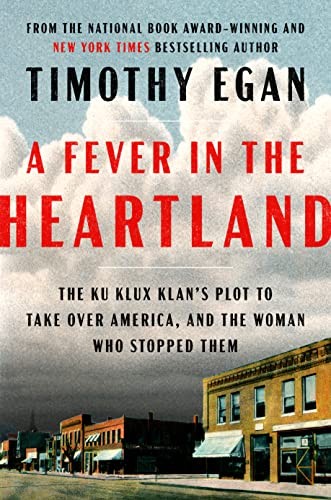
| Full Title | A Fever in the Heartland: The Ku Klux Klan's Plot to Take Over America, and the Woman Who Stopped Them |
|---|---|
| Author | Timothy Egan |
| Published | 2023 |
| Publisher | Viking |
| Category | History |
| Favorite quote | “When hate was on the ballot, especially in the guise of virtue, a majority of voters knew exactly what to do.” |
The Verdict
Egan’s real skill here is showing you how normal the Klan looked from the inside of 1920s Indiana – that’s the part that should unsettle you more than the violence. This wasn’t a movement operating in shadows; it was winning elections, running civic life, and recruiting from the respectable middle of the state.
The book earns its tension from Stephenson’s own certainty that his position made him untouchable, right up until the one act he assumed wouldn’t matter became the one that ended him. Egan doesn’t need to editorialize about the parallel to more recent political movements built on manufactured outrage and confident lying – the material does that work on its own.
Read it if you want to understand how a hate movement goes fully mainstream instead of staying fringe. Skip it if you need a story with a clean redemption arc for its victim – this one doesn’t offer that, and pretending otherwise would cheapen what actually happened to her.
you want to understand how a hate movement can go fully mainstream in American civic life, not stay confined to the fringe
you want a redemption arc -- the woman at the center of this story, Madge Oberholtzer, doesn't survive to see the justice her testimony helped deliver

Book Summary
The second Ku Klux Klan of the 1920s wasn't a marginal Southern phenomenon -- its strongest state chapter was in Indiana, where it recruited bankers, lawyers, teachers, and ministers, elected a Klan-backed governor, and functioned as mainstream civic infrastructure rather than a hidden fringe movement. Egan's book is as much about how a hate movement normalizes itself through respectability as it is about any single crime.
D.C. Stephenson, the Klan's Grand Dragon in Indiana, built personal political power on top of that mainstream base, effectively running the state through Klan-aligned officials, and believed his position made him untouchable, including in his assault of Madge Oberholtzer, a state education employee.
Oberholtzer's dying deposition, given after Stephenson assaulted her and she attempted suicide rather than live with what had happened, became the evidence that convicted him and triggered the exposure of Klan corruption throughout Indiana's government -- proof that a single, well-documented act of testimony can unravel a movement built on the assumption that its victims would never be believed.
Top 9 Lessons from A Fever in the Heartland
- A hate movement can achieve full civic respectability -- bankers, teachers, ministers, elected officials -- rather than staying confined to a visible fringe.
- A political machine built on intimidation can still function through entirely legal-looking channels: elections, endorsements, civic clubs.
- 'The key to telling a big lie was to do it with conviction' -- propaganda spread faster through confident repetition than through evidence.
- Powerful men who believe themselves untouchable often commit the crime that undoes them precisely because they've stopped believing consequences apply to them.
- One person's documented testimony, given under extreme personal cost, can be the single piece of evidence that collapses a much larger corrupt structure.
- Recruiting women into a movement's propaganda and organizing work (not just men into its violence) was central to how the Klan sustained itself.
- Institutions meant to provide oversight (courts, newspapers, state government) can be captured by the same movement they're supposed to check.
- Mass movements can recruit through ordinary social institutions -- churches, schools, clubs -- rather than through overtly extremist appeals.
- A movement's public image (patriotism, temperance, moral order) can be the opposite of what it actually practices privately.
Top 5 Quotes from A Fever in the Heartland
"When hate was on the ballot, especially in the guise of virtue, a majority of voters knew exactly what to do."
Timothy Egan, A Fever in the Heartland
"The key to telling a big lie was to do it with conviction."
Timothy Egan, A Fever in the Heartland
"They didn't hide by day and only come out at night. They were people who held their communities together, bankers and merchants, lawyers and doctors, coaches and teachers, servants of God and shapers of opinion."
Timothy Egan, A Fever in the Heartland
"The Klan prided itself on how quickly it could spread a lie: from a kitchen table to the whole state in six hours or less."
Timothy Egan, A Fever in the Heartland
"Stephenson had succeeded with an unusual formula for a mass movement: men were the muscle, women spread the poison, and ministers sanctified it all."
Timothy Egan, A Fever in the Heartland
Frequently Asked Questions
Is A Fever in the Heartland worth reading?
Yes -- it's a sharply reported account of how mainstream the Klan became in 1920s Indiana, and how one woman's testimony, given at enormous personal cost, brought down its most powerful leader.
What is A Fever in the Heartland about?
The Ku Klux Klan's political takeover of Indiana in the 1920s under Grand Dragon D.C. Stephenson, and the assault and dying deposition of Madge Oberholtzer that exposed and ended his power.
Is A Fever in the Heartland a true story?
Yes -- it's narrative nonfiction built from trial records, newspaper archives, and historical research, not a fictionalized account.
Does the book have a happy ending?
Justice arrives for Stephenson, but not for Madge Oberholtzer -- she doesn't survive the assault. Go in expecting a story about accountability, not redemption for its central victim.
How does this compare to other books about the Klan?
It's narrower and more specific than a general Klan history -- one state, one leader, one case -- which is what makes it land harder than a broader survey would.
Ready to read it?
Get A Fever in the Heartland on Amazon