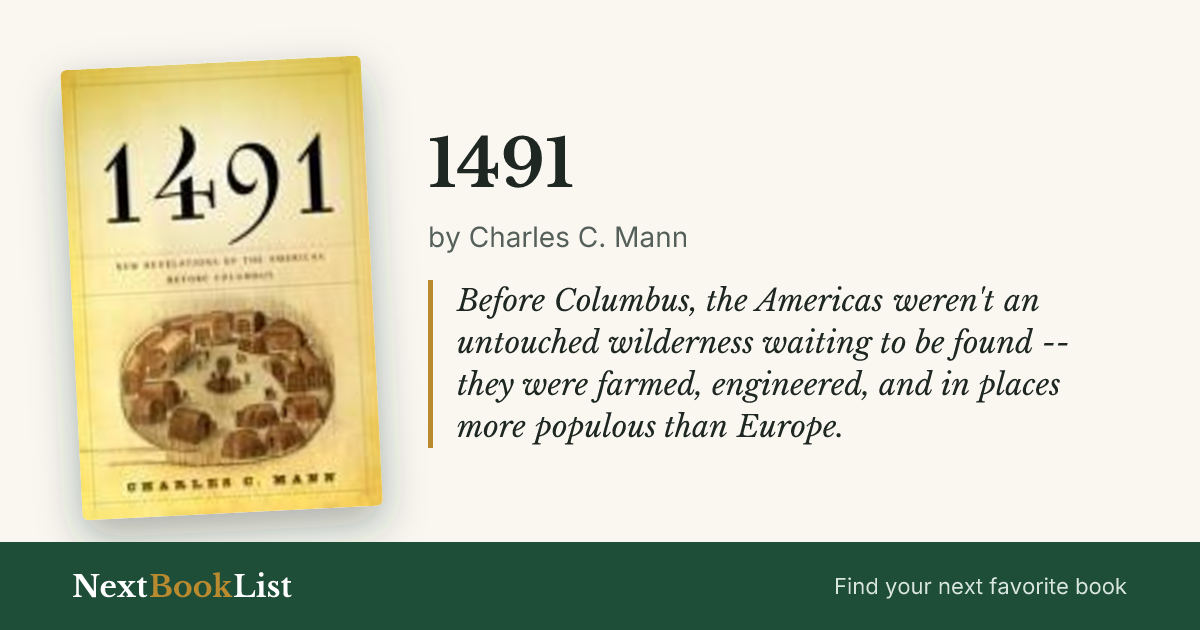
1491
by Charles C. Mann · 2005
Before Columbus, the Americas weren't an untouched wilderness waiting to be found -- they were farmed, engineered, and in places more populous than Europe.
Worth reading? 1491 does something rare for popular history: it changes what you assume a photograph of pre-Columbian America should look like. Mann's case that the Amazon basin was partly cultivated, that Cahokia rivaled contemporary European cities, and that Native American land management (particularly fire) shaped landscapes settlers later mistook for pristine wilderness is well-sourced and genuinely important. Some of the specific numbers (pre-contact population estimates especially) remain contested among archaeologists, and Mann is honest about that uncertainty rather than picking the most dramatic figure and running with it.
| Full Title | 1491: New Revelations of the Americas Before Columbus |
|---|---|
| Author | Charles C. Mann |
| Published | 2005 |
| Category | History |
The Verdict
Mann is a science journalist, not an archaeologist, and the book is best read as a guided tour through specialists’ work rather than original research – which is exactly its strength for a general reader. It won a National Book Critics Circle Award finalist nod and has genuinely shifted how the pre-Columbian Americas get taught since 2005.
you were taught the pre-Columbian Americas as sparse wilderness dotted with small tribes, and want the archaeological evidence that the real picture was far larger, more urban, and more engineered
you want a single tidy narrative -- Mann is synthesizing a lot of genuinely contested archaeology across wildly different regions and cultures, so the picture he builds is a survey of live debates, not a settled consensus
Book Summary
Mann's central claim is that the "untouched wilderness" version of the pre-Columbian Americas taught for generations is a myth built on a technicality: European explorers and settlers who arrived generations after first contact were looking at landscapes already emptied by disease epidemics that outran the explorers themselves, then mistook the resulting depopulation for how the Americas had always been. The actual pre-contact population was very likely far larger and more urbanized than that later snapshot suggested.
From there he surveys specific evidence across the hemisphere: Cahokia (near modern St. Louis) as a city larger than London at the time; terra preta, the engineered "dark earth" that suggests large-scale, sustained agriculture in the Amazon rather than untouched rainforest; sophisticated causeway and water-management systems in the Andes and Mesoamerica; and controlled-burn land management across North America that shaped forests settlers later assumed were naturally occurring.
Top 8 Lessons from 1491
- The 'pristine wilderness' Europeans thought they found in the Americas was often landscape recently depopulated by epidemic disease that had outrun the explorers describing it.
- Cahokia, a city near modern St. Louis, was likely larger than contemporary London -- a scale of pre-Columbian urbanism rarely taught in standard history.
- Terra preta, engineered fertile soil found across the Amazon basin, suggests parts of the 'untouched' rainforest were long-term, large-scale agricultural land.
- Native land management, especially controlled burning, actively shaped North American forests and prairies rather than leaving them in an unmanaged natural state.
- Pre-contact population estimates for the Americas vary enormously among archaeologists, and Mann treats that uncertainty honestly rather than picking the most dramatic number.
- Andean and Mesoamerican societies built sophisticated water-management, road, and agricultural-terracing systems well before European contact.
- Old-growth 'natural' landscapes early conservationists tried to preserve were often actually the result of centuries of deliberate indigenous management, not an absence of human presence.
- The scale of the post-contact demographic collapse (largely from disease, not warfare) may be the single most consequential and underappreciated event in world history.
Frequently Asked Questions
Is 1491 scientifically accurate?
It's a careful synthesis of genuinely contested archaeology -- Mann is transparent about which claims are well-supported and which are live academic debates, particularly pre-contact population estimates.
What is the main argument of 1491?
That the pre-Columbian Americas were far more populous, urbanized, and environmentally managed than the 'untouched wilderness' narrative long taught in schools, and that much of what looked like pristine nature to European settlers was actually the result of a recent population collapse from disease.
How does 1491 compare to Guns, Germs, and Steel?
Diamond explains why Eurasian societies had a geographic head start; Mann pushes back on the assumption that pre-Columbian American societies were therefore primitive or sparse -- they were often large and sophisticated, just less equipped for the specific disease and technology gap Diamond describes.
Ready to read it?
Get 1491 on Amazon