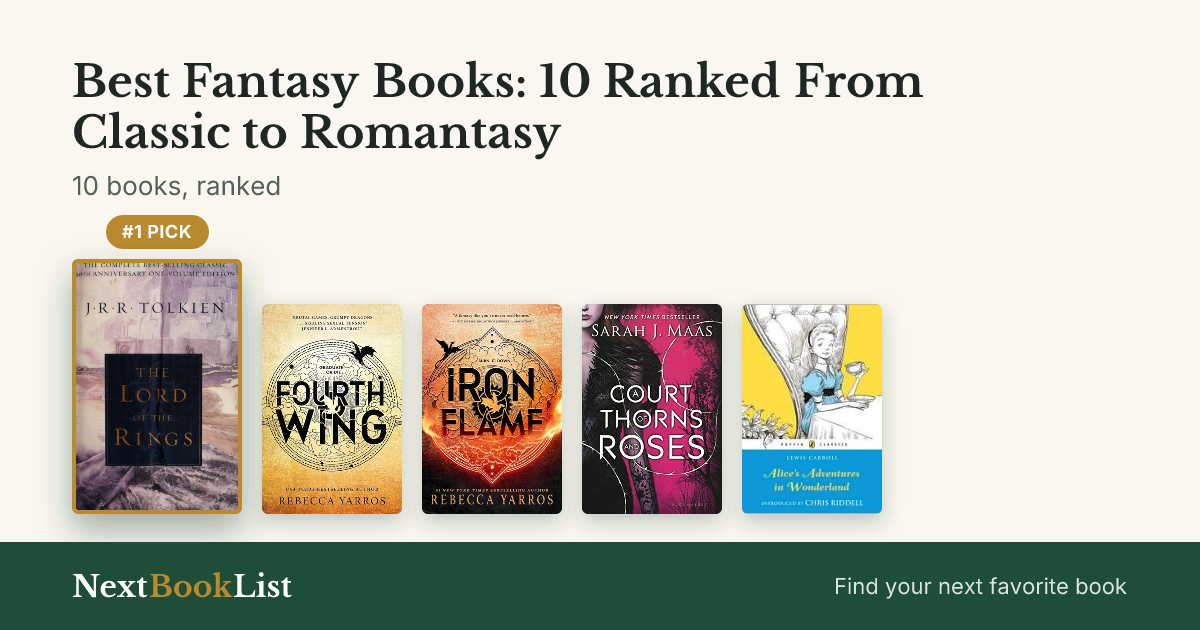
Best Fantasy Books: 10 Ranked From Classic to Romantasy

Updated July 16, 2026 · 10 books

Best Fantasy Books: 10 Ranked From Classic to Romantasy: ranked list of 10 books

The best fantasy book to start with is The Lord of the Rings, because it’s the one everything else on this list is downstream of. Tolkien invented enough history, language, and geography that Middle-earth feels older than the plot walking through it. It’s dense and slow in stretches, especially early on, but it built the vocabulary the entire genre still uses.

From there, this list splits into three genuinely different reading experiences wearing the same “fantasy” label. If you want the modern romantasy wave, start Fourth Wing, then Iron Flame once you’ve finished it (it’s a direct sequel, don’t skip ahead). It’s a dragon-rider war college with a slow-burn romance running through roughly half the page count. A Court of Thorns and Roses is the other big romantasy entry, a Beauty-and-the-Beast retelling with faerie court politics and a slow start that turns considerably darker by the end.

If you want whimsical classics instead of epic stakes, Alice’s Adventures in Wonderland, Peter Pan, and The Wind in the Willows are the Victorian and Edwardian originals — dream-logic, melancholy under the charm, and unhurried riverbank pacing, in that order of strangeness. The Jungle Book and The Secret Garden belong in this same lane: talking animals raising a boy in the Indian jungle, and a locked garden that heals two neglected, sickly children, both gentler and less ironic than Wonderland or Neverland. Gulliver’s Travels closes the list as the outlier: less “fantasy” than satire wearing a fantasy costume, using six-inch people and talking horses to roast 18th-century human vanity.

One warning: don’t hand a Tolkien reader Fourth Wing expecting the same kind of book, or hand a romantasy reader The Lord of the Rings expecting a fast romance arc. They share a shelf tag and almost nothing else.

Quick Comparison

#BookBest for
1The Lord of the RingsJ.R.R. Tolkienyou want the foundational modern fantasy epic, built with enough invented history, language, and geography that the world feels older than the plotAmazon
2Fourth WingRebecca Yarrosyou want the book that basically defined modern 'romantasy' -- high-stakes dragon-riding military fantasy with a slow-burn enemies-to-lovers romance running through itAmazon
3Iron FlameRebecca Yarrosyou already read and liked Fourth Wing and want the direct continuation, with higher stakes, a bigger cast, and the political conspiracy plot expandingAmazon
4A Court of Thorns and RosesSarah J. Maasyou want a fast, spicy Beauty-and-the-Beast retelling with faerie court politics and don't mind a slow start that turns into a much darker book by the endAmazon
5Alice's Adventures in WonderlandLewis Carrollyou want the original nonsense-literature classic, the book that invented a whole genre of stories that run on dream-logic instead of plotAmazon
6Peter PanJ.M. Barrieyou want the source of Neverland, Tinker Bell, and Captain Hook, told in Barrie's own narrative voice -- wry, melancholy, and far more interested in loss and mortality than the movie lets onAmazon
7The Wind in the WillowsKenneth Grahameyou want unhurried, pastoral English children's fiction with real prose craft -- riverbank afternoons, an obsessive car-mad toad, and genuine warmth between friendsAmazon
8Gulliver's TravelsJonathan Swiftyou want the original satirical travelogue -- the template for using absurd fictional societies to roast real politics, science, and human vanityAmazon
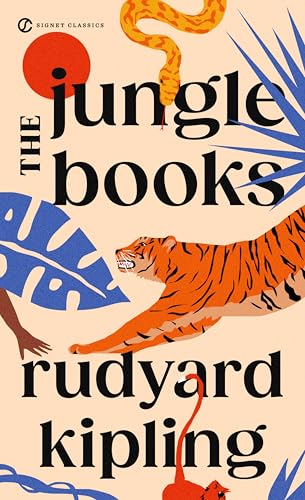
9The Jungle BookRudyard Kiplingyou want the source material behind Mowgli, the Law of the Jungle, and 'the strength of the pack is the wolf, the strength of the wolf is the pack' -- and you're fine with a collection of linked short stories instead of one continuous plotAmazon
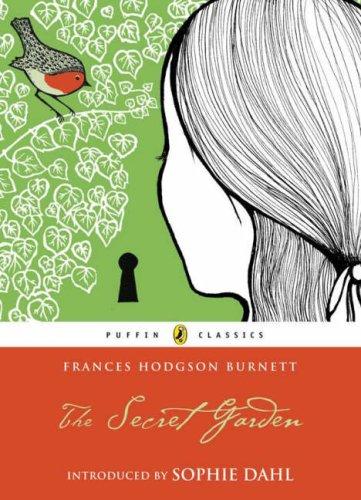
10The Secret GardenFrances Hodgson Burnettyou want a warm, well-built children's classic about healing through nature and purpose, without modern sentimentality laid on topAmazon

The Books

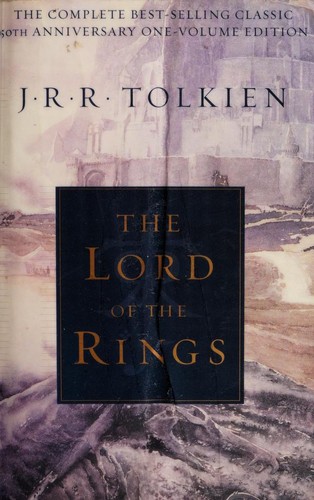
The Lord of the Rings by J.R.R. Tolkien book cover

1. The Lord of the Rings

J.R.R. Tolkien · 1954

A hobbit with no interest in adventure has to walk a cursed ring into the one volcano that can destroy it -- and the whole genre of modern fantasy is downstream of how Tolkien built the world around him.

What holds up best decades later isn’t the battles, it’s the ache underneath the ending – the sense that saving the world and getting to keep living in it peacefully are two different, not always compatible, things.

Read it if: you want the foundational modern fantasy epic, built with enough invented history, language, and geography that the world feels older than the plot

Skip it if: you want a fast read -- this is dense, slow in stretches (especially early in Fellowship), and rewards patience with world-building more than plot momentum
Full verdict: The Lord of the Rings →

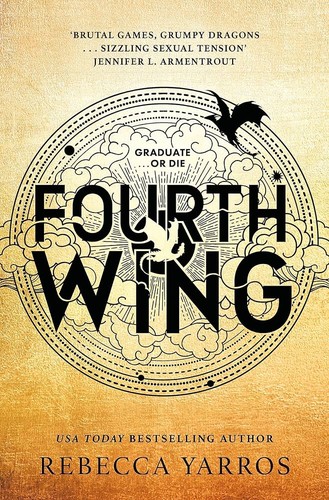
Fourth Wing by Rebecca Yarros book cover

2. Fourth Wing

Rebecca Yarros · 2023

A physically frail girl forced into a brutal dragon-rider war college -- where most cadets don't survive the first year -- has to out-think and out-bond everyone stronger than her just to make it to graduation.

The dragon-bonding mechanic (dragons choose their riders, and choosing wrong gets you killed) is doing more worldbuilding work than it first appears, since it’s the mechanism that keeps forcing Violet into rooms with people who’d rather she failed. It’s a smart structural choice even if the prose itself isn’t the draw – plot momentum is.

Read it if: you want the book that basically defined modern 'romantasy' -- high-stakes dragon-riding military fantasy with a slow-burn enemies-to-lovers romance running through it

Skip it if: you want fantasy without the romance -- this book is genuinely half romance novel, with explicit content alongside the war-college plot, and readers expecting a straight dragon-fantasy epic will be surprised by how much page time goes to Violet and Xaden

Full verdict: Fourth Wing →

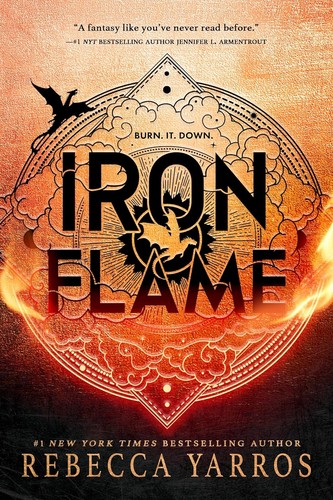
Iron Flame by Rebecca Yarros book cover

3. Iron Flame

Rebecca Yarros · 2023

Violet returns to Basgiath War College for a brutal second year, as the war escalates and the cracks in what she's been told about the kingdom's leadership start splitting wide open.

The shift from “survive training” to “survive a conspiracy” is the right instinct for a sequel, but it does mean Iron Flame trades some of Fourth Wing’s claustrophobic tension for a broader, slower-building plot. If you loved the first book specifically for its pacing, temper expectations slightly here – the payoff is still there, it just takes longer to arrive.

Read it if: you already read and liked Fourth Wing and want the direct continuation, with higher stakes, a bigger cast, and the political conspiracy plot expanding

Skip it if: you haven't read Fourth Wing -- this is a direct sequel that assumes full knowledge of book one's relationships, deaths, and reveals; starting here will make no sense, read Fourth Wing first

Full verdict: Iron Flame →

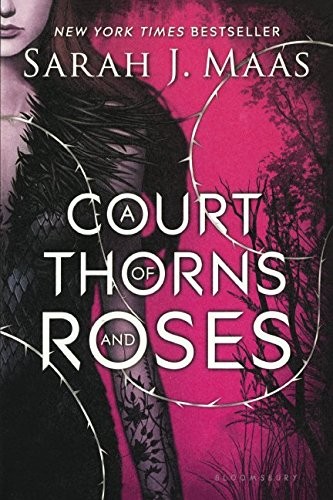
A Court of Thorns and Roses by Sarah J. Maas book cover

4. A Court of Thorns and Roses

Sarah J. Maas · 2015

A human huntress kills a faerie wolf, gets dragged into the faerie realm to pay for it, and ends up falling for the terrifying High Lord holding her captive.

This is a slower burn than its reputation suggests – the first half is closer to a gothic manor romance before the plot snaps into a genuinely brutal trial arc in the last third. Judge the series by where it ends up, not just this opening chapter; a lot of readers who bounce off book one end up loving book two.

Read it if: you want a fast, spicy Beauty-and-the-Beast retelling with faerie court politics and don't mind a slow start that turns into a much darker book by the end

Skip it if: you're not into romantasy tropes (fated-mates energy, brooding love interests, a heavy back-half romance pivot) or you want tight, economical prose -- Maas writes long and indulgent

Full verdict: A Court of Thorns and Roses →

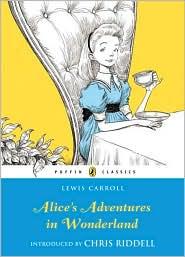
Alice's Adventures in Wonderland by Lewis Carroll book cover

5. Alice's Adventures in Wonderland

Lewis Carroll · 1865

A bored girl follows a rabbit down a hole and Victorian logic never fully recovers.

Carroll was a mathematician, and it shows – half the jokes are logic puzzles wearing a rabbit costume. The Mad Hatter’s tea party and the Queen’s court aren’t just whimsical, they’re pointed jabs at rules that exist for no reason except that someone in charge said so, and a kid is the one calling it out.

Skip it if you’re looking for a story with a clear arc and a lesson at the end – Carroll refuses to give you one, on purpose. But as a short, weird, genuinely funny book that invented an entire genre, it holds up better than most 19th-century children’s literature still does.

Read it if: you want the original nonsense-literature classic, the book that invented a whole genre of stories that run on dream-logic instead of plot

Skip it if: you need a story to resolve into a clean moral -- Carroll deliberately refuses that, and the episodic structure (one weird encounter after another) can feel aimless if you're reading for plot momentum

Full verdict: Alice's Adventures in Wonderland →

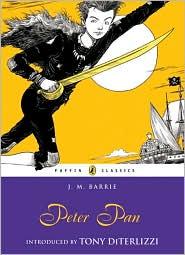
Peter Pan by J.M. Barrie book cover

6. Peter Pan

J.M. Barrie · 1911

The boy who refuses to grow up flies a Victorian family off to a magical island of pirates, mermaids, and lost boys -- and the actual novel is darker and stranger than the Disney version.

The line that sticks with most adult readers isn’t from the movie at all – it’s Barrie’s narrator quietly noting, almost in passing, how easily Peter forgets the people who love him. That’s the real engine of the book: freedom from growing up costs you your memory of everyone who mattered.

Read it if: you want the source of Neverland, Tinker Bell, and Captain Hook, told in Barrie's own narrative voice -- wry, melancholy, and far more interested in loss and mortality than the movie lets on

Skip it if: you want a straightforwardly cheerful children's book -- Barrie undercuts the whimsy constantly with reminders that Peter's forgetfulness and refusal to grow up are genuinely sad, not just charming

Full verdict: Peter Pan →

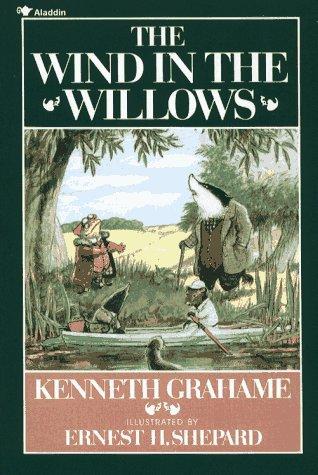
The Wind in the Willows by Kenneth Grahame book cover

7. The Wind in the Willows

Kenneth Grahame · 1908

A mole, a rat, a badger, and a reckless toad prove a story can be gentle and still hold together for a century.

The Toad chapters get all the attention – the stolen car, the prison break, the disguise as a washerwoman – but the reason this book has lasted since 1908 is Rat and Mole on the river, doing nothing in particular and being completely content about it. Grahame’s nature writing is genuinely good, not just pleasant filler between plot points.

Skip it if you’re reading to kids who need momentum every page – some of the riverbank chapters are pure mood. But as a quiet antidote to plot-stuffed modern fiction, it’s held up better than almost anything else from its era.

Read it if: you want unhurried, pastoral English children's fiction with real prose craft -- riverbank afternoons, an obsessive car-mad toad, and genuine warmth between friends

Skip it if: you want pace -- large stretches of this are mood and description rather than plot, and the Toad chapters (car chases, prison escape) sit oddly next to the slower riverbank chapters

Full verdict: The Wind in the Willows →

Gulliver's Travels by Jonathan Swift book cover

8. Gulliver's Travels

Jonathan Swift · 1726

A ship's surgeon washes ashore among six-inch-tall people, then giants, then floating philosophers, then talking horses -- and each stop is Swift mocking a different flavor of human stupidity, especially the English kind.

The fourth voyage is the one people skip in adaptations, and it’s the one that actually explains why the book has lasted – Swift isn’t just mocking specific institutions anymore, he’s questioning whether humans deserve the self-flattering label ‘rational animal’ at all.

Read it if: you want the original satirical travelogue -- the template for using absurd fictional societies to roast real politics, science, and human vanity

Skip it if: you only know the kids'-book version with the tiny people tying Gulliver down -- the full novel gets darker and more misanthropic with each voyage, especially the fourth

Full verdict: Gulliver's Travels →

The Jungle Book by Rudyard Kipling book cover

9. The Jungle Book

Rudyard Kipling · 1894

A boy raised by wolves in the Indian jungle, taught the Law of the Jungle by a bear and a black panther -- the original Mowgli stories, darker and stranger than the Disney version.

The gap between the phrase “law of the jungle” as most people use it (ruthless self-interest) and what Kipling actually wrote (a code of communal obligation) is the whole book in miniature – it’s a stranger, more structured work than its pop-culture reputation suggests. Read the actual Law of the Jungle verses before you decide you already know this story.

Read it if: you want the source material behind Mowgli, the Law of the Jungle, and 'the strength of the pack is the wolf, the strength of the wolf is the pack' -- and you're fine with a collection of linked short stories instead of one continuous plot

Skip it if: you're expecting the Disney movie's plot or tone -- the book is a linked-story collection, several with no Mowgli in them at all, and it's more somber and moralistic than the cartoon

Full verdict: The Jungle Book →

The Secret Garden by Frances Hodgson Burnett book cover

10. The Secret Garden

Frances Hodgson Burnett · 1911

A sour, neglected orphan finds a locked garden and grows into a person by bringing it back to life.

The trick this book pulls off is making the healing feel earned instead of magical – Mary and Colin get better because they dig, plant, argue, and spend time outside, not because of a fairy godmother moment. Burnett trusts that a slow build pays off, and it does.

Skip it if you need momentum from page one – Mary is genuinely unpleasant for the first stretch, on purpose. But once the garden opens, the book’s argument (that purpose and connection are real medicine) still lands, over a century later.

Read it if: you want a warm, well-built children's classic about healing through nature and purpose, without modern sentimentality laid on top

Skip it if: you want fast pacing -- the first third is deliberately slow, following Mary's isolation and unpleasantness before the garden (and the plot) opens up

Full verdict: The Secret Garden →

Frequently Asked Questions

What is the best fantasy book to start with?

The Lord of the Rings, if you want the genre's foundation. Tolkien built the invented history, languages, and geography first and let the plot walk through it after, and most modern fantasy is still reacting to that choice one way or another.

What's the difference between fantasy and romantasy on this list?

Fantasy uses a magical world to tell a story about something else — war, temptation, growing up. Romantasy uses a magical world as the backdrop for a romance, and the relationship is the plot. Fourth Wing and A Court of Thorns and Roses are romantasy first, fantasy second.

Should I read Fourth Wing or Iron Flame first?

Fourth Wing. Iron Flame is a direct sequel that assumes you already know who died, who Violet trusts, and what the war college actually is. Starting with Iron Flame will make no sense.

Are Alice in Wonderland and Peter Pan too childish for an adult reader?

No, but they read differently as an adult than you remember. Wonderland runs on dream-logic with no moral to land on, and Peter Pan's narrator keeps undercutting the whimsy with reminders that Peter's refusal to grow up is actually sad. Neither is the cleaned-up version you got as a kid.

Keep Reading