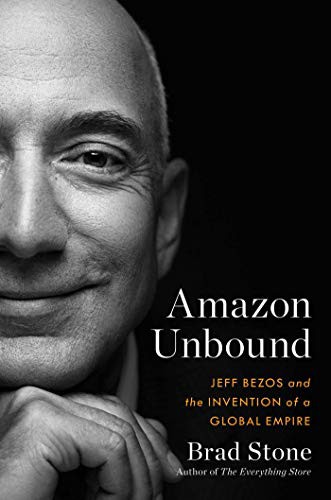
Amazon Unbound
by Brad Stone · 2021
The sequel to The Everything Store, covering the decade Amazon stopped being a bookstore and started being everything.
Worth reading? Amazon Unbound is the best account of Amazon's 2010s expansion, and it works because Stone doesn't flinch from the company's ugly side -- warehouse conditions, seller squeezes, Bezos's divorce -- while still explaining how the empire actually got built. Skip it only if you want a tidy hero narrative; this book has no interest in giving you one.
| Full Title | Amazon Unbound: Jeff Bezos and the Invention of a Global Empire |
|---|---|
| Author | Brad Stone |
| Published | 2021 |
| Publisher | Simon & Schuster |
| Category | Business & Money |
| Favorite quote | “In business, every once in a while, when you step up to the plate, you can score 1,000 runs. This long-tailed distribution of returns is why it's important to be bold.” |
The Verdict
Stone’s first book, The Everything Store, told you how Amazon got built. This one tells you what it cost to keep building it. The AWS story alone is worth the price – a side bet that quietly became the thing funding every other Amazon experiment, including the ones that flopped hard (the Fire Phone is a genuinely funny disaster in hindsight).
What separates this from a standard tech-empire book is that Stone doesn’t let the “genius founder” framing crowd out the warehouse-floor reporting. You get both: the mechanism (six-page memos, Day 1 paranoia, ruthless long-game bets) and the fallout (worker injuries, squeezed sellers, a company that became the thing regulators started circling). That tension is the book’s real subject, and it’s why it holds up better than most business-hero narratives from the same era.
you want the inside account of how Amazon built AWS, Alexa, the Fire Phone flop, and its logistics empire while crushing sellers and warehouse workers along the way
you already read The Everything Store cover to cover and just want a recap -- this assumes that book as backstory rather than re-explaining Amazon's early years
Book Summary
Amazon's growth in the 2010s wasn't one strategy, it was several bets running in parallel: AWS became the profit engine that funded everything else, the third-party marketplace turned Amazon into a platform that also competes with the sellers on it, and Alexa/Echo turned voice into a new front door, even as the Fire Phone flopped hard enough to write off $170 million in inventory.
Bezos ran the company on a small set of repeatable mechanisms -- the six-page narrative memo instead of slide decks, the 'Day 1' obsession with staying paranoid about complacency, and a willingness to lose money for years on a bet (Prime, AWS, India) if the long-term math worked. Those same mechanisms that built Amazon's advantages also produced brutal internal pressure and well-documented warehouse and seller-side harm.
Bezos's personal empire scaled alongside Amazon's -- the Washington Post acquisition, Blue Origin, and a net worth run-up that made him the world's richest man -- and his 2019 divorce and public MacKenzie Scott split played out while Amazon's antitrust and labor scrutiny was intensifying, which the book treats as one connected story rather than separate ones.
Top 9 Lessons from Amazon Unbound
- A single profitable division (AWS) can fund years of money-losing bets in other divisions without the market punishing you, as long as investors believe the long game.
- Being both the platform and a competitor on that platform (Amazon selling its own products against third-party sellers) creates conflicts of interest regulators eventually notice.
- A visible operating mechanism -- Bezos's six-page memo culture -- can outlast the person who invented it and become a genuine competitive moat.
- Voice and hardware bets (Echo/Alexa) can succeed even when adjacent bets (Fire Phone) fail completely, because the winners fund the losers.
- Aggressive cost and speed pressure on warehouse operations produces measurable human costs that don't show up in quarterly earnings.
- Owning a media property (The Washington Post) changes how a founder is covered, and Bezos used that leverage deliberately, not accidentally.
- Rapid international expansion (India, in this book) runs into local regulation and competition in ways that don't just replicate the US playbook.
- Sustained 'Day 1' paranoia is a stated cultural value at Amazon, but the book shows how unevenly that paranoia gets applied depending on which part of the business you're in.
- A founder's personal life (Bezos's divorce, tabloid exposure) becomes a live risk factor for a public company once he's globally famous, not just a private matter.
Top 2 Quotes from Amazon Unbound
"There are two ways of building a business. Many times, you aim, aim, aim, and then shoot. Or, you shoot, shoot, shoot, and then aim a little bit. That is what you want to do here. Don't spend a lot of time on analysis and precision. Keep trying stuff."
Brad Stone, Amazon Unbound
"In business, every once in a while, when you step up to the plate, you can score 1,000 runs. This long-tailed distribution of returns is why it's important to be bold."
Brad Stone, Amazon Unbound
Frequently Asked Questions
Is Amazon Unbound worth reading?
Yes, if you want to understand how Amazon actually became the company it is today -- AWS, Alexa, the marketplace, the labor practices -- told with real reporting instead of press-release framing.
Do I need to read The Everything Store first?
It helps but isn't required. Amazon Unbound picks up roughly where that book left off and assumes some familiarity with Amazon's founding story, but it stands on its own.
Is Amazon Unbound critical of Jeff Bezos?
It's balanced but not soft -- Stone credits the strategic decisions that worked while documenting warehouse conditions, seller conflicts, and Bezos's personal life in unflattering detail where the reporting supports it.
What does Amazon Unbound cover that The Everything Store doesn't?
The 2010s: AWS's rise to Amazon's profit engine, the Alexa/Echo bet, the Fire Phone failure, India expansion, Whole Foods, the Washington Post purchase, and Bezos's divorce.
Ready to read it?
Get Amazon Unbound on Amazon