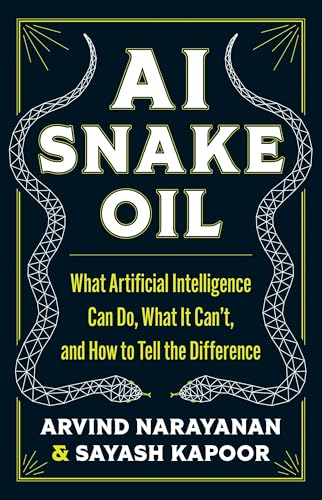
AI Snake Oil
by Arvind Narayanan and Sayash Kapoor · 2024
Two Princeton computer scientists sort real AI capability from marketing hype, and name names.
Worth reading? Narayanan and Kapoor's core service is a taxonomy: generative AI (genuinely improving fast), predictive AI used for things like hiring or criminal-risk scoring (frequently oversold, often broken), and content-moderation AI (a mixed bag) are three different technologies getting lumped into one hype cycle. Their case studies of predictive-AI failures, from broken hiring algorithms to recidivism scores, are the most useful corrective in the AI-book genre right now. Read it if you're tired of both AI hype and AI doom and want the boring, evidence-based middle. Skip it if you want a grand unified theory, this book is deliberately narrow and specific.
| Full Title | AI Snake Oil: What Artificial Intelligence Can Do, What It Can't, and How to Tell the Difference |
|---|---|
| Author | Arvind Narayanan and Sayash Kapoor |
| Published | 2024 |
| Category | Business & Money |
The Verdict
Most AI books pick a side, hype or doom. This one refuses to, and is more useful for it: it names specific products, specific failures, and specific evidence, rather than arguing in the abstract. If you’re the person in the room asking “wait, does this actually work,” this is your reference book.
readers tired of AI hype and doom alike who want a sober, evidence-based sorting of what actually works
you want optimism or alarm, this book is deliberately, usefully unglamorous
Book Summary
The authors' central move is refusing to talk about 'AI' as one thing. They split it into generative AI (genuinely improving, genuinely useful for many tasks), predictive AI (used for hiring, lending, and criminal justice decisions, where the evidence for accuracy is frequently much weaker than vendors claim), and content moderation AI (a mixed, context-dependent bag). Treating these as one technology, they argue, is how both hype and doom narratives get away with sloppy claims.
Much of the book is spent debunking specific, real-world predictive-AI products that were sold as scientifically rigorous but performed no better than simple checklists or random chance in independent audits, arguing the harm isn't hypothetical, it's already showing up in hiring, lending, and sentencing decisions today.
Top 7 Lessons from AI Snake Oil
- 'AI' isn't one technology, generative, predictive, and moderation AI have very different track records.
- Predictive AI products (hiring, lending, sentencing) are frequently sold as more accurate than independent audits confirm.
- A checklist can sometimes outperform a marketed AI system, and vendors rarely volunteer that comparison.
- Generative AI's rapid improvement doesn't mean every AI category is improving at the same rate.
- AI hype and AI doom often share the same flawed premise: treating AI as a single, uniform technology.
- Ask for independent audit data before trusting a vendor's accuracy claims.
- Real, documented AI harms today are mostly in predictive systems, not the generative tools getting the headlines.
Frequently Asked Questions
Is AI Snake Oil worth reading?
Yes, especially if you're skeptical of both AI hype and AI doom and want a fact-based sorting of what current AI actually does well versus what's oversold.
What is AI Snake Oil about?
Princeton computer scientists Arvind Narayanan and Sayash Kapoor's case-by-case breakdown of which AI applications work, which are overhyped, and how to tell the difference, with a focus on predictive AI's real-world failures.
Is AI Snake Oil against AI?
No. The authors are explicit that generative AI is genuinely improving. Their target is specifically the overselling of predictive AI products in hiring, lending, and criminal justice.
Ready to read it?
Get AI Snake Oil on Amazon