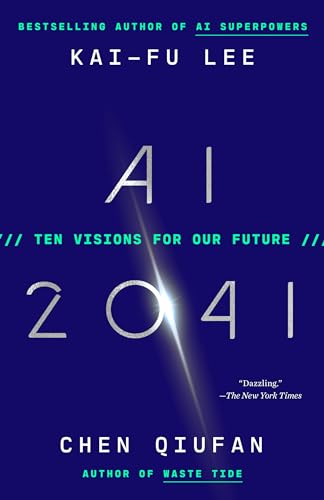
AI 2041
by Kai-Fu Lee and Chen Qiufan · 2021
Ten short stories about life in 2041 paired with technical essays explaining exactly how each scenario could actually happen, from a former Google China president turned AI investor.
Worth reading? Lee's format is the hook: novelist Chen Qiufan writes a story imagining one facet of AI-saturated life in 2041 (deepfakes, autonomous weapons, personalized education, job displacement), then Lee follows with a technical essay grounding exactly which parts are plausible and why, and on what timeline. It's the most concrete, least abstract entry on this list, useful precisely because it forces you to imagine specifics instead of vague futurism. Read it if scenarios stick with you better than arguments. Skip it if you want a single sustained thesis rather than ten separate ones.
| Full Title | AI 2041: Ten Visions for Our Future |
|---|---|
| Author | Kai-Fu Lee and Chen Qiufan |
| Published | 2021 |
| Category | Business & Money |
The Verdict
Most AI-future books argue in the abstract. AI 2041 makes you sit inside ten specific, lived-in scenarios first, then explains the mechanics after. It’s a different reading experience than the rest of this list, and a useful one if vague futurism has stopped landing for you.
readers who learn better from concrete scenarios than abstract argument
you want a straight nonfiction argument, not fiction-plus-analysis
Book Summary
Lee's underlying claim, developed across the technical essays, is that most AI applications over the next two decades will be evolutionary extensions of narrow, already-deployed capabilities (recommendation systems, computer vision, language models), not a sudden leap to general intelligence. The interesting and disruptive part isn't the technology arriving, it's how fast it compounds across labor markets, education, and geopolitics once deployed at scale.
The fiction-plus-essay structure lets him make specific, falsifiable predictions (which jobs get automated first, which countries lead which subfields, how fast autonomous systems get deployed in specific industries) rather than the vague 'AI will change everything' framing common in the genre.
Top 7 Lessons from AI 2041
- Most near-term AI disruption comes from scaling existing narrow capabilities, not sudden general intelligence.
- Concrete scenarios expose assumptions that abstract predictions let you skip past.
- Job displacement from AI will be uneven across industries and geographies, not a single wave.
- China and the US are likely to lead different subfields of AI deployment, not the same race.
- Deepfakes and synthetic media create verification problems well before they create superintelligence problems.
- Personalized AI education could widen or narrow inequality depending on deployment choices, not the technology itself.
- Fiction paired with technical grounding makes speculative futures easier to stress-test than either alone.
Frequently Asked Questions
Is AI 2041 worth reading?
Yes, especially if you find concrete scenarios more useful than abstract futurism. The fiction-plus-analysis format is unusual and effective.
What is AI 2041 about?
Ten short stories imagining specific facets of AI-saturated life in 2041, each followed by a technical essay from Kai-Fu Lee grounding what's realistic and on what timeline.
Who is Kai-Fu Lee?
A former president of Google China and founder of Sinovation Ventures, one of the most prominent AI investors and commentators bridging the US and Chinese tech industries.
Ready to read it?
Get AI 2041 on Amazon