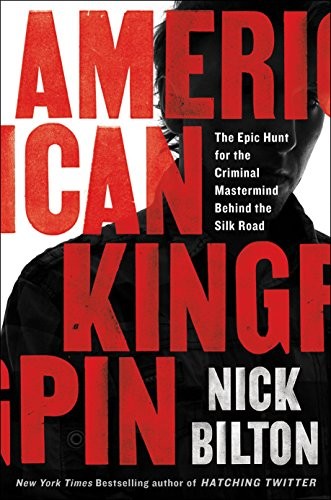
American Kingpin
by Nick Bilton · 2017
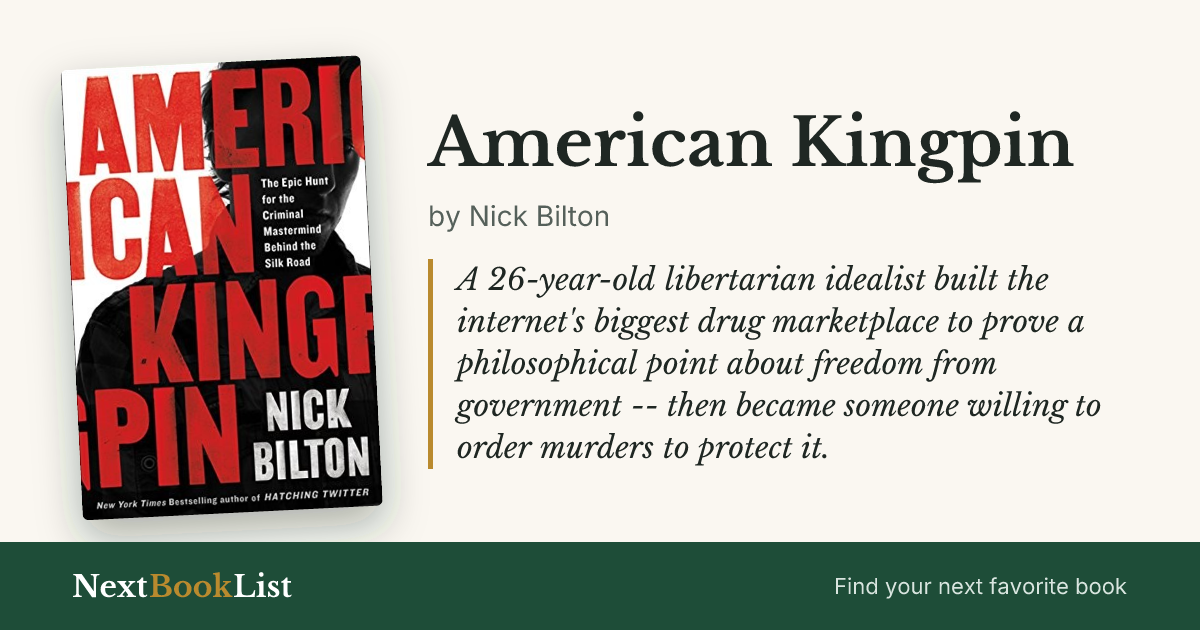
A 26-year-old libertarian idealist built the internet's biggest drug marketplace to prove a philosophical point about freedom from government -- then became someone willing to order murders to protect it.
Worth reading? Bilton earns the comparison to Breaking Bad that reviewers reached for: Ross Ulbricht starts Silk Road as a genuine libertarian experiment and ends it negotiating murders-for-hire to protect his empire, and the book tracks that slide in specific, well-reported steps rather than treating it as inevitable.
| Full Title | American Kingpin: The Epic Hunt for the Criminal Mastermind Behind the Silk Road |
|---|---|
| Author | Nick Bilton |
| Published | 2017 |
| Publisher | Portfolio |
| Category | History |
| Favorite quote | “And then you wake up one morning and you're not you anymore. You're one of the most notorious drug dealers alive. And now you're deciding if someone should live or die. You're the judge in your own court. You're god.” |
The Verdict
The comparison to Breaking Bad gets used a lot for this book, and it holds up: Ulbricht doesn’t start out a villain, he starts out a true believer in an idea, and the book’s real tension is watching how gradually and rationally each escalating decision made sense to him at the time.
Bilton’s reporting is strong enough that the technical parts (Tor, Bitcoin, how a hidden marketplace actually functions) never feel like a lecture – they’re woven into the plot instead of sitting outside it. The federal investigation’s own ethical mess, including agents who stole from the case, keeps this from being a simple cops-and-robbers story too.
Read it if you want a true-crime thriller that treats the internet’s mechanics as seriously as the human drama. Skip it if you need a clean hero to root for on either side – neither Ulbricht nor his pursuers come out of this uncomplicated.
you want a true-crime tech thriller that actually explains how the dark web, Bitcoin, and Tor worked in practice, not just as buzzwords
you're looking for a sympathetic redemption arc for Ross Ulbricht -- Bilton's reporting traces his transformation from idealist to someone ordering violence, without softening it
Book Summary
Ross Ulbricht built Silk Road as a practical test of his libertarian belief that people should be free to buy and sell what they choose without government interference, using Tor for anonymity and Bitcoin for payment to build the first major dark web marketplace, which grew far faster and larger than he originally anticipated.
As Silk Road's success brought scrutiny, competition, and internal threats, Ulbricht (operating under the pseudonym Dread Pirate Roberts) escalated from ideological entrepreneur to someone who solicited multiple murders-for-hire against people he saw as threats to the site, a transformation Bilton traces through his own private journals and chat logs rather than speculation.
The government's pursuit of Ulbricht involved its own ethical gray areas -- corrupt federal agents who stole Bitcoin during the investigation, aggressive surveillance and entrapment-adjacent tactics -- complicating any simple story of clean law enforcement finally catching a clean villain.
Top 8 Lessons from American Kingpin
- An idealistic principle (freedom from government interference) can be used to justify a system that scales into real, serious harm once it succeeds beyond its founder's original expectations.
- Success and threat can escalate a person's ethics faster than their self-image updates -- Ulbricht kept seeing himself as principled well past the point his actions weren't.
- New technology (Tor, Bitcoin) doesn't just enable new crime, it changes the practical texture of how a criminal enterprise gets built and run day to day.
- Anonymity online is rarely as complete as its users believe -- small operational mistakes, not brilliant countermeasures, are what usually end anonymous criminal enterprises.
- Government investigations of even legitimate targets can themselves be corrupted -- federal agents in this case stole from the very case they were building.
- A founder's private writings (journals, chat logs) often reveal a slower, more gradual moral slide than the public narrative of their downfall suggests.
- Scaling any system, legal or illegal, multiplies the stakes of every subsequent decision -- what was survivable at a small scale can become catastrophic at a large one.
- Pursuing an anonymous target online often comes down to unglamorous investigative persistence -- cross-referencing usernames, timestamps, and old forum posts -- more than any single dramatic breakthrough.
Top 3 Quotes from American Kingpin
"And then you wake up one morning and you're not you anymore. You're one of the most notorious drug dealers alive. And now you're deciding if someone should live or die. You're the judge in your own court. You're god."
Nick Bilton, American Kingpin
"What he needed was a place where he could be on his laptop for eighteen hours a day and no one would question why he was being antisocial or what he was working on."
Nick Bilton, American Kingpin
"Over time he learned that the way to have a leg up on everyone else was to anticipate something before it happened and then have the answer to it."
Nick Bilton, American Kingpin
Frequently Asked Questions
Is American Kingpin worth reading?
Yes -- it's a well-reported true-crime tech thriller that actually explains how Tor, Bitcoin, and dark web marketplaces functioned, while tracking Ross Ulbricht's slide from idealist to someone ordering murders-for-hire.
What is American Kingpin about?
The rise and fall of Ross Ulbricht, who built the Silk Road dark web drug marketplace under the pseudonym Dread Pirate Roberts, and the federal investigation, including corrupt agents, that eventually caught him.
Is American Kingpin a true story?
Yes -- it's narrative nonfiction built from court documents, Ulbricht's own journals and chat logs, and interviews, not a fictionalized account.
Does the book make Ross Ulbricht sympathetic?
It shows his idealistic starting point without excusing where he ended up -- soliciting violence to protect his empire. Bilton traces the transformation rather than softening or condemning it outright.
Do I need to understand Bitcoin or the dark web already to read this?
No -- Bilton explains both clearly enough for a general reader, which is part of what makes the book work as a thriller and not just a tech explainer.
Ready to read it?
Get American Kingpin on Amazon