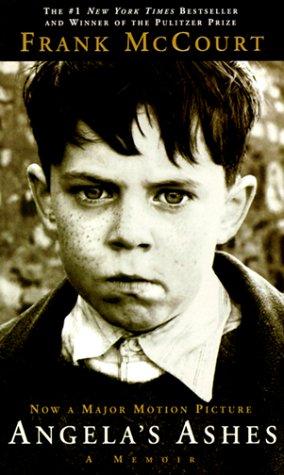
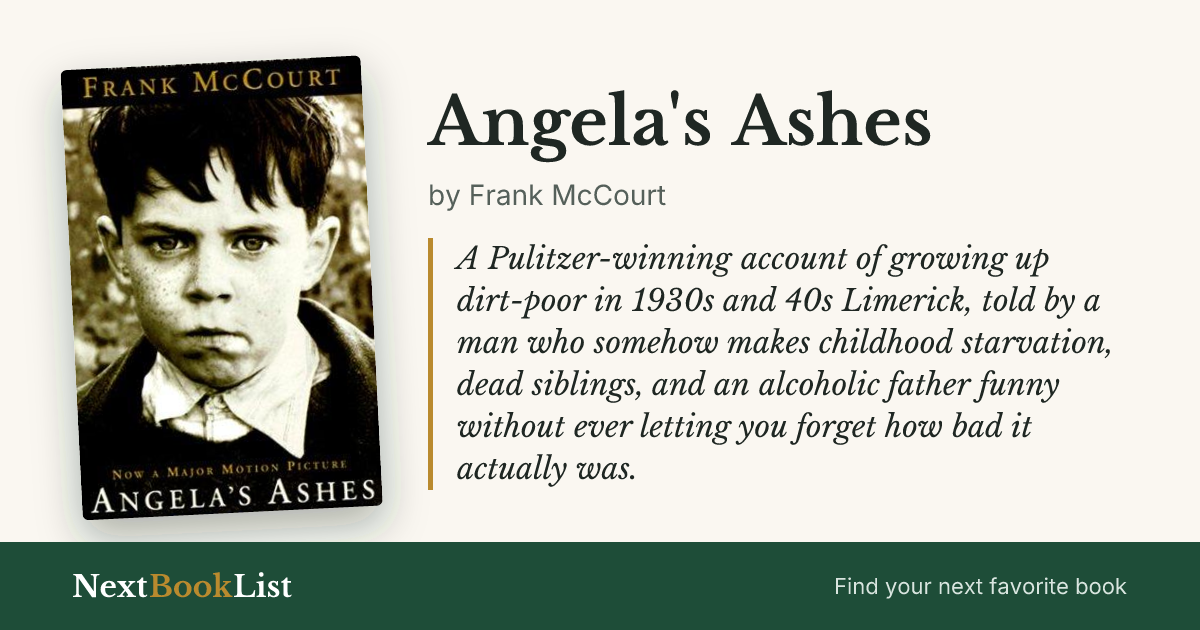
Angela's Ashes
by Frank McCourt · 1996
A Pulitzer-winning account of growing up dirt-poor in 1930s and 40s Limerick, told by a man who somehow makes childhood starvation, dead siblings, and an alcoholic father funny without ever letting you forget how bad it actually was.
Worth reading? Angela's Ashes works because McCourt writes the whole thing from a child's eye level, present tense in feeling even when it's past tense on the page, so you experience the hunger and the humiliation the way a kid does: confused, ashamed, and still finding something to laugh at. It's grim material handled with more control than almost any misery memoir that followed it.
| Full Title | Angela's Ashes: A Memoir |
|---|---|
| Author | Frank McCourt |
| Published | 1996 |
| Publisher | Scribner |
| Category | Biographies & Memoirs |
| Favorite quote | “When I look back on my childhood I wonder how I survived at all. It was, of course, a miserable childhood: the happy childhood is hardly worth your while. Worse than the ordinary miserable childhood is the miserable Irish childhood, and worse yet is the miserable Irish Catholic childhood.” |
The Verdict
McCourt’s trick is pacing: he never slows down to tell you how sad a scene is, he just lays it out and moves on, and that restraint is what makes the book land instead of feeling like misery porn. A lesser writer turns three dead siblings into three separate tearjerker set pieces. McCourt gives you a paragraph and keeps walking, because that’s how a kid actually processes loss.
The father is the book’s most complicated character, and McCourt doesn’t resolve him into a villain. He’s magnetic when sober, useless when drunk, and the book never pretends those two things cancel out. That refusal to simplify him is why the book still gets discussed decades later instead of being filed under standard-issue trauma memoir.
Read it if you want a memoir that treats a genuinely brutal childhood with craft instead of sentiment. Skip it if you need your misery memoirs to end with the family healing – this one ends with McCourt getting on a boat and leaving almost everyone behind.
you want misery-lit that earns its laughs instead of just wallowing, and you can handle a childhood memoir that doesn't sand down the ugliest parts of poverty and addiction
you want a tidy redemption arc or a father figure who gets better -- McCourt's dad stays a drunk who steals grocery money for pints almost to the last page, and the book doesn't pretend otherwise
Book Summary
McCourt narrates his own childhood in Brooklyn and then Limerick, Ireland, where his family returns after losing an infant daughter, and where poverty, damp housing, and his father's alcoholism combine to kill three more of his siblings before he reaches his teens.
The book's central tension is McCourt's father: a charming storyteller and devoted-sounding parent who is also incapable of holding a job or keeping money out of the pub, so every small windfall the family gets -- a paycheck, a charity donation, money collected for a dead child's funeral -- gets drunk away within days.
McCourt's prose voice, plain, present-feeling, almost deadpan about horrific events, is the book's real achievement: he refuses to editorialize about how sad any of this is, trusting the facts (and his own dark humor) to do the emotional work instead.
The last section, where a teenage McCourt starts working, saving, and finally buys passage to America, reframes the entire book as a long windup to an escape -- the memoir isn't really about surviving Limerick, it's about getting out.
Top 7 Lessons from Angela's Ashes
- Poverty in the book isn't just lack of money -- it's structural: damp housing that gives the family repeated illness, a school system that shames poor kids openly, and a culture that treats begging and charity as constant, humiliating necessities.
- McCourt's father embodies a specific kind of failure: he's not cruel, he's unreliable, and the book argues unreliability can be just as destructive to a family as outright abuse.
- The Catholic Church in the book functions as both a source of comfort and an instrument of shame, particularly around McCourt's out-of-wedlock cousins and his own sense of sin.
- McCourt survives partly through storytelling itself -- his father's tall tales, however useless practically, give him a template for turning misery into narrative, which is exactly what the book he's writing does.
- Deaths in the book are almost never dwelt on emotionally in the text; the flat, matter-of-fact delivery of infant deaths is a deliberate choice that makes them land harder than a sentimental treatment would.
- Emigration functions as the only realistic escape hatch from generational poverty in the book's world -- not education, not local opportunity, just leaving.
- The book's humor isn't comic relief bolted onto tragedy -- it's the same coping mechanism the real McCourt family used, which is part of why it doesn't feel exploitative.
Top 1 Quotes from Angela's Ashes
"When I look back on my childhood I wonder how I survived at all. It was, of course, a miserable childhood: the happy childhood is hardly worth your while. Worse than the ordinary miserable childhood is the miserable Irish childhood, and worse yet is the miserable Irish Catholic childhood."
Frank McCourt, Angela's Ashes
Frequently Asked Questions
Is Angela's Ashes worth reading?
Yes -- it's one of the best-executed misery memoirs ever written, funny and devastating in almost the same sentence, and it earned its Pulitzer honestly.
What is Angela's Ashes about?
Frank McCourt's childhood growing up in extreme poverty in 1930s and 40s Limerick, Ireland, with an alcoholic father and a mother struggling to keep the family fed and alive.
Is Angela's Ashes a true story?
Yes -- it's a memoir, though McCourt has acknowledged compressing timelines and reconstructing dialogue the way most memoirists do.
Is Angela's Ashes depressing?
It covers genuinely dark material -- child deaths, alcoholism, hunger -- but McCourt's dry humor keeps it from reading as pure misery.
Do I need to read the sequel, 'Tis, to understand Angela's Ashes?
No -- Angela's Ashes is a complete, self-contained story ending with McCourt's departure for America.
Ready to read it?
Get Angela's Ashes on Amazon