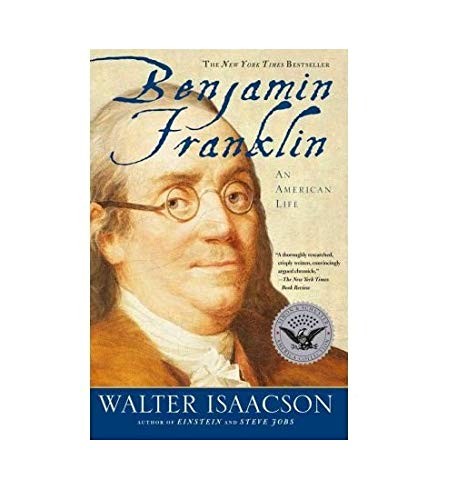
Benjamin Franklin
by Walter Isaacson · 2003
Isaacson's biography of the founding father who was simultaneously a printer, scientist, diplomat, and self-made businessman, the original American polymath.
Worth reading? Isaacson treats Franklin less as a distant founding father and more as the original American self-made polymath, tracing his path from runaway printer's apprentice to internationally famous scientist, successful businessman, and eventually indispensable diplomat, all built on a lifelong habit of deliberate self-improvement (Franklin famously tracked his own virtues in a daily ledger). It's the biography most often cited by entrepreneurs and inventors specifically for that self-reinvention arc. Read it if you want a founder's life told through the lens of practical craft and constant self-improvement. Skip it if you want political history alone, Isaacson gives equal weight to Franklin's science and business.
| Full Title | Benjamin Franklin: An American Life |
|---|---|
| Author | Walter Isaacson |
| Published | 2003 |
| Category | Biographies & Memoirs |
The Verdict
Isaacson’s real subject here isn’t the kite and the key, it’s the deliberate, almost engineering-minded approach Franklin took to his own character and career across multiple, genuinely different fields. It’s the founder biography entrepreneurs actually reread.
readers who want a founder's biography focused on practical self-improvement and reinvention, not just political history
you want a narrow political biography, Isaacson covers Franklin's science and business life just as thoroughly
Book Summary
Isaacson's throughline is Franklin's relentless, lifelong project of self-improvement, most famously his personal ledger tracking thirteen virtues he tried to systematically develop, treating character itself as something to be engineered and refined rather than fixed at birth. This practical, almost businesslike approach to self-development runs through everything else Franklin did.
The biography also emphasizes Franklin's genuine polymath range, printing, scientific research (his kite experiment wasn't a one-off, he did serious electrical research), civic institution-building (he founded a library, a fire department, and a university), and diplomacy, arguing that Franklin's ability to move fluidly between these domains, rather than specializing narrowly, was itself a defining American trait he helped establish.
Top 7 Lessons from Benjamin Franklin
- Character and habits can be deliberately engineered through tracking and practice, not just accepted as fixed.
- Franklin's thirteen-virtue ledger is one of history's earliest documented systematic self-improvement practices.
- Genuine polymath range, moving fluidly between printing, science, business, and diplomacy, was itself a defining trait, not a distraction from mastery.
- Building civic institutions (libraries, fire departments, universities) can be as lasting a legacy as any single invention.
- Franklin's scientific work (electricity research) was serious, sustained inquiry, not a single famous anecdote.
- Reinvention across multiple careers within one lifetime was possible, and valuable, even in the 18th century.
- Practical, systematic self-development can coexist with genuine intellectual curiosity, they aren't opposites.
Frequently Asked Questions
Is Benjamin Franklin worth reading?
Yes, especially for readers interested in the self-improvement and reinvention arc, from runaway printer's apprentice to scientist, businessman, and diplomat, told through Isaacson's thorough research and access.
What is Benjamin Franklin: An American Life about?
Walter Isaacson's biography of Benjamin Franklin, tracing his path from printer's apprentice to internationally recognized scientist, successful businessman, civic institution-builder, and diplomat, built on a lifelong practice of deliberate self-improvement.
What was Franklin's virtue ledger?
A personal tracking system where Franklin identified thirteen virtues (like temperance, industry, and humility) and systematically monitored his own daily progress toward each, one of history's earliest documented self-improvement frameworks.
Ready to read it?
Get Benjamin Franklin on Amazon