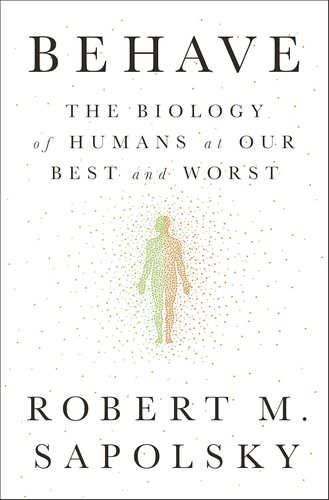
Behave
by Robert M. Sapolsky · 2017
A Stanford neuroscientist explains a single violent or generous act by zooming out in stages, from the second before it happened, back through hormones, childhood, culture, and evolution.
Worth reading? Sapolsky's structural conceit is genuinely brilliant: he examines a single behavior -- an act of violence, or an act of extraordinary kindness -- by explaining it at successively earlier timescales, starting with what happened in the brain one second before, then hours before (hormones), then days before, then developmental childhood factors, then genetic and evolutionary history, building the most integrated single account of human behavior across scientific disciplines currently available in one book. It's genuinely difficult reading in places given the sheer breadth of material, but Sapolsky's dry wit and refusal to oversimplify make it worth the effort for readers willing to invest the time.
| Full Title | Behave: The Biology of Humans at Our Best and Worst |
|---|---|
| Author | Robert M. Sapolsky |
| Published | 2017 |
| Category | Self-Improvement & Psychology |
| Favorite quote | “We have the biological capacity for extraordinary compassion and generosity, and the capacity for stunning violence. Context determines which we express.” |
The Verdict
Sapolsky’s structural device (zooming out through progressively earlier timescales to explain a single act) is what makes 700 dense pages hold together as a genuinely coherent argument rather than a scattered survey. It’s the book to read if you want to actually understand human behavior rather than just get a simplified single-factor explanation.
you want the most comprehensive single-volume explanation of why humans behave violently or altruistically, integrating neuroscience, endocrinology, genetics, and anthropology
you want a quick read -- this is a genuinely dense 700-plus-page synthesis across multiple scientific disciplines, built for readers willing to sit with real complexity
Book Summary
No single explanatory level -- not neuroscience alone, not hormones alone, not childhood environment alone, not genetics alone, not evolutionary history alone -- adequately explains human behavior on its own; Sapolsky's structural approach of examining the same behavior at successively earlier timescales (seconds before, hours before, days before, years before, generations before) demonstrates that a complete explanation requires integrating all these levels simultaneously, not choosing one as the "real" cause.
He's particularly focused on dismantling simplistic narratives about violence and tribalism -- showing how "us versus them" categorization can form almost instantly and unconsciously (within milliseconds, measurable in brain activity), while also showing that the same underlying neural and hormonal machinery that enables violence also enables extraordinary cooperation and altruism, meaning humans aren't inherently good or bad but capable of both depending heavily on context and circumstance.
Top 7 Lessons from Behave
- No single explanatory level (neuroscience, hormones, genetics, culture) alone adequately explains human behavior -- a complete account requires integrating all of them.
- Explaining a behavior at successively earlier timescales (seconds, hours, days, years, generations before) reveals how deeply layered the causes actually are.
- 'Us versus them' categorization can form almost instantly and unconsciously, measurable in brain activity within milliseconds.
- The same underlying neural and hormonal machinery enables both violence and extraordinary altruism -- humans aren't inherently one or the other.
- Context and circumstance heavily determine whether the same underlying human capacities express as cruelty or cooperation.
- Testosterone's actual relationship to aggression is more context-dependent and complex than the popular simplified narrative suggests.
- Childhood environment and stress shape adult behavioral tendencies through measurable biological mechanisms, not just vague psychological influence.
Top 3 Quotes from Behave
"We have the biological capacity for extraordinary compassion and generosity, and the capacity for stunning violence. Context determines which we express."
Robert M. Sapolsky, Behave
"The opposite of love is not hate; its opposite is indifference."
Robert M. Sapolsky, Behave
"If you have to boil this book down to a single phrase, it would be 'it's complicated.'"
Robert M. Sapolsky, Behave
Frequently Asked Questions
Is Behave worth reading?
Yes, especially if you want the most comprehensive single-volume synthesis of why humans behave violently or altruistically, integrating neuroscience, hormones, genetics, and culture. It's dense but rewards patient reading.
What is the main idea of Behave?
Human behavior can't be fully explained by any single factor (brain chemistry, hormones, genetics, or culture) alone -- Sapolsky examines a single behavior at successively earlier timescales to show how deeply integrated the actual causes are.
How long is Behave?
Over 700 pages, covering an unusually wide range of scientific disciplines -- it's a genuinely substantial commitment, best approached over weeks rather than as a quick read.
Who is Robert Sapolsky?
A neuroscientist and primatologist at Stanford University, recipient of a MacArthur 'Genius Grant,' known for his research on stress biology and for making complex neuroscience accessible without oversimplifying it.
Ready to read it?
Get Behave on Amazon