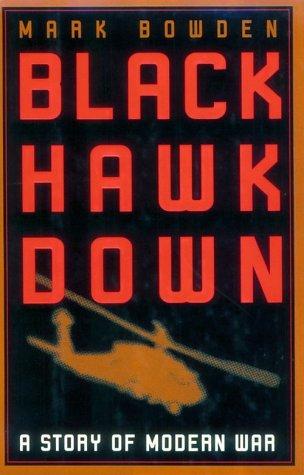
Black Hawk Down
by Mark Bowden · 1999
A routine 1993 mission to capture a Somali warlord's lieutenants turned into an eighteen-hour firefight that killed eighteen American soldiers, and Bowden rebuilds it minute by minute from both American and Somali accounts.
Worth reading? Black Hawk Down is a masterclass in reconstructive journalism. Bowden interviewed dozens of American soldiers, and unusually for a book like this, Somali fighters and civilians too, to rebuild a single, chaotic battle almost in real time. The result reads like fiction but is sourced like an investigation, and that combination is why it became the standard against which modern war reporting gets measured.
| Full Title | Black Hawk Down: A Story of Modern War |
|---|---|
| Author | Mark Bowden |
| Published | 1999 |
| Publisher | Atlantic Monthly Press |
| Category | History |
The Verdict
Bowden’s reporting is the whole show here. The prose is functional rather than flashy, but the level of detail, who was where, what radio call happened when, what a specific soldier was thinking as a helicopter went down, gives the book a documentary intensity most war narratives don’t reach.
The Somali chapters are what separate this from a standard American war story. Bowden doesn’t use them to score a political point; he uses them to show that the same eighteen hours looked very different, and cost far more, from the other side of the fighting.
Read it if you want the most granular, best-sourced account of modern urban combat available in nonfiction. Skip it if you’re looking for analysis of the broader Somalia intervention rather than the battle itself.
you want an intensely detailed, ground-level reconstruction of modern urban combat, built from interviews with soldiers who were actually there
you want strategic or political analysis of the broader Somalia intervention -- the book stays tight on the battle itself, not the policy that led to it
Book Summary
In October 1993, U.S. Army Rangers and Delta Force operators launched a raid to capture lieutenants of Somali warlord Mohamed Farrah Aidid in Mogadishu, expecting the mission to last under an hour; instead, two Black Hawk helicopters were shot down and the operation turned into an overnight battle that trapped American forces in hostile territory.
Bowden reconstructs the eighteen hours almost minute by minute, alternating between individual soldiers' experiences on the ground, the helicopter crews, and the command structure trying to coordinate a rescue, using extensive interviews conducted years after the battle to recover details that hadn't previously been public.
Unusually for an American war narrative, Bowden also interviewed Somali fighters and civilians who experienced the same battle from the other side, giving the book a dual perspective that complicates a simple heroic-rescue framing and shows the civilian cost of the fighting in Mogadishu's streets.
Top 7 Lessons from Black Hawk Down
- A mission planned to last under an hour turned into an eighteen-hour battle once the first helicopter went down, showing how quickly a tightly scoped operation can spiral once initial assumptions fail.
- Individual soldiers' accounts, gathered years after the battle, revealed tactical and communication failures that hadn't been part of the initial public narrative of the mission.
- Bowden's inclusion of Somali fighters' and civilians' perspectives is rare for an American war narrative and shows the same battle producing a very different, and much larger, human cost on the other side.
- Urban combat in a dense civilian environment made it extremely difficult to distinguish combatants from civilians, a tension the book returns to repeatedly from both American and Somali viewpoints.
- The battle's political aftermath, a shift in U.S. willingness to commit ground troops to humanitarian interventions, shaped American foreign policy decisions for years afterward, though the book stays mostly focused on the battle itself rather than that broader policy shift.
- Individual soldiers' courage and specific decisions under fire, documented through firsthand interviews, carry much of the narrative rather than command-level strategy.
- The book's reconstructive method, cross-referencing dozens of individual accounts to build a single coherent timeline, became a template for later works of narrative war journalism.
Frequently Asked Questions
Is Black Hawk Down worth reading?
Yes -- it's one of the most detailed and well-sourced reconstructions of a modern battle, built from firsthand interviews on both sides of the fighting.
Is Black Hawk Down a true story?
Yes -- it's a nonfiction reconstruction of the 1993 Battle of Mogadishu, based on extensive interviews Bowden conducted with participants.
Did Ridley Scott adapt this book into a movie?
Yes -- the 2001 film Black Hawk Down, directed by Ridley Scott, is based on Bowden's book.
Does the book include the Somali perspective?
Yes -- Bowden interviewed Somali fighters and civilians as well as American soldiers, which is unusual for a book centered on an American military engagement.
Ready to read it?
Get Black Hawk Down on Amazon