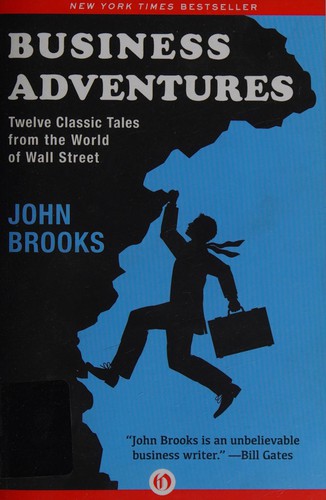
Business Adventures
by John Brooks · 1969
Bill Gates asked Buffett for his favorite business book. Buffett mailed him this one.
Worth reading? The best business book Bill Gates ever got from Buffett, and the rare one that reads like literature instead of a manual. Brooks's dozen New Yorker pieces -- the Ford Edsel flop, Xerox's rise, a brazen corner in Piggly Wiggly stock -- teach more about how markets and companies actually behave than any MBA case file. Skip it if you want bullet-point takeaways; Brooks hands you the story and leaves the lesson for you to earn.
| Full Title | Business Adventures: Twelve Classic Tales from the World of Wall Street |
|---|---|
| Author | John Brooks |
| Published | 1969 |
| Category | Business & Money |
| Favorite quote | “To set high goals, to have almost unattainable aspirations, to imbue people with the belief that they can be achieved, these are as important as the balance sheet, perhaps more so.” |
The Verdict
Twelve New Yorker essays from the 1960s: the Ford Edsel disaster, the three-day stock market crash of 1962, the rise of Xerox. The companies are dated. The human behavior (hubris, panic, herding, denial) is identical to whatever happened in markets last week. That’s why Gates and Buffett still recommend it.
readers who learn from stories and want business writing that's actually literature
you need takeaways in bullet points (Brooks makes you earn the lessons)
Book Summary
Business is run by people, not by models, and Brooks shows the same human blindness -- overconfidence, herd behavior, the inability to learn -- repeating across decades and industries. The Edsel launch failed not from bad math but from executives who fell in love with their own data.
Markets are a mood as much as a mechanism. The chapters on a manipulated stock corner and on a panicked bear market prove that prices swing on sentiment and rumor long before they reflect any real value.
Luck and timing matter more than planners admit. The "right" corporate decision often looks brilliant only because the cycle cooperated, a humbling point for anyone who worships a single CEO's genius.
Top 7 Lessons from Business Adventures
- A company's fate usually turns on human behavior, not on the spreadsheet.
- Overconfidence is the most expensive mistake in business.
- Markets move on sentiment and rumor before they reflect real value.
- The best business writing tells a story instead of preaching a lesson.
- Today's genius CEO is often tomorrow's cautionary tale.
- Read history; the same blunders keep reporting for duty.
- Secrecy and collusion always surface eventually, and cost more than honesty would have.
Top 4 Quotes from Business Adventures
"To set high goals, to have almost unattainable aspirations, to imbue people with the belief that they can be achieved, these are as important as the balance sheet, perhaps more so."
John Brooks, Business Adventures
"Every dog has one free bite. A dog cannot be presumed to be vicious until he has proved that he is by biting someone."
John Brooks, Business Adventures
"In industry, you take a bump now and then, but you bounce back as long as you don't get defeated inside."
John Brooks, Business Adventures
"It is foolish to think that you can withdraw from the Exchange after you have tasted the sweetness of the honey."
John Brooks, Business Adventures
Frequently Asked Questions
Is Business Adventures worth reading?
Yes if you learn from stories and want business writing with a novelist's eye. Skip it if you need actionable bullet points -- Brooks makes you draw the lesson yourself.
What is the main idea of Business Adventures?
Business and markets are driven by human nature -- overconfidence, mood, and luck -- more than by clean models, and the same blunders repeat across every era.
How long does it take to read Business Adventures?
About 400 pages, so a steady week or two of evening reading; the chapters stand alone, so you can read them out of order.
Who should read Business Adventures?
Readers who learn from stories and want business writing that's actually literature. Skip it if you need takeaways in bullet points.
Ready to read it?
Get Business Adventures on Amazon