The Peter Principle
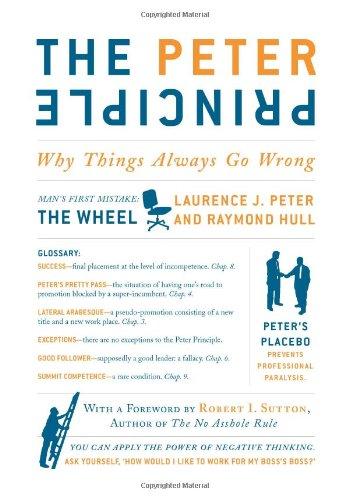
by Laurence J. Peter · 1969
The observation that in any hierarchy, people get promoted until they reach their level of incompetence, and then stay there.
Worth reading? This 1969 book is the rare business satire that became a real theory. Laurence Peter framed it as a joke, 'in a hierarchy, every employee tends to rise to their level of incompetence,' but the joke explains more about why big companies feel broken than most serious management books do. If you've ever watched a brilliant engineer promoted into a managerial coma, or felt yourself quietly drowning after a promotion, this is the book that names it. It's short, funny, and slightly corrosive, you'll never look at an org chart the same way. It's popular precisely because it's true and everybody knows it. That's the Lindy tell: a half-century later, every workplace on earth still confirms it daily.
| Full Title | The Peter Principle: Why Things Always Go Wrong |
|---|---|
| Author | Laurence J. Peter |
| Published | 1969 |
| Publisher | William Morrow |
| Category | Business & Money |
| Favorite quote | “In a hierarchy every employee tends to rise to his level of incompetence.” |
The Verdict
Peter’s 1969 satire, every employee rises to their level of incompetence, became a real theory of why hierarchies quietly fill their top ranks with people who can’t do the top job. Still confirmed in every office on earth.
Read it if you've watched a great engineer become a terrible manager, or suspect your own promotion was a demotion in disguise.
Skip it if you want a serious management system. It's a witty satire with a deadly serious core idea.

Book Summary
The principle: in a hierarchy, every employee tends to rise to their level of incompetence. Competence in one role earns promotion to a role where the old skills don't transfer, until the person is stuck, failing, and immovable.
The corollaries are the funny part. Competence is usually rewarded with promotion, which means the final, permanent job is the first one you're bad at. The system manufactures incompetent managers by design.
Peter's point isn't just office comedy. Any merit-based ladder eventually fills its top ranks with people doing work they can't do, which is why large organizations so often feel quietly broken at the top.
Top 10 Lessons from The Peter Principle
- In a hierarchy, you rise to your level of incompetence. The job you're worst at is the one you get to keep.
- Competence gets rewarded with promotion, straight into a role where the old skills don't apply.
- The top of any organization is staffed by people doing work they can't do. That's not a bug; it's the design.
- Don't confuse a title with ability. A vice president can be failing upward in slow motion.
- The best individual contributor is often the worst manager, because the jobs require opposite skills.
- Watch for 'Peter's Corollary': work is accomplished by those employees who have not yet reached their level of incompetence.
- Lateral moves and mastery beats blind promotion if you want to keep being good at your job.
- Humor is the only defense. Peter sold the idea as satire because the truth was too depressing to deliver straight.
- Institutions optimize for the ladder, not for results, so the ladder keeps producing the wrong people at the top.
- If you're terrified of your new role, you might already be at your level. That's normal; the system expects it.
Top 4 Quotes from The Peter Principle
"In a hierarchy every employee tends to rise to his level of incompetence."
Laurence J. Peter, The Peter Principle
"Work is accomplished by those employees who have not yet reached their level of incompetence."
Laurence J. Peter, The Peter Principle
"The cream rises until it sours."
Laurence J. Peter, The Peter Principle
"In time, every post tends to be occupied by an employee who is incompetent to carry out its duties."
Laurence J. Peter, The Peter Principle
Frequently Asked Questions
Is the Peter Principle a real theory or a joke?
Both. Laurence Peter presented it as gentle satire in 1969, but the mechanism is genuinely observed: merit-based promotion keeps advancing people until they hit a role they can't do, then stops. It's funny because it's true.
How do I avoid my own level of incompetence?
Be deliberate about promotions. If you love the craft, sometimes refusing the management ladder is the smart move. Or pick roles where the new skills build on the old instead of replacing them.
Why is this on a Lindy list?
Because hierarchies haven't changed since 1969, and the principle still explains why your company's top ranks are full of people over their heads. A half-century of confirmation is the Lindy signal.
Ready to read it?
Get The Peter Principle on Amazon