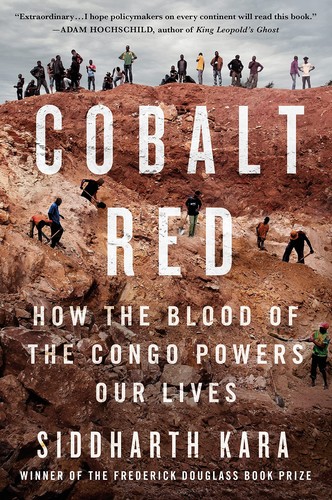
Cobalt Red
by Siddharth Kara · 2023
Every smartphone and EV battery runs on cobalt, and Kara went into the Congo's mines to document what that actually costs the people digging it out by hand.
Worth reading? The strongest case for reading Cobalt Red is also the reason people avoid it: it removes any ability to think of cobalt mining as an abstraction. Kara went into the mines himself, and the book reads like a war correspondent's dispatch, not a policy paper.
| Full Title | Cobalt Red: How the Blood of the Congo Powers Our Lives |
|---|---|
| Author | Siddharth Kara |
| Published | 2023 |
| Publisher | St. Martin's Press |
| Category | History |
| Favorite quote | “Please tell the people in your country, a child of the Congo dies every day so that they can plug in their phones.” |
The Verdict
Kara doesn’t write this as an outside academic tallying up a distant problem. He goes into the pits, talks to the miners, and the book has the texture of witness testimony more than research summary. That’s what makes it land – you can’t file this under “supply chain issue” once you’ve read it.
The tradeoff is that it’s heavier on documentation than on prescription. If you finish this wanting a clear five-step plan for what to do next, you won’t get one. What you’ll get instead is a book that makes it much harder to plug in your phone without a flicker of discomfort, which is arguably the more honest response to what’s actually happening.
Read it if you want the unfiltered version of where a “clean” battery actually comes from. Skip it, or brace yourself, if you need the subject softened to get through it – Kara isn’t interested in softening it.
you want unflinching, on-the-ground reporting on where your phone's and EV's battery actually comes from
you're looking for a policy roadmap -- Kara documents the atrocity in forensic detail, but the 'here's how we fix it' section is thin
Book Summary
More than 70% of the world's cobalt, the mineral inside nearly every lithium-ion battery, comes from the Democratic Republic of the Congo, and a meaningful share of it is dug by hand by "artisanal" miners, including children, working in unregulated pits alongside industrial mining operations owned by multinational corporations. Kara's core argument is that "artisanal" is a misleading, sanitizing word for what is often forced, dangerous, and starvation-wage labor functioning as an informal extension of the formal industrial supply chain, not a separate, small-scale activity happening nearby it.
The corporate accountability structures built to prevent exactly this (ethical sourcing audits, supply chain traceability programs) mostly fail in practice, because cobalt from artisanal pits gets physically mixed with industrially mined cobalt before it ever leaves the Congo, making it nearly impossible for a phone or EV maker to certify its battery is clean, and giving companies plausible deniability they don't have to work very hard to maintain.
Kara frames this as a direct continuation of the Congo's colonial extraction history -- rubber and ivory under Belgian rule, now cobalt under a global tech economy -- with the same pattern of outside wealth extracted at the cost of local lives, and the same asymmetry of power that leaves Congolese miners with almost no ability to change the terms of their own exploitation.
Top 10 Lessons from Cobalt Red
- Global tech supply chains can run on forced and child labor that the end consumer never sees and is actively shielded from by layers of subcontracting.
- 'Artisanal mining' sounds small-scale and informal, but in the Congo's cobalt sector it often functions as an unregulated, dangerous extension of industrial mining companies' own supply chains.
- Ethical sourcing audits and supply chain traceability programs can function as a shield for corporate liability rather than a genuine safeguard for workers, especially once artisanal and industrial cobalt get physically mixed together.
- Poverty and desperation, not a lack of awareness of the danger, push families and children into mines known to be lethal.
- Colonial-era extraction patterns in the Congo (rubber, ivory) have repeated themselves under new commodities and new corporate names, not ended with independence.
- A multinational's legal ownership of a mine doesn't guarantee the labor inside it is monitored or humane -- subcontracting layers exist partly to obscure who is actually responsible.
- The demand driving this exploitation isn't a distant villain -- it's the everyday electronics (phones, laptops, EVs) the reader already owns.
- Government and corporate accountability moves slowly, or not at all, when the people harmed have almost no political leverage domestically or internationally.
- On-the-ground reporting can surface a systemic injustice that a finished product's marketing (a sleek phone, a 'green' EV) will never reveal.
- A supply chain being framed as environmentally responsible (electric vehicles, renewable energy storage) doesn't mean the labor behind it is.
Top 4 Quotes from Cobalt Red
"Labor is valued by the penny, life hardly at all."
Siddharth Kara, Cobalt Red
"Our daily lives are powered by a human and environmental catastrophe in the Congo."
Siddharth Kara, Cobalt Red
"Cobalt mining is the slave farm perfected -- the cost of labor has been nullified through the degradation of Africans at the bottom of an economic chain that purports to exonerate all participants of accountability through a shrewd scheme of obfuscation adorned with hypocritical proclamations about the preservation of human rights."
Siddharth Kara, Cobalt Red
"Please tell the people in your country, a child of the Congo dies every day so that they can plug in their phones."
Siddharth Kara, Cobalt Red
Frequently Asked Questions
Is Cobalt Red worth reading?
Yes -- it's the most direct, ground-level account available of what cobalt mining actually costs the people doing it, and Kara's own reporting (not secondhand summary) is what makes the claims hard to dismiss.
What is Cobalt Red about?
Siddharth Kara's firsthand investigation into cobalt mining in the Democratic Republic of the Congo, documenting the forced and child labor behind a mineral that powers nearly every smartphone, laptop, and electric vehicle battery in the world.
Is Cobalt Red hard to read?
Yes. It covers child labor and mining deaths directly, without softening them for comfort. That's a feature of the reporting, not a flaw -- treat it as a heavy read, not a casual one.
Does Cobalt Red name the companies involved?
It discusses the corporate supply chain broadly and how sourcing audits fail in practice, more than it runs a company-by-company indictment -- the point is systemic, not a single villain to blame.
Does Cobalt Red offer solutions, not just the problem?
Some, toward the end, but it's the thinnest part of the book. Read it for the reporting; don't expect a fully worked-out policy fix.
Ready to read it?
Get Cobalt Red on Amazon