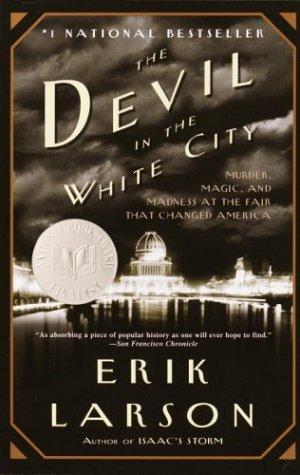
Devil in the White City
by Erik Larson · 2003
The story of the 1893 Chicago World's Fair, told alongside the story of a serial killer who used the fair's chaos and crowds to lure and murder victims a few miles from the gates.
Worth reading? Larson's dual structure is the reason this book became a phenomenon: the architectural triumph of the 1893 World's Fair and H.H. Holmes's murders unfolding a few miles apart make each other more vivid by contrast, one story showcasing America's engineering ambition, the other exploiting the same era's lack of infrastructure for tracking a missing person.
| Full Title | The Devil in the White City: Murder, Magic, and Madness at the Fair That Changed America |
|---|---|
| Author | Erik Larson |
| Published | 2003 |
| Publisher | Crown Publishers |
| Category | History |
The Verdict
The alternating structure is the whole craft achievement here – cutting between Burnham racing the calendar to open the fair and Holmes calmly luring victims a few miles away lets Larson build suspense in both threads simultaneously, even though you already know the fair opens and Holmes eventually gets caught.
The fair sections are more detailed than most readers expect going in, and genuinely fascinating on their own: the invention of the Ferris Wheel, the death of the chief architect mid-project, the sheer scale of building a temporary city in two years.
Holmes’s sections are unsettling specifically because Larson doesn’t sensationalize – the mundane, procedural way he lured and killed victims is more disturbing for being underplayed.
Read it if you want narrative nonfiction that reads like a thriller but holds up as rigorous history. Skip it if you’re looking for a primarily true-crime book – the fair’s construction gets equal or greater attention.
you want narrative nonfiction that reads with the pacing of a thriller while staying rigorously sourced -- Larson alternates between the fair's construction and the killer's crimes chapter by chapter
you want the true-crime thread to be the book's main focus -- the fair's architecture and construction actually gets more page count than the murders, which surprises some readers expecting a pure serial-killer story

Book Summary
Daniel Burnham led the herculean, disaster-plagued effort to build the 1893 World's Columbian Exposition in Chicago in barely two years, an undertaking that included inventing the Ferris Wheel to out-do the Eiffel Tower, surviving the deaths of key architects mid-project, and racing weather and labor disputes to open on time -- the fair ultimately drew over 27 million visitors and showcased electric lighting and technologies that reshaped how Americans imagined a city.
Simultaneously, H.H. Holmes, a charming con man and physician, built a hotel near the fairgrounds specifically designed with hidden rooms, gas chambers, and a basement crematorium to murder an unknown number of victims -- mostly young women drawn to Chicago by the fair -- exploiting the era's lack of any missing-persons infrastructure or interstate criminal tracking to operate for years without detection.
Larson uses the two threads to argue something larger about the era itself: the same forces that made the fair possible -- rapid urbanization, a flood of newcomers to Chicago, weak civic infrastructure, and the era's faith in charismatic individual genius -- also created ideal cover for a predator like Holmes to operate undetected for years.
Top 8 Lessons from Devil in the White City
- The 1893 World's Fair was built in roughly two years under Daniel Burnham's direction, an engineering and logistical feat that included inventing the Ferris Wheel specifically to rival the Eiffel Tower from the 1889 Paris exposition.
- H.H. Holmes built his 'murder castle' hotel with architectural features -- hidden rooms, gas lines, a basement crematorium -- specifically designed to enable murder and body disposal without detection.
- The lack of interstate missing-persons tracking or coordinated police infrastructure in the 1890s let Holmes operate for years, since victims who came from other cities or states were rarely traced back to Chicago.
- The fair showcased then-novel technologies, including widespread electric lighting, that fundamentally changed public expectations of what a modern city could look like and function like.
- Burnham's project faced repeated disasters during construction, including the sudden death of his chief architect, John Root, and constant risk of missing the fair's opening deadline.
- Holmes exploited the fair's massive influx of young, often single women arriving in Chicago for work or adventure, using employment offers and charm to lure victims to his hotel.
- The fair's 'White City' nickname came from the uniform white neoclassical facades of its buildings, a deliberate aesthetic choice meant to project order and civilizational progress -- an irony given what was simultaneously happening nearby.
- Larson's reconstruction is built entirely from primary sources -- letters, journals, court records -- and he's explicit in his author's note about where the historical record has gaps versus where scenes are documented.
Frequently Asked Questions
Is Devil in the White City worth reading?
Yes -- it's meticulously researched narrative nonfiction that reads with thriller pacing, alternating between the World's Fair's construction and H.H. Holmes's murders.
What is Devil in the White City about?
The 1893 Chicago World's Fair, built under architect Daniel Burnham, told alongside the simultaneous murders committed by serial killer H.H. Holmes, who lured victims to a hotel he built near the fairgrounds.
Is Devil in the White City a true story?
Yes, it's narrative nonfiction built from primary sources -- letters, journals, and court records -- with Larson noting in his author's note where scenes are documented versus reconstructed.
Is Devil in the White City more about the fair or the murders?
The fair's construction actually receives more page count than the murders, which surprises some readers expecting a primarily true-crime book.
Has Devil in the White City been adapted into a film or show?
A television adaptation has been in development for years with figures including Martin Scorsese and Leonardo DiCaprio attached at various points, though it had not been released as of this writing.
Ready to read it?
Get Devil in the White City on Amazon