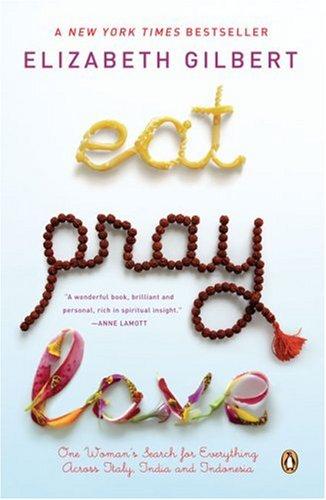
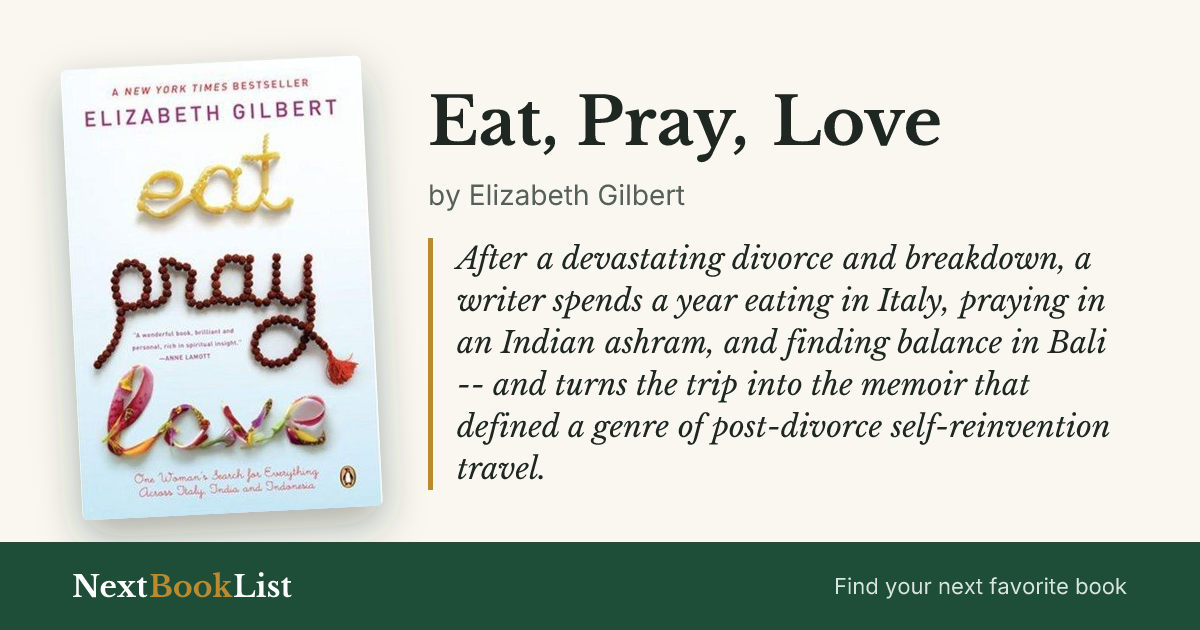
Eat, Pray, Love
by Elizabeth Gilbert · 2006
After a devastating divorce and breakdown, a writer spends a year eating in Italy, praying in an Indian ashram, and finding balance in Bali -- and turns the trip into the memoir that defined a genre of post-divorce self-reinvention travel.
Worth reading? Eat, Pray, Love earned its ubiquity because Gilbert is a genuinely skilled prose stylist who's honest about her own mess, not just performing enlightenment. The Italy section is the most purely enjoyable, the India section the most serious, and the Bali section the one that draws the most criticism for wrapping things up too neatly with a romance.
| Full Title | Eat, Pray, Love: One Woman's Search for Everything Across Italy, India and Indonesia |
|---|---|
| Author | Elizabeth Gilbert |
| Published | 2006 |
| Publisher | Viking / Penguin |
| Category | Biographies & Memoirs |
| Favorite quote | “Ruin is a gift. Ruin is the road to transformation.” |
The Verdict
The Italy section is the easiest sell – Gilbert learning to actually taste food again after a depression that flattened her appetite for pleasure is a legitimately moving recovery story, even before it gets to the language lessons and long lunches.
India is where the book earns its seriousness. Gilbert doesn’t pretend meditation comes easily to her; she’s blunt about squirming through it, and that honesty is what keeps the ashram section from reading like spiritual-tourism marketing copy.
The Bali section is the weakest, mostly because its resolution – finding balance largely through a new romance – sits uneasily against a book that spent 250 pages arguing for learning to be whole alone.
Read it if you want a candid, well-crafted memoir about rebuilding a sense of self after a real collapse. Skip it if the “book advance funds a year of self-discovery abroad” premise is a dealbreaker you can’t get past.
you want a candid, well-written account of rebuilding a sense of self after a personal collapse, structured around genuine spiritual searching rather than a vacation dressed up as growth
the premise of funding a year abroad through a book advance strikes you as a privilege the book doesn't reckon with enough -- it's a fair criticism, and the book has taken real heat for it
Book Summary
After a brutal divorce and a rebound relationship that also collapses, Gilbert negotiates a book deal to fund a year split evenly across three countries, each mapped to a different pursuit: Italy for pleasure (specifically, learning to enjoy food and language again after depression stripped her appetite for both), India for devotion (four months at an ashram doing intensive meditation and spiritual practice), and Indonesia for balance (studying with a Balinese medicine man she'd met on an earlier trip).
The book's structure -- 108 short chapters, echoing the beads of a japa mala prayer necklace -- mirrors its spiritual framing, and Gilbert is candid throughout about her own impatience, selfishness, and struggle to sit still with meditation, which keeps the book from reading as spiritual tourism dressed up as profundity.
The book became a cultural touchstone (and later a target of backlash) partly because it gave language to a specific kind of post-divorce, financially enabled self-reinvention journey, and partly because Gilbert's prose is genuinely funny and self-aware even when the material gets heavy.
Top 8 Lessons from Eat, Pray, Love
- The book is structured deliberately around three countries mapped to three pursuits -- pleasure in Italy, devotion in India, balance in Indonesia -- which gives the memoir a clear thematic architecture rather than a loose travelogue.
- Gilbert is candid about failing at meditation and spiritual discipline for much of her time at the Indian ashram, which keeps the India section from reading as an easy enlightenment narrative.
- The Italy section reframes pleasure itself -- specifically learning to enjoy food and language -- as a legitimate form of recovery after depression, not just self-indulgence.
- Gilbert's relationship with Ketut Liyer, the Balinese medicine man, and her earlier promise to help him financially, becomes a real narrative thread that pays off later in the book and in her life.
- The memoir doesn't hide its own privilege -- Gilbert explicitly acknowledges the book advance that funded the trip -- though critics have argued the book still doesn't reckon with that privilege deeply enough.
- The book treats depression and divorce-related breakdown honestly, including a scene of Gilbert crying on her bathroom floor that opens the book and sets its emotional stakes.
- Her friendship and mentorship with Richard from Texas at the ashram provides the book's clearest voice of blunt, unsentimental wisdom, cutting through some of Gilbert's more indulgent passages.
- The Bali section's resolution in a new romantic relationship (with Felipe, later her husband) is the part most criticized for undercutting the book's stated goal of learning to be whole alone.
Top 4 Quotes from Eat, Pray, Love
"Ruin is a gift. Ruin is the road to transformation."
Elizabeth Gilbert, Eat, Pray, Love
"You need to learn how to select your thoughts just the same way you select your clothes every day."
Elizabeth Gilbert, Eat, Pray, Love
"To lose balance sometimes for love is part of living a balanced life."
Elizabeth Gilbert, Eat, Pray, Love
"Happiness is the consequence of personal effort."
Elizabeth Gilbert, Eat, Pray, Love
Frequently Asked Questions
Is Eat, Pray, Love worth reading?
Yes, if you want a candid, well-written memoir about rebuilding identity after collapse -- Gilbert's prose is genuinely strong, even if the premise draws fair criticism about privilege.
What is Eat, Pray, Love about?
Elizabeth Gilbert's account of spending a year after her divorce split between Italy, India, and Indonesia, seeking pleasure, spiritual devotion, and balance respectively.
Is Eat, Pray, Love a true story?
Yes, it's a memoir based on Gilbert's own year of travel, though some names and details were changed.
Why has Eat, Pray, Love received criticism?
Critics argue the book doesn't fully reckon with the financial privilege (a book advance) that funded the trip, and that the Bali section's romantic resolution undercuts its message about being whole alone.
Is the movie adaptation faithful to the book?
The 2010 film starring Julia Roberts follows the book's three-country structure closely but compresses much of the interior reflection that makes the book work.
Ready to read it?
Get Eat, Pray, Love on Amazon