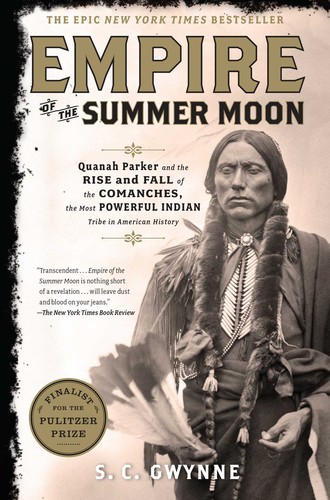
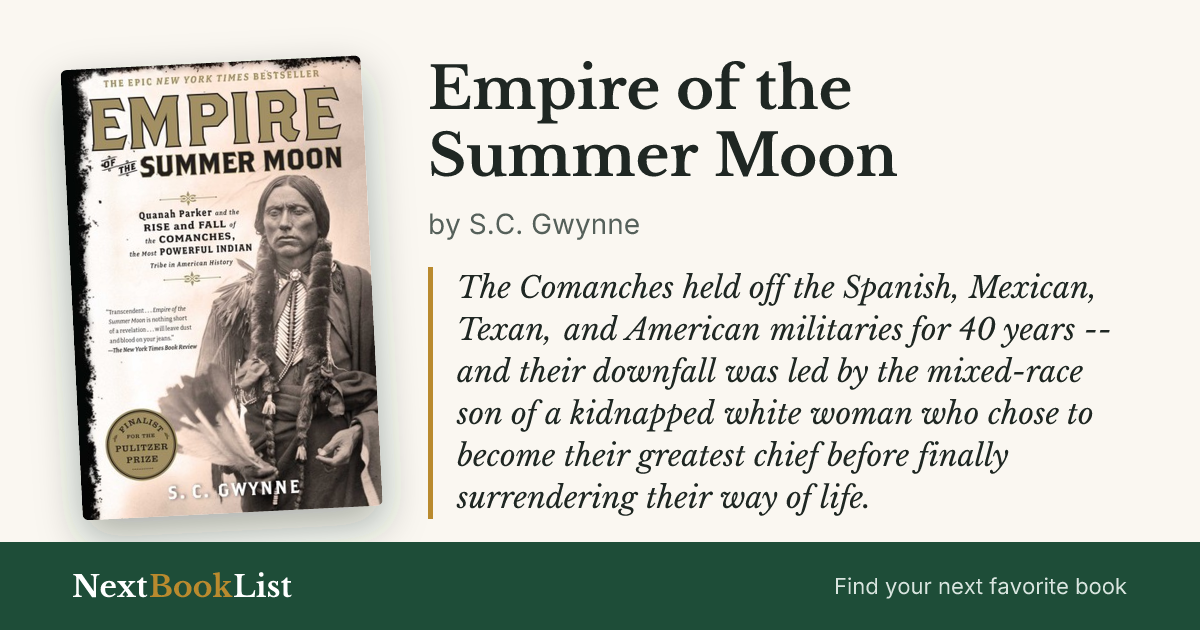
Empire of the Summer Moon
by S.C. Gwynne · 2010
The Comanches held off the Spanish, Mexican, Texan, and American militaries for 40 years -- and their downfall was led by the mixed-race son of a kidnapped white woman who chose to become their greatest chief before finally surrendering their way of life.
Worth reading? Gwynne's real achievement is refusing to pick a side -- he shows you Comanche raiding brutality and U.S. Army brutality with the same unflinching detail, then centers the whole story on Quanah Parker, a man who lived inside both worlds and ended up brokering the terms of his own people's defeat.
| Full Title | Empire of the Summer Moon: Quanah Parker and the Rise and Fall of the Comanches, the Most Powerful Indian Tribe in American History |
|---|---|
| Author | S.C. Gwynne |
| Published | 2010 |
| Publisher | Scribner |
| Category | History |
| Favorite quote | “The Comanches were, quite simply, the most powerful Indian tribe in American history.” |
The Verdict
Gwynne’s smartest choice is scale – instead of trying to cover the entire Plains Indian Wars, he narrows to one family and lets their story carry the whole collision. Cynthia Ann Parker gets kidnapped as a child, goes fully native, and later refuses to be “rescued” back into white society. Her son Quanah becomes the last great Comanche war chief and then, when the fight is lost, a pragmatic broker for his people’s survival.
What makes this better than a standard frontier history is Gwynne’s refusal to flatten either side into hero or villain. Comanche raids get described in the same unflinching detail as U.S. Army massacres. Nobody comes out of this book looking clean, and that’s the point – it’s history, not myth.
Read it if you want one sweeping, well-told story that explains the entire violent collision between Plains Indian cultures and American expansion. Skip it if graphic violence on both sides is going to be more than you want to sit with – this book doesn’t look away from either.
you want a single, sweeping story that explains the entire violent collision between Plains Indian cultures and westward American expansion, centered on one family
you're sensitive to graphic violence -- Gwynne doesn't sanitize Comanche raiding tactics or the U.S. Army's retaliation, and both get described in unflinching detail
Book Summary
The Comanches weren't a static, pre-modern culture waiting to be overrun -- they were history's most dominant light cavalry, having transformed themselves around the horse into a mobile empire that controlled a territory called the Comancheria and held off three empires and one republic for the better part of two centuries.
Cynthia Ann Parker's kidnapping as a child and her total assimilation into Comanche life (she refused repatriation and mourned her return to white society) complicates every simple narrative about captivity -- and her son Quanah's rise to become the last great Comanche war chief, and later a pragmatic reservation-era leader, embodies the same complexity on a larger scale.
The Comanches' defeat wasn't primarily a military failure -- it was the destruction of the buffalo herds, systematically hunted toward extinction by the U.S. government as a deliberate strategy, that broke the material base of Comanche independence faster than any single battle could.
Top 8 Lessons from Empire of the Summer Moon
- The Comanches transformed themselves into a dominant military and economic power by mastering horse culture, not by having superior numbers or technology.
- Buffalo extermination was a deliberate U.S. strategy to break Plains Indian independence, not an accidental byproduct of westward settlement.
- Captivity narratives are more complicated than rescue stories suggest -- Cynthia Ann Parker resisted her own 'rescue' back into white society after decades of Comanche life.
- A single family's story (the Parkers) can carry the weight of an entire civilizational collision if the author picks the right family.
- Quanah Parker's pivot from war chief to reservation-era political leader shows that surviving conquest sometimes requires becoming a pragmatic broker rather than a martyr.
- Neither side of the frontier wars was uniformly innocent -- Comanche raiding tactics and U.S. Army reprisals both involved deliberate brutality against civilians.
- Cultural assimilation runs in both directions -- white captives sometimes fully adopted the culture that captured them, complicating any simple 'civilization versus savagery' framing.
- Technological and economic disruption (repeating rifles, railroads, buffalo hide markets) can end a centuries-old way of life faster than direct military confrontation.
Top 2 Quotes from Empire of the Summer Moon
"The Comanches were, quite simply, the most powerful Indian tribe in American history."
S.C. Gwynne, Empire of the Summer Moon
"There was no such thing as the American West without the Comanches, and no such thing as the Comanches without the horse."
S.C. Gwynne, Empire of the Summer Moon
Frequently Asked Questions
Is Empire of the Summer Moon worth reading?
Yes -- it's a gripping, well-researched account of the Comanche empire's rise and fall, told through one family's story rather than as a dry historical survey.
What is Empire of the Summer Moon about?
It traces the Comanche tribe's rise as history's most dominant Plains cavalry power and its eventual defeat, centered on Cynthia Ann Parker (a white captive who became fully Comanche) and her son Quanah Parker, the last great Comanche war chief.
Is Empire of the Summer Moon historically accurate?
Yes -- it's narrative nonfiction built on extensive historical research and primary sources, though like any popular history it compresses and dramatizes for readability.
Is the book violent?
Yes -- it describes both Comanche raiding tactics and U.S. Army reprisals in unflinching, sometimes graphic detail. Go in prepared for that.
Who was Quanah Parker?
The last great war chief of the Comanches and the mixed-race son of Cynthia Ann Parker, a kidnapped white settler who fully assimilated into Comanche life -- he later became a pragmatic reservation-era leader.
Ready to read it?
Get Empire of the Summer Moon on Amazon