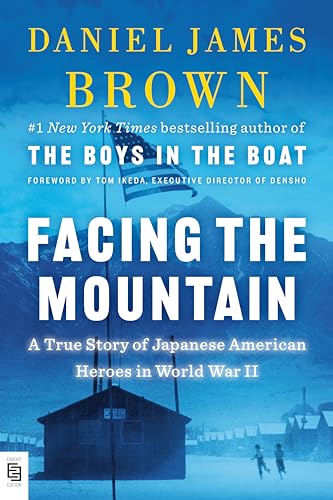
Facing the Mountain
by Daniel James Brown · 2021
Young Japanese American men fight for a country that just imprisoned their families in internment camps, and Brown follows several of them from behind barbed wire to the battlefields of Europe, where their unit became one of the most decorated in US military history.
Worth reading? Brown takes the same multi-thread, deeply reported approach that made The Boys in the Boat work and applies it to a much darker premise: young Japanese American men enlisting to fight for a country that had just locked their families behind barbed wire. The 442nd's battlefield record -- one of the most decorated units in US history -- lands with real weight because Brown has already shown you exactly what these men and their families were asked to sacrifice before they ever set foot in Europe.
| Full Title | Facing the Mountain: A True Story of Japanese American Heroes in World War II |
|---|---|
| Author | Daniel James Brown |
| Published | 2021 |
| Publisher | Viking |
| Category | History |
The Verdict
Brown takes the reporting style that made The Boys in the Boat land – multiple deeply researched lives followed in parallel – and applies it to a story with a much harder edge: young Japanese American men enlisting to fight for a country that had just put their families behind barbed wire. He doesn’t resolve that contradiction, and he shouldn’t. Both the loyalty and the injustice were real.
The 442nd’s combat record becomes genuinely moving because you’ve already seen what it cost these families before a single battle. Read it for one of the strongest entries in recent WWII narrative history. Skip it if you want a single-protagonist story – this tracks several men and families at once, which asks more patience up front.
you want WWII history that centers the internment camps and the 442nd Regimental Combat Team, told through several individual soldiers' full arcs rather than a single hero's story
you want a tight single-narrative WWII book -- Brown tracks multiple men across camps, battlefields, and postwar lives in parallel, which asks more patience than a single-protagonist account
Book Summary
Japanese American soldiers in the 442nd fought with extraordinary distinction for a country actively imprisoning their families in internment camps, a contradiction Brown refuses to resolve or soften -- their loyalty was real, and the injustice done to them was also real, simultaneously.
Internment wasn't a backdrop detail -- it was the direct, material condition many of these soldiers' families lived under while their sons fought and died overseas, and Brown tracks both threads in parallel to keep that connection visible throughout.
Extraordinary battlefield performance doesn't automatically translate into full citizenship or respect back home. The 442nd's soldiers returned to a country still capable of treating them as suspect, which complicates any simple wartime-heroism narrative.
Top 8 Lessons from Facing the Mountain
- Japanese American soldiers fought with extraordinary distinction for a country that had imprisoned their own families in internment camps.
- Wartime loyalty and the injustice of internment coexisted as simultaneous, unresolved facts -- one doesn't cancel the other.
- Extraordinary battlefield sacrifice doesn't automatically convert into full civic acceptance back home.
- Fear and prejudice during wartime can override due process at a national scale, as internment demonstrates.
- Individual family sacrifice (parents in camps, sons on the battlefield) was the lived reality behind unit-level statistics.
- Military service was one path some Japanese Americans used to actively contest their treatment as suspect citizens.
- A single historical injustice (internment) can run in parallel with genuine wartime heroism without either erasing the other.
- Postwar recognition for the 442nd came slowly and unevenly, well behind the scale of what the unit actually achieved.
Frequently Asked Questions
Is Facing the Mountain worth reading?
Yes, especially if you want WWII history that centers Japanese American internment and the 442nd's combat record together, told through deeply reported individual stories.
What is Facing the Mountain about?
Several young Japanese American men who enlisted to fight in WWII Europe while their families were held in internment camps, and their unit's record as one of the most decorated in US history.
Is Facing the Mountain similar to The Boys in the Boat?
Yes in structure and reporting style -- Brown uses the same multi-thread, deeply researched narrative approach, applied here to a much darker historical injustice.
Does Facing the Mountain cover the internment camps in detail?
Yes -- it tracks the soldiers' families' internment experience in parallel with the battlefield narrative throughout the book.
Ready to read it?
Get Facing the Mountain on Amazon