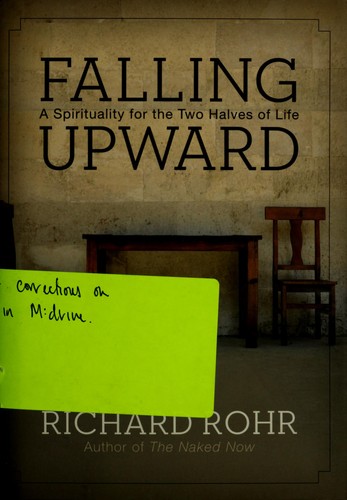
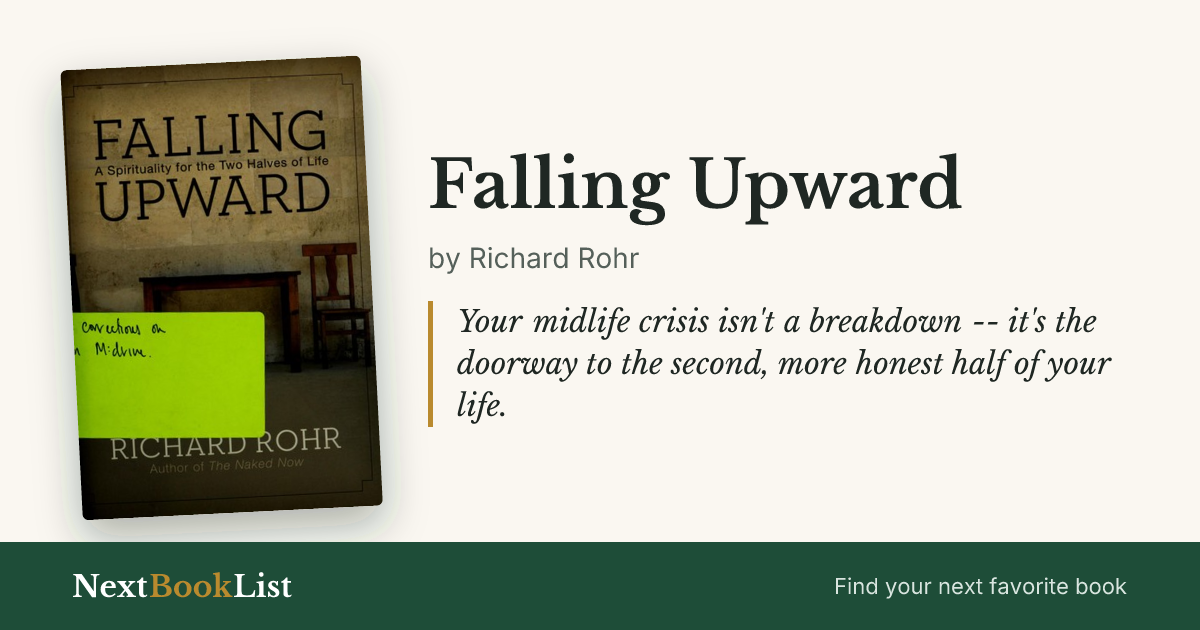
Falling Upward
by Richard Rohr · 2011
Your midlife crisis isn't a breakdown -- it's the doorway to the second, more honest half of your life.
Worth reading? Falling Upward is the rare spirituality book that admits failure is the curriculum, not the interruption. Rohr, a Franciscan priest, argues that the first half of life is about building a container (identity, career, security) and the second half is about what you put in it once the falling apart happens -- a divorce, a layoff, a diagnosis, whatever cracks the container open. It's Christian in its language but not narrow in its audience; the framework holds up whether or not you believe what Rohr believes. Read it once you've actually had a fall to make sense of, not before.
| Full Title | Falling Upward: A Spirituality for the Two Halves of Life |
|---|---|
| Author | Richard Rohr |
| Published | 2011 |
| Publisher | Jossey-Bass |
| Category | Religion & Spirituality |
| Favorite quote | “Before the truth sets you free, it tends to make you miserable.” |
The Verdict
Rohr spends the first half of the book describing the first half of life, and it’s a useful mirror even if you already know the story: you build an identity, a career, a set of rules, because you need a container before you can put anything meaningful in it. The second half of the book is where it earns its keep – the argument that the container has to crack, usually through something you didn’t choose, before you can access what actually matters.
It’s written from inside a Christian framework, and Rohr doesn’t pretend otherwise. But the shape of the argument, that failure isn’t a bug in the spiritual life but the actual mechanism of growth, holds up whether or not you share his theology. Read it if you’re on the other side of a fall and want language for what happened. Skip it if you’re still building your first-half identity – Rohr himself says the book won’t make sense yet.
you're past 40, questioning what you built, and want a framework that isn't 'just be more grateful'
you're in your 20s building your identity -- Rohr says this book won't land until you've actually got a first half to fall from
Book Summary
Life has two halves with two different jobs. The first half builds the container: identity, security, a career, rules to live by. The second half is about what actually goes into that container -- meaning, wisdom, service -- and most people never make the transition because nothing forces them to.
The transition is usually triggered by "necessary suffering": a failure, loss, illness, or humiliation that cracks the first-half container. Rohr's central, counterintuitive claim is that this falling apart is not a mistake to recover from, it's the doorway itself. You fall upward, not down.
Second-half-of-life people trade certainty for mystery and control for surrender. They stop needing to win every argument or prove themselves right, because the ego's grip has already been loosened by whatever broke them.
Top 8 Lessons from Falling Upward
- Life has two distinct halves: building a container (first half), then filling it with meaning (second half).
- Most people never make the transition to the second half because nothing forces the change.
- Necessary suffering, failure, loss, humiliation, is usually what triggers the shift, not gradual insight.
- The fall itself is the doorway, not a detour from the real path.
- First-half priorities: identity, security, achievement, rules. Second-half priorities: meaning, service, mystery.
- Letting go of the need to be right is a marker of second-half maturity, not weakness.
- Institutions and religions are mostly built for first-half tasks, which is why they often can't guide people through the second half.
- Growing older without growing up is possible -- age alone doesn't guarantee the transition happens.
Top 5 Quotes from Falling Upward
"Before the truth sets you free, it tends to make you miserable."
Richard Rohr, Falling Upward
"The ego hates losing -- even to God."
Richard Rohr, Falling Upward
"You ironically have to have a very strong ego structure to let go of your ego. You need to struggle with the rules more than a bit before you throw them out. You only internalize values by butting up against external values for a while."
Richard Rohr, Falling Upward
"In the second half of life, we do not have strong and final opinions about everything, every event, or most people, as much as we allow things and people to delight us, sadden us, and truly influence us."
Richard Rohr, Falling Upward
"Wisdom happily lives with mystery, doubt, and 'unknowing,' and in such living, ironically resolves that very mystery to some degree."
Richard Rohr, Falling Upward
Frequently Asked Questions
Is Falling Upward worth reading?
Yes, especially if you're past a major life setback and looking for a framework that treats the setback as meaningful rather than just something to recover from.
Do I need to be religious to read Falling Upward?
No. Rohr writes from a Franciscan Christian perspective, but the two-halves-of-life framework holds up regardless of your beliefs.
What is the main idea of Falling Upward?
Life has two halves -- building an identity, then finding meaning -- and the shift between them is usually triggered by failure or loss, not gradual self-improvement.
Who is Falling Upward for?
Adults, generally past 40, who've had something crack their sense of who they are: a career failure, a divorce, a health scare. It's less useful to someone still building their first-half identity.
Is Falling Upward a self-help book?
Not in the tactical sense -- there's no program or exercises. It's a reframe, meant to help you make sense of a fall you've already had, not prevent one.
Ready to read it?
Get Falling Upward on Amazon