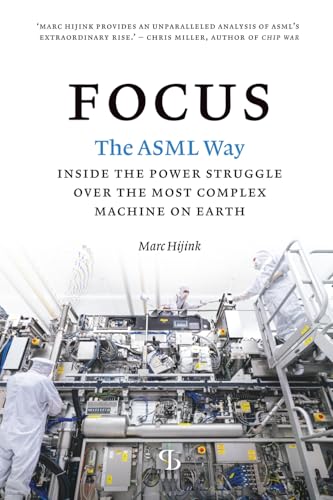
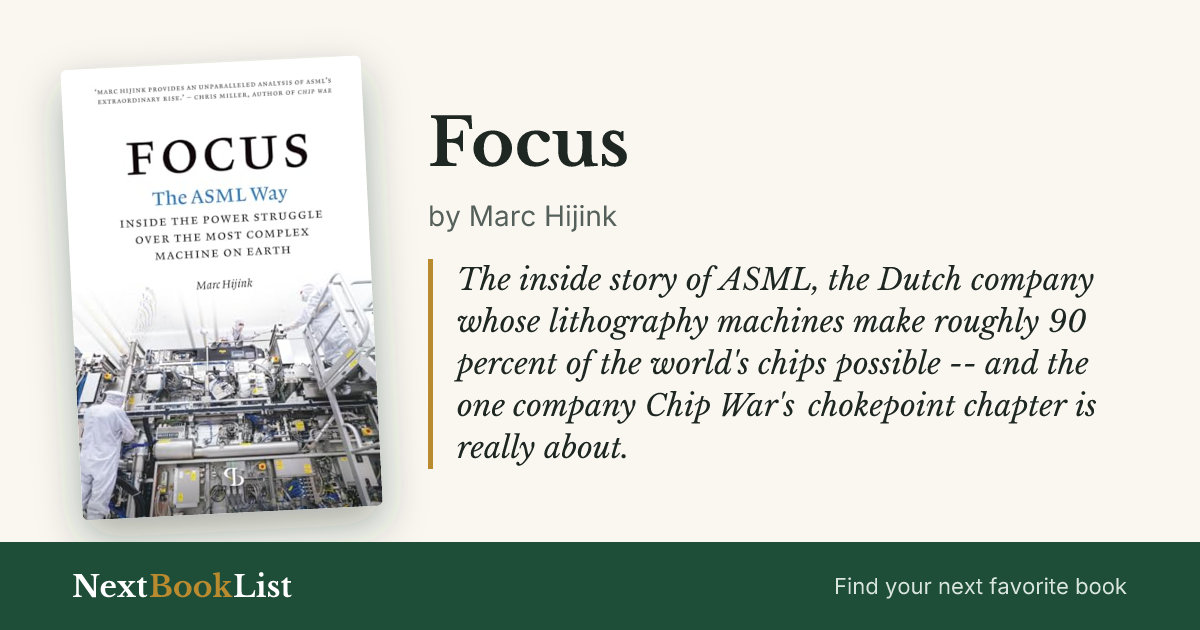
Focus
by Marc Hijink · 2024
The inside story of ASML, the Dutch company whose lithography machines make roughly 90 percent of the world's chips possible -- and the one company Chip War's chokepoint chapter is really about.
Worth reading? Focus goes where Chip War only gestures: inside ASML, the single company that makes the extreme ultraviolet (EUV) lithography machines every advanced chipmaker depends on. Hijink, a journalist who covered the company for years, had rare access to its engineers and executives, and the result reads less like a geopolitics book and more like a technology company biography, closer in spirit to a Michael Lewis narrative than a policy report. It's strongest explaining how ASML became a monopoly almost by accident, through decades of engineering bets few competitors were willing to make. It's weaker on independent scrutiny of the company's government ties and export-control entanglements. Read it after Chip War if you want the ASML chapter expanded into a full book. Skip it if you specifically want a critical outsider's account.
| Full Title | Focus: The ASML Way -- Inside the Power Struggle Over the Most Complex Machine on Earth |
|---|---|
| Author | Marc Hijink |
| Published | 2024 |
| Category | Business & Money |
The Verdict
Chip War tells you ASML is the industry’s chokepoint. Hijink, who covered the company for over a decade, tells you how a Philips spinoff turned an all-or-nothing bet on EUV lithography into a monopoly almost nobody else was willing to chase.
you read Chip War and want the company-level deep dive on ASML specifically, not just its role in the wider industry
you want a critical, arm's-length analysis -- Hijink covered ASML for over a decade and the book leans closer to admiring than skeptical
Book Summary
ASML's EUV lithography monopoly wasn't inevitable, it came from a decades-long bet on a technology (extreme ultraviolet light for chip patterning) so difficult that most competitors gave up on it, leaving ASML alone at the frontier by the time it finally worked.
A single EUV machine takes years to build, costs well over $100 million, and requires components from a global supply chain so specialized that no rival company can currently replicate the whole stack, making ASML a structural chokepoint rather than just a market leader.
ASML's culture prized long-term, collaborative engineering over short-term shareholder pressure, and that patience, funded partly through partnerships with customers like Intel, Samsung, and TSMC who invested directly in ASML's R&D, is part of why competitors couldn't catch up.
Top 7 Lessons from Focus
- ASML's EUV monopoly came from persisting on a bet competitors judged too difficult, not from a single clever product decision.
- A single EUV lithography machine takes years to build and costs well over $100 million.
- ASML's own customers (Intel, Samsung, TSMC) invested directly in its R&D, tying their futures to ASML's success.
- No single company can currently replicate ASML's full supply chain, which is what turns market leadership into a structural chokepoint.
- Long, patient engineering bets that shareholders might not tolerate elsewhere were core to how ASML pulled ahead.
- ASML sits at the center of U.S.-China chip export control fights precisely because it has no real substitute.
- The company's rise from a Philips spinoff to indispensable chokepoint took decades, not a single breakthrough moment.
Frequently Asked Questions
Is Focus: The ASML Way worth reading?
Yes, if you want the company-level story behind the chokepoint Chip War describes at the industry level. It's an access-driven account, not a critical outsider's analysis.
Why does ASML matter so much in chip manufacturing?
ASML is the only company that makes the extreme ultraviolet (EUV) lithography machines required to manufacture the most advanced chips, giving it an effective monopoly on a critical step nearly every advanced chipmaker depends on.
How does Focus compare to Chip War?
Chip War covers the whole semiconductor industry's geopolitics; Focus narrows in on one company, ASML, with far more operational and cultural detail, but less independent scrutiny.
Ready to read it?
Get Focus on Amazon