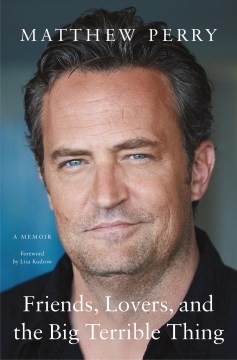
Friends, Lovers, and the Big Terrible Thing
by Matthew Perry · 2022
The actor who played Chandler Bing on the most successful sitcom of its era spent that entire run addicted to alcohol and opioids -- and this memoir, published a year before his death, is his own account of nearly dying from it more than once.
Worth reading? Friends, Lovers, and the Big Terrible Thing is a harder book than its marketing suggested, and given Perry's death in 2023, it now reads as a document with more weight than anyone could have intended at publication. He's specific and unsparing about the mechanics of his addiction -- the near-fatal colon rupture, the dozens of stints in rehab, relapsing during some of the show's most famous episodes -- and that specificity, not the celebrity name-dropping, is what makes the book matter.
| Full Title | Friends, Lovers, and the Big Terrible Thing: A Memoir |
|---|---|
| Author | Matthew Perry |
| Published | 2022 |
| Publisher | Flatiron Books |
| Category | Biographies & Memoirs |
| Favorite quote | “I think you actually have to have all of your dreams come true to realize they are the wrong dreams.” |
The Verdict
Handle this one with real gravity, not a quip. Perry died a little over a year after this book came out, from causes tied to the same addiction the book describes in detail, which means the near-death passages here aren’t a survivor’s retrospective anymore – they’re closer to a warning that went unheeded. Read it as what it actually is: someone trying, imperfectly and repeatedly, to tell the truth about something that eventually killed him.
you want a genuinely honest addiction memoir from someone whose public success (Friends, at its peak) makes the private collapse it's hiding underneath more jarring, not less
you want a nostalgic Friends-cast retrospective -- the show is present but this book is fundamentally about addiction and near-death, not a lighthearted trip through the sitcom's greatest moments
Book Summary
Perry traces his addiction to alcohol and prescription opioids from his teenage years through the entire run of Friends, describing how he was often the funniest person in a scene while privately in withdrawal or actively drunk on set, and details a 2018 gastrointestinal perforation that put him in a coma and nearly killed him, followed by years of surgeries and continued relapse.
The book's central argument, made explicit in its title, is that addiction ("the big terrible thing") was the actual organizing force of his adult life regardless of how much external success -- fame, wealth, a beloved role -- surrounded it. He's candid that neither the show's success nor any individual relationship could fix what the addiction was doing to him, and that recovery required ongoing, unglamorous, repeated effort rather than a single dramatic turning point.
Top 7 Lessons from Friends, Lovers, and the Big Terrible Thing
- Perry is specific that career success and public adoration (being Chandler on the biggest show on television) did nothing to interrupt his addiction -- external validation and internal crisis ran on entirely separate tracks.
- The book documents relapse as cyclical and ongoing rather than a single failure to overcome -- he describes dozens of stints in treatment, underscoring that addiction recovery isn't a one-time fix even with resources most people don't have access to.
- His account of the 2018 gastrointestinal rupture and resulting coma is presented as a near-death event he doesn't fully remember, which he uses to illustrate how close addiction brought him to dying without even being present enough to witness it.
- Perry is honest that his relationships, including several long-term ones, were repeatedly damaged or ended by the addiction, resisting any narrative where love alone could have been the thing that saved him.
- The book treats his wealth and access to premium treatment as both an advantage and its own trap -- he had resources most addicts don't, and still nearly died repeatedly, which undercuts any assumption that money solves addiction.
- Perry's account of being visibly impaired during some of Friends' most famous episodes reframes iconic television moments as documents of active crisis, which he includes deliberately rather than protecting the show's legacy from that truth.
- He frames the book's mission explicitly as wanting to help other addicts by being fully honest about relapse and near-death, rather than writing a tidy recovery narrative -- a stated purpose that reads differently now, after his death.
Top 4 Quotes from Friends, Lovers, and the Big Terrible Thing
"I think you actually have to have all of your dreams come true to realize they are the wrong dreams."
Matthew Perry, Friends, Lovers, and the Big Terrible Thing
"Addiction, the big terrible thing, is far too powerful for anyone to defeat alone. But together, one day at a time, we can beat it down."
Matthew Perry, Friends, Lovers, and the Big Terrible Thing
"And if you're going to blame your parents for the bad stuff, you also have to give them credit for the good stuff."
Matthew Perry, Friends, Lovers, and the Big Terrible Thing
"Now, all these years later, I'm certain that I got famous so I would not waste my entire life trying to get famous. You have to get famous to know that it's not the answer."
Matthew Perry, Friends, Lovers, and the Big Terrible Thing
Frequently Asked Questions
Is Friends, Lovers, and the Big Terrible Thing worth reading?
Yes, if you want an unflinching addiction memoir -- it's more candid about relapse and near-death than most celebrity recovery books, and reads with added weight given Perry's death in 2023.
Is this book mostly about Friends?
No -- the show is present throughout as context, but the book's actual subject is Perry's addiction and near-fatal health crises, not a retrospective on the sitcom.
Was Matthew Perry sober when he wrote this book?
He describes periods of sobriety in the book, but is honest that his recovery was ongoing and non-linear rather than complete by the time of publication.
Is this book sad to read given what happened to Matthew Perry afterward?
Yes -- given his death in October 2023, roughly a year after publication, passages about near-death experiences and his stated hope to help other addicts carry more weight than intended at the time of writing.
Ready to read it?
Get Friends, Lovers, and the Big Terrible Thing on Amazon