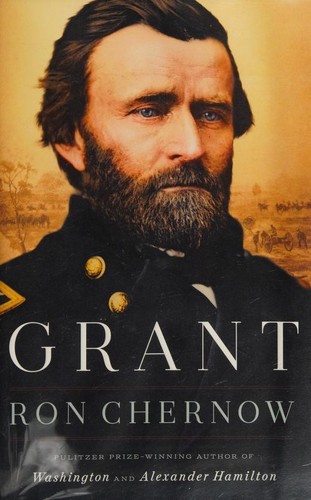
Grant
by Ron Chernow · 2017
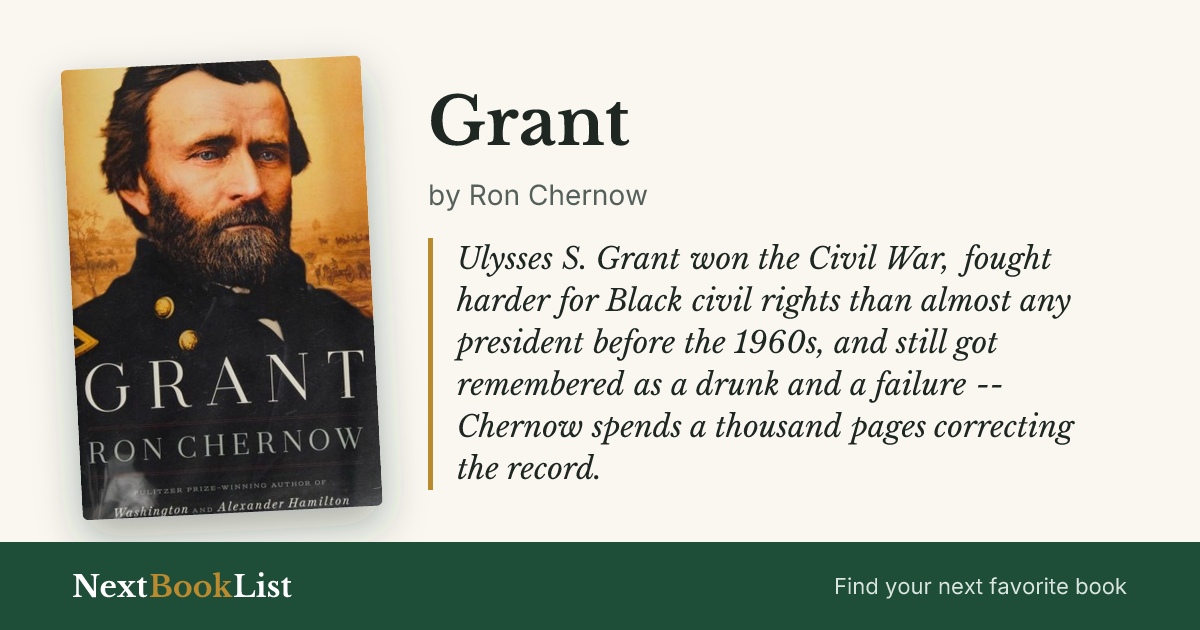
Ulysses S. Grant won the Civil War, fought harder for Black civil rights than almost any president before the 1960s, and still got remembered as a drunk and a failure -- Chernow spends a thousand pages correcting the record.
Worth reading? Chernow's real project is reputation repair -- he makes the case, with overwhelming evidence, that Grant's drinking was episodic rather than constant, his generalship was more brilliant than lucky, and his presidency did more for Black civil rights than any administration between Lincoln and Johnson, only to get erased by decades of Lost Cause propaganda.
| Full Title | Grant |
|---|---|
| Author | Ron Chernow |
| Published | 2017 |
| Publisher | Penguin Press |
| Category | History |
| Favorite quote | “Let us have peace.” |
The Verdict
Chernow isn’t just narrating Grant’s life, he’s building a legal case. Page after page, he lines up primary sources against the caricature most of us inherited: the drunk, the failed businessman, the accidental general who won through numbers instead of skill. By the end, the caricature doesn’t hold up.
The most useful part isn’t the war, though the war sections are excellent. It’s the presidency – Grant used federal power to go after the Klan harder than any president would again until the 1960s, and it cost him. Chernow doesn’t let you forget that doing the right thing on civil rights was politically expensive even then, and Grant paid that price willingly.
Read it if you want the fullest, fairest account of a man history flattened into a drunk who got lucky. Skip it if you want something under 400 pages – this one takes its time, and it needs all of it.
you want the case for Grant as one of the most underrated presidents in American history, backed by the primary sources most textbooks skipped
you're looking for a quick primer -- this is a doorstop biography that goes deep on military campaigns and Reconstruction-era politics in equal, exhausting detail
Book Summary
Grant's reputation as a battlefield butcher and a hopeless drunk was substantially a product of Lost Cause historians who needed to diminish the Union's most effective general in order to romanticize the Confederacy. Chernow works through the primary sources to show a commander who understood total war, logistics, and relentless pressure better than any of his contemporaries.
As president, Grant used federal power aggressively to prosecute the Ku Klux Klan and protect Black voting rights in the South, a record that later historians buried under his administration's real corruption scandals -- scandals that were mostly the work of subordinates Grant trusted too easily, not crimes he committed himself.
Grant's personal struggle with alcohol was real but episodic and largely contained to periods of boredom and separation from his family, not the constant impairment his enemies claimed -- and his final act, writing his memoirs while dying of throat cancer to secure his family's finances, is one of the more quietly heroic endings in American public life.
Top 8 Lessons from Grant
- A general's reputation can be rewritten by the losing side's mythmakers -- Grant's 'butcher' label came largely from Lost Cause historians erasing his tactical sophistication.
- Grant's presidency used federal troops and prosecutions aggressively against the Klan, a civil rights record later generations mostly forgot.
- Personal weaknesses (Grant's drinking) can be exaggerated by political enemies into a defining caricature that outlives the truth by a century.
- Trusting subordinates too completely was Grant's real presidential failure -- the corruption scandals of his administration were mostly committed by men he refused to believe would betray him.
- Total war logistics -- supply lines, attrition, relentless pressure -- won the Civil War more than any single brilliant battlefield maneuver.
- A person's worst public moments (Grant's failed businesses, his drinking) don't have to define the whole story if the fuller record gets told.
- Writing your own account of your life, even under terrible circumstances, can be an act of both financial necessity and legacy control -- Grant's memoirs, finished as he was dying, secured his family's future.
- Reconstruction's failure wasn't inevitable -- it was actively undermined by Southern violence and Northern political exhaustion, not a natural expiration of federal will.
Top 5 Quotes from Grant
"Let us have peace."
Ron Chernow, Grant
"The art of war is simple enough. Find out where your enemy is. Get at him as soon as you can. Strike him as hard as you can, and keep moving on."
Ron Chernow, Grant
"I have never advocated war except as a means of peace."
Ron Chernow, Grant
"In every battle there comes a time when both sides consider themselves beaten, then he who continues the attack wins."
Ron Chernow, Grant
"I know only two tunes: one of them is 'Yankee Doodle,' and the other isn't."
Ron Chernow, Grant
Frequently Asked Questions
Is Grant by Ron Chernow worth reading?
Yes -- it's a thorough, well-sourced case for Grant as an underrated general and president, and it corrects a lot of myth that textbooks never bothered to check.
What is Grant about?
It covers Ulysses S. Grant's full life -- his early failures, his Civil War command, and his presidency's fight to protect Reconstruction and Black civil rights against Southern violence.
Is Grant hard to read because of its length?
It's long at over a thousand pages, but Chernow writes clearly and chronologically -- the difficulty is time investment, not density of prose.
Does the book excuse Grant's drinking problem?
No -- it treats it honestly as real and recurring, but argues it was episodic rather than the constant impairment his political enemies claimed.
How does Grant compare to Chernow's other biographies, like Hamilton?
Similar in ambition and length, but Grant leans harder into political rehabilitation -- Chernow is more explicitly making a case for reputation repair here than in Hamilton.
Ready to read it?
Get Grant on Amazon