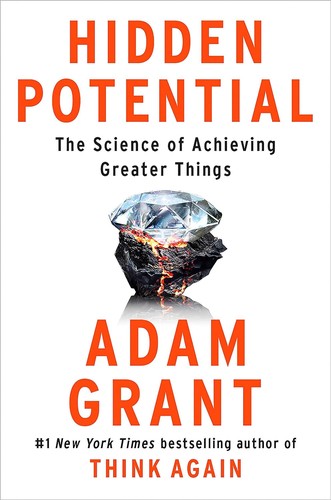
Hidden Potential
by Adam Grant · 2023
Grant's argument that starting talent is wildly overrated and the systems around practice, feedback, and character are what actually predict who improves.
Worth reading? Hidden Potential argues that how far someone climbs matters less than how far they climb relative to where they started, and that character skills, proactivity, discipline, taking feedback well, predict growth better than raw starting talent. Compared to Grit, it's broader: Duckworth's book is about one trait, this one is about the systems (scaffolding, sponges, jungle gyms) that let ordinary people become excellent. It's a genuine antidote to talent-worship in hiring and parenting. Skip it if you're already sold on "practice and systems beat innate talent" -- you've internalized the thesis.
| Full Title | Hidden Potential: The Science of Achieving Greater Things |
|---|---|
| Author | Adam Grant |
| Published | 2023 |
| Publisher | Viking |
| Category | Business & Money |
| Favorite quote | “Being good at something is not the same as being good at getting better at something.” |
The Verdict
Grant’s real target here is talent-worship: the habit of assuming someone who started ahead will stay ahead. Hidden Potential makes the opposite case with data, character skills and good scaffolding beat raw talent, and that’s as useful for hiring as it is for how you talk to your own kids about ability.
you've written yourself off in a skill because you 'weren't a natural,' or you're building a team and picking for talent over growth
you want a habits framework -- this is about the character skills underlying growth, not a step-by-step system
Book Summary
Talent is overrated as a predictor of achievement; character skills, the discipline to practice deliberately, the ability to absorb difficult feedback, and proactivity, matter more for how far someone improves from their starting point.
Grant reframes learning environments using metaphors: "sponges" who absorb information passively need to become "scientists" who test it; "scaffolding" describes the structured support that lets beginners attempt things above their current level safely.
Systems, not just individual grit, determine whether potential gets realized. Schools, teams, and organizations that build the right scaffolding turn ordinary starting points into extraordinary outcomes, which means hidden potential is often a design problem, not a talent shortage.
Top 8 Lessons from Hidden Potential
- How far you climb relative to your starting point matters more than your absolute talent ceiling.
- Character skills, proactivity, discipline, and taking feedback well predict growth better than raw ability.
- Being a 'sponge' (absorbing passively) isn't enough; become a 'scientist' who tests what you've absorbed.
- Scaffolding, structured support that lets you attempt things above your level safely, builds skill faster than sink-or-swim.
- Discomfort with feedback is often really discomfort with the messenger; separate the two to actually use it.
- Perfectionism blocks growth by treating each attempt as a final verdict instead of a data point.
- Diverse, well-run teams outperform teams of individually brilliant people who don't complement each other.
- Hiring for potential and coachability beats hiring for polish when you can design good scaffolding around new people.
Top 3 Quotes from Hidden Potential
"Being good at something is not the same as being good at getting better at something."
Adam Grant, Hidden Potential
"Character is not a fixed trait. It's a collection of habits that can be built."
Adam Grant, Hidden Potential
"Growth is not always about being the best. It's about being better than you used to be."
Adam Grant, Hidden Potential
Frequently Asked Questions
Is Hidden Potential worth reading?
Yes, especially for managers, coaches, and parents who catch themselves writing someone off as 'not a natural.' It reframes achievement around character skills and systems, not innate talent.
What's the main idea of Hidden Potential?
How far you grow from your starting point predicts achievement better than raw talent. Character skills and good scaffolding turn ordinary starting points into extraordinary results.
How does it compare to Grit?
Grit focuses on perseverance as the key trait. Hidden Potential is broader, covering the systems, scaffolding, feedback, coachability, that let character skills actually convert into growth.
Ready to read it?
Get Hidden Potential on Amazon