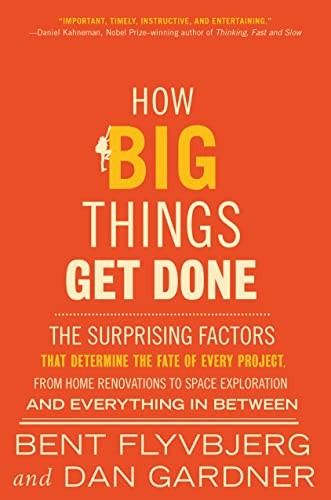
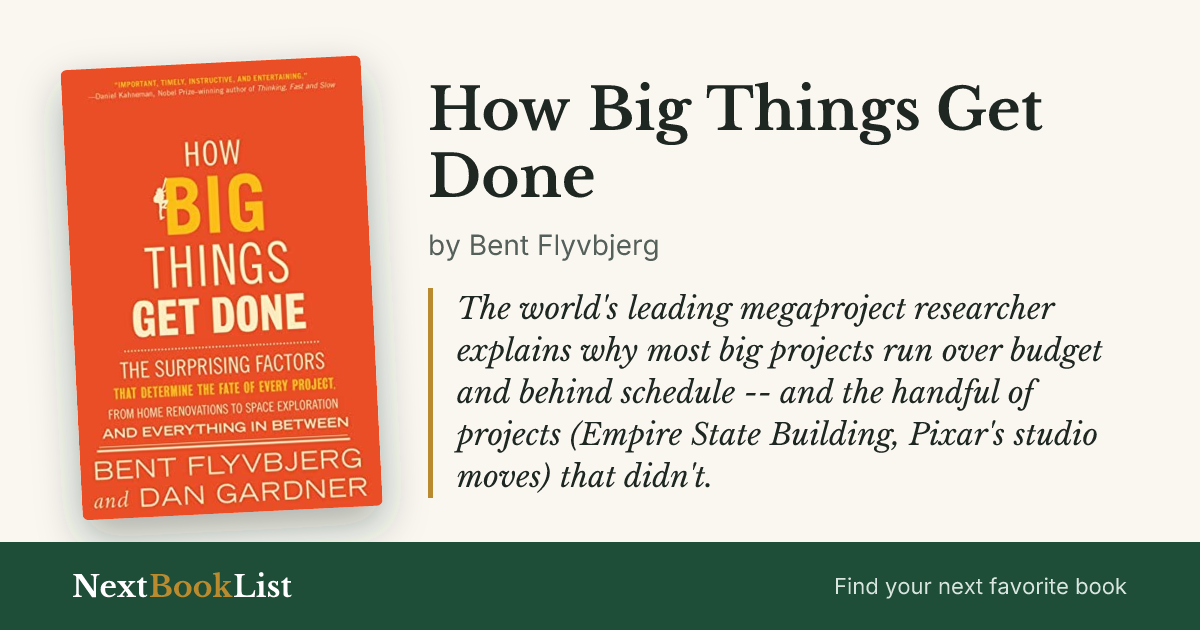
How Big Things Get Done
by Bent Flyvbjerg · 2023
The world's leading megaproject researcher explains why most big projects run over budget and behind schedule -- and the handful of projects (Empire State Building, Pixar's studio moves) that didn't.
Worth reading? How Big Things Get Done is the best book on why large projects fail because Flyvbjerg backs every claim with his own database of thousands of megaprojects, rather than anecdote. Skip it if you want an easy, inspirational read; this one wants you to actually change how you plan.
| Full Title | How Big Things Get Done: The Surprising Factors That Determine the Fate of Every Project, from Home Renovations to Space Exploration |
|---|---|
| Author | Bent Flyvbjerg |
| Published | 2023 |
| Publisher | Currency |
| Category | Business & Money |
| Favorite quote | “Think slow, act fast.” |
The Verdict
Flyvbjerg has spent decades building the largest database of megaproject outcomes that exists, and this book is the readable version of that research – which means the arguments are backed by numbers, not just a consultant’s favorite anecdotes. That’s rare in the project-management genre, and it’s the book’s biggest strength.
The most useful idea is also the most counterintuitive: spend more time planning than feels comfortable, because the projects that fail almost always failed at the planning stage, not during execution. Read it if you actually run projects and want your intuitions checked against real data. Skip it if you want quick inspiration – this book wants you to slow down before you start, which is the opposite of a pep talk.
you plan, manage, or fund large projects -- construction, software, infrastructure, film production -- and want research-backed reasons why most of them blow their budgets
you want motivational project-management platitudes -- this is a data-driven, occasionally dry academic argument, not a pep talk
Book Summary
Most large projects fail not from bad luck but from a predictable planning error Flyvbjerg calls the "planning fallacy" combined with strategic misrepresentation -- project sponsors systematically underestimate costs and timelines, sometimes honestly and sometimes deliberately, to get projects approved, and reality catches up during execution.
The single best predictor of a project's success is "experience," not ambition or planning detail -- teams and organizations that have done a similar project many times before (Pixar rebuilding studios repeatedly, modular construction firms) dramatically outperform first-time or bespoke projects, because they've already made and fixed the expensive mistakes.
Flyvbjerg's core prescription is to "think slow, act fast": spend far more time in planning and simulation before committing (his research shows most project overruns trace back to inadequate planning, not poor execution), then execute quickly once the plan is solid, using modular, repeatable components wherever possible instead of bespoke, one-off designs.
Top 9 Lessons from How Big Things Get Done
- Most large project overruns trace back to a systematic underestimation at the planning stage (the planning fallacy), not just bad luck during execution.
- Project sponsors sometimes deliberately lowball early cost and time estimates (strategic misrepresentation) to get a project approved, knowing the real numbers will surface later.
- Prior experience with similar projects is the strongest predictor of success -- teams that have done something many times before dramatically outperform first-timers, regardless of talent or resources.
- 'Think slow, act fast': spend disproportionate time in planning and simulation before committing, then execute rapidly once the plan is genuinely solid.
- Modular, repeatable components (used across projects) beat bespoke, one-off designs for cost and schedule predictability, even when bespoke feels more prestigious.
- The Empire State Building was built in about 14 months partly because its design used repeatable, modular floor plans rather than a unique design per floor.
- Projects with a clear, narrow, well-defined goal from the start outperform projects that let scope expand as stakeholders add requirements mid-project.
- Simulating a project extensively before breaking ground (or writing code, or shooting film) catches expensive problems while they're still cheap to fix, not after resources are committed.
- Big project success is often a story about doing something mundane very well repeatedly, not about heroic improvisation during a crisis.
Top 2 Quotes from How Big Things Get Done
"Think slow, act fast."
Bent Flyvbjerg, How Big Things Get Done
"The Iron Law of Megaprojects: over budget, over time, over and over again."
Bent Flyvbjerg, How Big Things Get Done
Frequently Asked Questions
Is How Big Things Get Done worth reading?
Yes, if you plan or manage large projects of any kind -- construction, software, film, infrastructure. It's the most research-backed explanation available for why projects blow their budgets.
What is the 'planning fallacy' in How Big Things Get Done?
The systematic tendency to underestimate a project's true cost and timeline at the planning stage, driven by overoptimism and sometimes by deliberate strategic lowballing to win approval.
What does 'think slow, act fast' mean?
Flyvbjerg's core prescription: spend much more time than feels comfortable in planning and simulation before committing resources, then execute quickly once the plan is genuinely solid, rather than rushing into execution and fixing problems as they surface.
Does How Big Things Get Done use real project examples?
Yes -- it draws on Flyvbjerg's database of thousands of megaprojects, plus detailed case studies including the Empire State Building, the Sydney Opera House, Pixar's studio construction, and various infrastructure and software projects.
Ready to read it?
Get How Big Things Get Done on Amazon