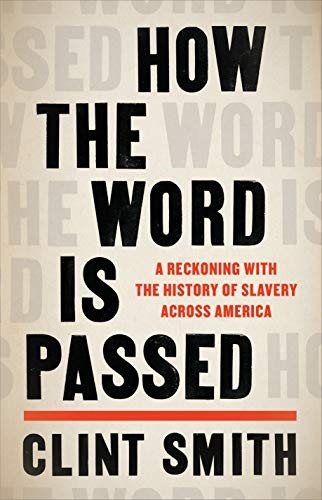
How the Word Is Passed
by Clint Smith · 2021
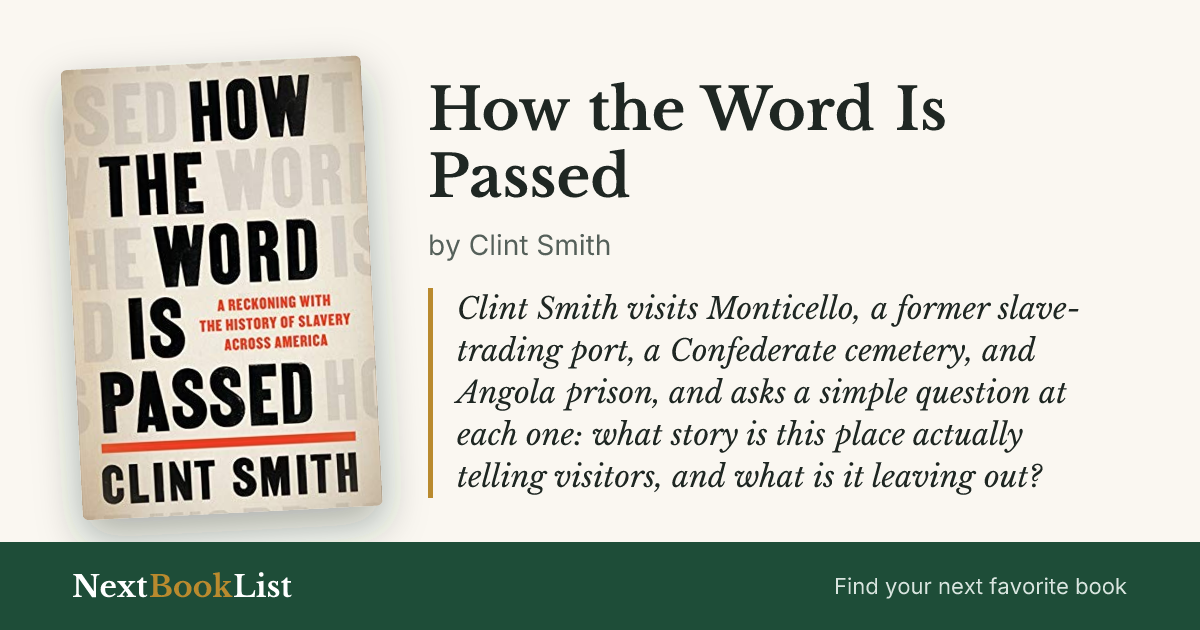
Clint Smith visits Monticello, a former slave-trading port, a Confederate cemetery, and Angola prison, and asks a simple question at each one: what story is this place actually telling visitors, and what is it leaving out?
Worth reading? Smith's method -- go to the actual site, listen to the tour guide's script, talk to the visitors standing next to you -- makes this land harder than a straight historical survey would. Monticello has clearly changed how it tells its own story over the decades; Angola prison, built on a former plantation and still worked largely by Black inmates, hasn't changed nearly as much.
| Full Title | How the Word Is Passed: A Reckoning with the History of Slavery Across America |
|---|---|
| Author | Clint Smith |
| Published | 2021 |
| Publisher | Little, Brown |
| Category | History |
| Favorite quote | “The history of slavery is the history of the United States. It was not peripheral to our founding; it was central to it.” |
The Verdict
What makes Smith’s approach work is that he doesn’t just report on a site, he reports on the experience of visiting it – what the tour guide says, what gets left out, what the other visitors ask or don’t ask. That’s a smarter structure than a straight chronological history, because it shows you the history being actively shaped in real time, not just recorded.
The contrast between sites is the book’s sharpest tool. Monticello and the Whitney Plantation have visibly reworked their narratives to center enslaved people. Angola Prison, built on a former plantation and still worked largely by Black incarcerated men, makes almost no such acknowledgment – the continuity is simply there, unremarked, for anyone paying attention.
Read it if you want to understand how a country’s relationship to its own history keeps changing, unevenly, site by site. Skip it if you’re after a comprehensive academic survey of slavery itself – this is narrower and more personal than that, by design.
you want to understand how slavery's history gets told, mistold, or quietly erased at the actual physical sites connected to it
you want a comprehensive academic history of slavery -- this is a site-by-site, first-person travelogue and reckoning, not a chronological survey
Book Summary
Smith structures the book around visits to specific sites -- Monticello, the Whitney Plantation, Angola Prison, Blandford Cemetery, Galveston, Gorée Island in Senegal, and a Confederate memorial in New York -- treating each as a case study in how a place's official narrative either confronts or launders its connection to slavery.
The book argues that history isn't a settled fact sitting in the past, it's an ongoing negotiation over what gets told at the sites where it happened -- some places (Monticello, the Whitney Plantation) have visibly reworked their tours to center enslaved people's experience, while others (Angola Prison, built on a former plantation and still predominantly worked by Black incarcerated men) have barely changed the underlying reality at all.
Smith weaves his own family history and personal reactions into each site visit, making the book as much a memoir of reckoning with his own relationship to this history as a work of reported nonfiction, and arguing that a personal, felt understanding of history matters alongside the factual record, not instead of it.
Top 8 Lessons from How the Word Is Passed
- A historical site's official tour script is itself a choice, shaped by decades of decisions about what to include and what to omit -- it's not a neutral presentation of fact.
- Some institutions (Monticello, the Whitney Plantation) have visibly reworked how they tell their own history to center enslaved people; others have barely changed at all.
- A place can physically continue a historical pattern (Angola Prison, built on a plantation and still worked largely by Black incarcerated men) without ever being framed that way to visitors.
- History is not just about the past; it's an ongoing negotiation over what gets told at the sites where the past happened.
- Listening to the actual tour guides and fellow visitors at a historical site can reveal more about a country's relationship to its history than reading about the site alone.
- A personal, felt reckoning with historical trauma can carry real weight alongside the documented factual record, not as a substitute for it.
- Confederate memorials and cemeteries continue actively shaping public memory today, not just marking a settled past.
- Erasure of uncomfortable history often happens through omission and euphemism in official narration, more than through outright denial.
Top 4 Quotes from How the Word Is Passed
"This history is in our soil, it is in our policies, and it must, too, be in our memories."
Clint Smith, How the Word Is Passed
"Oppression is never about humanity or lack thereof. It is, and always has been, about power."
Clint Smith, How the Word Is Passed
"The history of slavery is the history of the United States. It was not peripheral to our founding; it was central to it."
Clint Smith, How the Word Is Passed
"Just because something is difficult to accept doesn't mean you should refuse to accept it. Just because someone tells you a story doesn't make that story true."
Clint Smith, How the Word Is Passed
Frequently Asked Questions
Is How the Word Is Passed worth reading?
Yes -- Smith's site-by-site approach, listening to actual tour guides and visitors rather than just summarizing history from a desk, makes the book's argument land with real specificity.
What is How the Word Is Passed about?
Clint Smith's visits to historical sites connected to American slavery -- Monticello, the Whitney Plantation, Angola Prison, and others -- examining how each one tells, mistells, or omits its own history.
Is How the Word Is Passed a memoir or a history book?
Both -- it's structured as reported nonfiction built around site visits, but Smith weaves in his own family history and personal reckoning throughout, so it reads as part memoir too.
Which sites does the book cover?
Monticello, the Whitney Plantation, Angola Prison, Blandford Cemetery, Galveston, Gorée Island in Senegal, and a Confederate memorial in New York, among others.
Is this a comprehensive history of slavery?
No -- it's a focused, site-by-site examination of public memory and how slavery's history gets told today, not a chronological academic survey of slavery itself.
Ready to read it?
Get How the Word Is Passed on Amazon