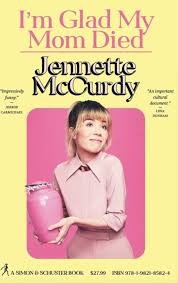
I'm Glad My Mom Died
by Jennette McCurdy · 2022
A former child star spent her adolescence controlled, calorie-restricted, and pushed into a career she never wanted by a mother whose death she processes, in this book's own blunt title, as relief.
Worth reading? The provocative title is the least surprising thing about this book -- what's genuinely striking is how precisely McCurdy documents the mechanics of her mother's control: the calorie counting instilled at age eleven, the invasive 'exams,' the way an entire career was built around meeting someone else's need rather than the daughter's own wishes. It's a harder, more clinical book about abuse than its viral title suggests, and it earns its reputation as one of the most honest celebrity memoirs in years.
| Author | Jennette McCurdy |
|---|---|
| Published | 2022 |
| Publisher | Simon & Schuster |
| Category | Biographies & Memoirs |
| Favorite quote | “So much of my life felt so out of control for so long. And I'm done with that being my reality. I want my life to be in my hands.” |
The Verdict
Handle this one with real gravity. The title reads as dark comedy from the outside, but the book itself is a precise, clinical account of childhood control and disordered eating that never plays the abuse for laughs, even when McCurdy’s voice stays wry. Respect what’s actually being described here – a child’s body and career repurposed for someone else’s unmet needs – rather than treating the provocative title as the whole point.
you want an unusually direct account of childhood emotional abuse and eating disorders from inside the entertainment industry, told with dark humor that never undercuts how serious the subject matter actually is
you're not ready to read detailed accounts of disordered eating, grooming-adjacent parental control, or child stardom's exploitation -- this book doesn't soften any of it for comfort, and specific eating disorder content could be triggering
Book Summary
McCurdy traces her mother's controlling behavior from early childhood -- restrictive dieting she now identifies as the root of a decades-long eating disorder, invasive physical "exams," and total control over her earnings and career decisions -- through her years starring on Nickelodeon's iCarly, a career she says she never wanted but pursued to satisfy her mother's own unfulfilled ambitions.
The book's real subject is what happens after the abuser dies but the psychological patterns don't -- McCurdy's eating disorders, addiction, and difficulty forming a stable identity persist well past her mother's death, and the title's provocation ("glad") is ultimately revealed as a complicated, hard-won relief rather than simple happiness, since her mother's absence doesn't automatically undo the damage already done.
Top 7 Lessons from I'm Glad My Mom Died
- McCurdy is explicit that her eating disorder was actively instilled by her mother, who introduced calorie restriction when McCurdy was eleven -- treating it not as something she developed independently but as a direct product of parental control.
- Her acting career on iCarly is framed as something she pursued to satisfy her mother's own thwarted ambitions, not her own desire -- the book is a sharp account of a child's talent being repurposed for a parent's unmet needs.
- The book documents invasive physical 'exams' her mother performed on her well into her teenage years, which McCurdy names directly as a boundary violation rather than softening it into vague 'overbearing parenting.'
- Her mother's death doesn't function as a clean resolution -- McCurdy's disordered eating and identity confusion continue well afterward, illustrating that the abuser's absence doesn't automatically undo the internalized patterns.
- McCurdy is candid that entertainment industry adults around her (not just her mother) enabled and sometimes exploited her situation, widening the book's critique beyond a single family story to how child stardom structurally fails to protect kids.
- Recovery, in the book's account, required years of therapy and active unlearning, not a single moment of clarity after her mother's death -- the book resists a tidy redemption arc in favor of a slower, harder-won stability.
- The provocative title is explained, not just used for shock -- McCurdy frames 'glad' as relief from an ongoing harm, distinct from simple happiness, and the book earns that distinction by the specificity of what she describes surviving.
Top 4 Quotes from I'm Glad My Mom Died
"Performing feels inherently fake. Writing feels inherently real."
Jennette McCurdy, I'm Glad My Mom Died
"Through writing, I feel power for maybe the first time in my life. I don't have to say somebody else's words. I can write my own. I can be myself for once."
Jennette McCurdy, I'm Glad My Mom Died
"So much of my life felt so out of control for so long. And I'm done with that being my reality. I want my life to be in my hands. Not an eating disorder's or a casting director's or an agent's or my mom's. Mine."
Jennette McCurdy, I'm Glad My Mom Died
"She was a narcissist. She refused to admit she had any problems, despite how destructive those problems were to our entire family. My mom emotionally, mentally, and physically abused me in ways that will forever impact me."
Jennette McCurdy, I'm Glad My Mom Died
Frequently Asked Questions
Is I'm Glad My Mom Died appropriate for readers sensitive to eating disorder content?
Approach with real caution -- the book describes disordered eating and calorie restriction in specific detail, including how it was instilled in childhood. Consider your own triggers before reading.
Why is the book called I'm Glad My Mom Died?
The title reflects McCurdy's complicated relief after her mother's death from cancer, given the abuse she documents -- the book explains this as relief from ongoing harm, not simple happiness, in detail.
Is I'm Glad My Mom Died about iCarly?
Partly -- her time on the Nickelodeon show is covered, but the book's central focus is her relationship with her mother and its lasting psychological effects, not behind-the-scenes show content.
Is I'm Glad My Mom Died worth reading?
Yes, if you're prepared for its subject matter -- it's regarded as an unusually candid account of childhood abuse and its long recovery, not just a provocative title.
Ready to read it?
Get I'm Glad My Mom Died on Amazon